
Cybersecurity is no longer just a technical concern — it is a core business priority. As organizations expand across cloud platforms, remote environments, and digital ecosystems, the complexity of securing infrastructure continues to grow.
In this landscape, cybersecurity frameworks provide structure. They help organizations define policies, manage risks, and implement consistent security practices across systems.
In 2026, IT leaders are not just choosing tools — they are choosing frameworks that can scale with their infrastructure and align with regulatory and operational requirements.
Cybersecurity teams implementing security controls.
Compliance teams managing regulatory requirements.
Organizations operating in cloud or hybrid environments.
- Cybersecurity frameworks provide a structured approach to managing security risks.
- Different frameworks serve different purposes, from compliance to operational security.
- The most effective strategies combine multiple frameworks based on business needs.
Why Frameworks Matter in Modern Security
Modern IT environments are too complex to manage security in an ad hoc way.
Organizations operate across cloud platforms, SaaS tools, on-prem systems, and distributed teams. Without a structured approach, security becomes fragmented, inconsistent, and difficult to scale.
Cybersecurity frameworks solve this problem by providing standardized guidelines for managing risks, protecting data, and responding to threats.
They help organizations move from reactive security to proactive risk management.
For IT leaders, frameworks also provide a common language across teams, auditors, and stakeholders.
Key Cybersecurity Frameworks in 2026
Several frameworks are widely adopted and trusted by IT leaders.
- NIST Cybersecurity Framework (CSF)
One of the most widely used frameworks globally. It focuses on identifying, protecting, detecting, responding to, and recovering from security threats. - ISO/IEC 27001
An international standard for information security management systems (ISMS). It is often used for compliance and certification. - CIS Critical Security Controls
A practical framework that provides prioritized actions for improving cybersecurity posture.
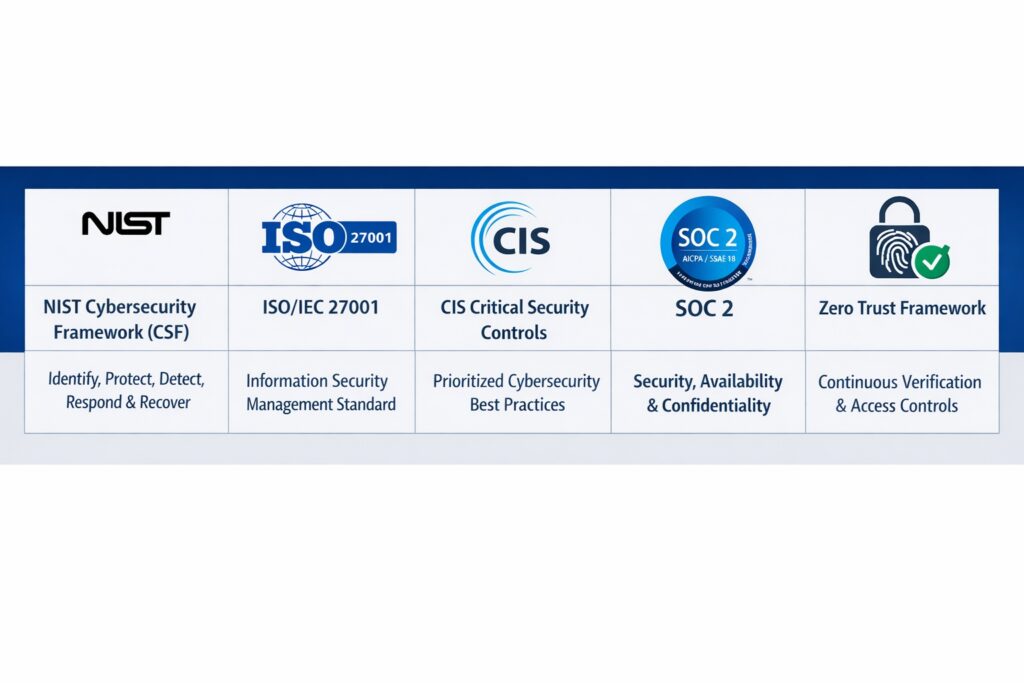
- SOC 2
Focused on service organizations, particularly those handling customer data. It emphasizes security, availability, and confidentiality. - Zero Trust Framework
Not a single standard, but a model based on continuous verification and identity-based access control.
Each framework addresses different aspects of security, and organizations often use them together.
Cybersecurity Framework Adoption
Cybersecurity frameworks are becoming essential for modern organizations.
Over 85% of enterprises now rely on at least one formal cybersecurity framework to structure their security programs.
At the same time, more than 70% of organizations use multiple frameworks simultaneously, combining compliance standards with operational models.
Regulatory pressure continues to grow. By 2026, over 80% of organizations must comply with at least one major security or data protection framework, especially in regulated industries.
Security maturity is directly linked to framework adoption. Companies with structured frameworks are 2–3 times more likely to detect and respond to threats faster than those without.
Another key trend is Zero Trust. More than 60% of organizations are actively implementing Zero Trust principles as part of their security strategy.
These numbers show that frameworks are no longer optional — they are foundational.
How IT Leaders Choose the Right Framework
Choosing a cybersecurity framework is not about selecting a single standard — it is about building a security model that fits the reality of the organization.
Modern IT environments are too complex for a one-size-fits-all approach. Companies operate across cloud platforms, SaaS tools, on-prem systems, and distributed teams. As a result, framework selection becomes a strategic decision rather than a compliance checkbox.
IT leaders start with business context. Regulatory requirements often define the baseline. Industries such as finance, healthcare, and SaaS are required to follow specific standards like ISO 27001 or SOC2. These frameworks provide structure, but they rarely cover all operational needs. Infrastructure is another critical factor.
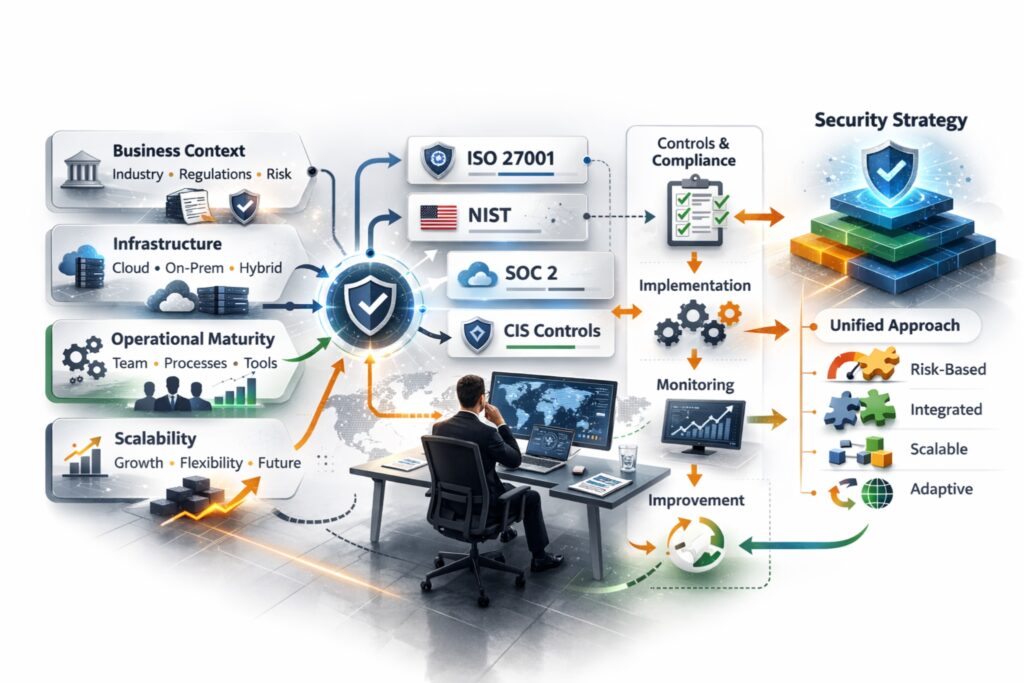
Cloud-native environments require different security controls than traditional on-prem systems. Organizations running multi-cloud or hybrid architectures must ensure that frameworks can support distributed access, identity-based security, and real-time monitoring.
Operational maturity also plays a major role. Organizations with established security teams and processes tend to adopt more comprehensive frameworks such as NIST, which provide broader guidance across the entire security lifecycle. Less mature teams often start with more practical and prioritized approaches like CIS Controls.
Scalability is equally important. Frameworks must evolve with the organization. As systems grow and threats become more sophisticated, security models must adapt without creating unnecessary complexity.
Frameworks vs Real Security
One of the most common misconceptions in cybersecurity is that adopting a framework automatically means being secure.
In reality, frameworks do not provide protection — they provide structure. They define what should be done, but they do not execute security controls, detect threats, or prevent incidents. Without proper implementation, even the most comprehensive framework remains a static document.
Real security comes from execution. Organizations must translate frameworks into actionable controls, integrate them into systems, and continuously monitor how those controls perform in real environments. This includes access management, threat detection, incident response, and ongoing risk assessment.
Frameworks create consistency, but security requires activity. They are effective only when embedded into daily operations — when policies are enforced automatically, systems are monitored in real time, and teams respond quickly to emerging threats.
Compliance alone is not enough. An organization can meet all formal requirements and still remain vulnerable if controls are outdated, poorly implemented, or not aligned with actual risks.
Turn cybersecurity frameworks into scalable, real-world security systems.
Contact usThe Role of Automation in Framework Adoption
Automation is becoming essential for managing cybersecurity frameworks at scale. Modern tools help organizations:
- Monitor compliance in real time
- Enforce security policies automatically
- Detect anomalies and respond quickly
- Reduce manual workload
Automation transforms frameworks from static documents into dynamic systems.
Conclusion
Cybersecurity frameworks provide the foundation for managing security in complex digital environments.
They help organizations structure their security strategy, meet regulatory requirements, and improve resilience against threats.
However, frameworks alone are not enough. Real security comes from how they are implemented, integrated, and maintained.
In 2026, the most effective organizations are those that combine frameworks, automation, and modern architecture into a unified security strategy.
Why Ficus Technologies?
Ficus Technologies helps organizations design and implement security frameworks that align with modern infrastructure and business goals.
We support companies in integrating frameworks, automating security processes, and building scalable cybersecurity systems.
A structured set of guidelines for managing and improving security practices.
It depends on business needs. Many organizations use multiple frameworks.
No. Compliance is part of security, but not a complete solution.
It ensures continuous verification and reduces risk in distributed environments.




 Success...!