
Tokenization is no longer limited to crypto markets. In 2026, it is becoming a practical tool for businesses looking to digitize assets, improve liquidity, and build new financial models.
Companies are no longer asking what tokenization is. They are asking how it can be applied in real business scenarios. The shift is from experimentation to implementation.
Product teams building blockchain-based solutions.
Companies evaluating tokenization for real-world assets.
Organizations navigating compliance and regulation.
- Tokenization is moving from theory to real business use.
- It enables new models of ownership, liquidity, and investment.
- Compliance and regulation are critical for success.
- Implementation requires both technical and legal alignment.
What Tokenization Means in Practice
Tokenization is the process of converting real-world or digital assets into blockchain-based tokens.
These tokens represent ownership, access rights, or value. Unlike traditional systems, tokenized assets can be transferred, divided, and managed more efficiently across global markets.
The real advantage is not just technology — it is programmability. Ownership can be automated, transactions can be executed without intermediaries, and rules can be embedded directly into smart contracts. This creates entirely new ways of structuring assets and managing value.
Innovation is not about ideas — it’s about making ideas work.
Scott Belsky
Real-World Use Cases
Tokenization is no longer a theoretical concept — it is actively moving into production across multiple industries, where it solves real business challenges and enables new models of value creation.
In finance, tokenization is reshaping how assets are issued, traded, and managed. Funds, bonds, private equity, and even traditionally illiquid assets are being converted into digital tokens. This enables fractional ownership, allowing investors to participate with smaller capital while improving overall market liquidity. Transactions become faster, settlement times are reduced, and intermediaries can be minimized. For financial institutions, this opens new distribution channels and more flexible investment structures.
In real estate, tokenization addresses one of the biggest limitations of the market — accessibility. High-value properties can be divided into smaller digital shares, allowing a broader group of investors to participate. This not only democratizes access but also improves capital efficiency for property owners. Additionally, tokenization can streamline transactions, reduce administrative overhead, and make ownership transfers more transparent and efficient.
The Rise of Tokenization
The growth of tokenization is backed by strong market signals.
More than 70% of financial institutions are actively exploring or investing in tokenized assets, indicating that tokenization is moving into mainstream finance.
The market for tokenized real-world assets is expected to reach hundreds of billions of dollars within the next few years, driven by demand for liquidity and fractional ownership.
At the same time, over 60% of enterprises are experimenting with blockchain-based asset management models, especially in finance, supply chain, and digital identity.
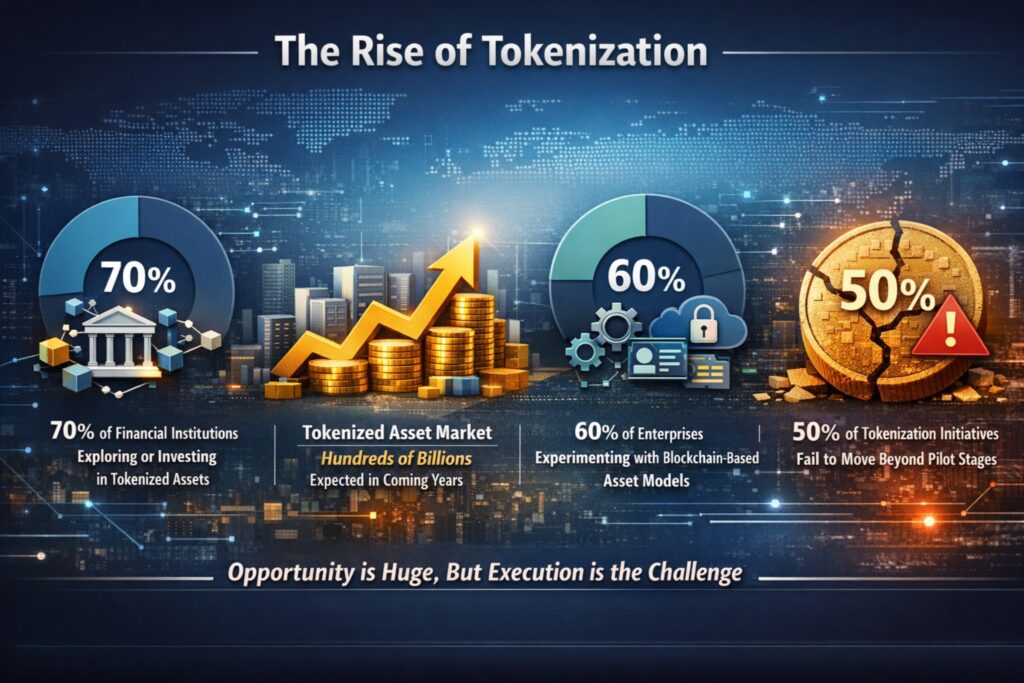
Despite this momentum, adoption is still uneven. Nearly 50% of tokenization initiatives fail to move beyond pilot stages, primarily due to regulatory uncertainty, integration challenges, and unclear business models. These numbers highlight a critical insight: the opportunity is significant, but execution remains the key barrier.
Compliance Risks and Challenges
Tokenization introduces a fundamentally new layer of regulatory and legal complexity that many organizations underestimate at early stages.
Unlike traditional systems, where ownership and rights are clearly defined within established legal frameworks, tokenized assets operate at the intersection of technology, finance, and law. This creates ambiguity — and with it, risk.
One of the most critical challenges is classification. Depending on how a token is structured, it may be considered a security, a utility token, or a financial instrument. Each category is governed by different regulatory requirements, including licensing, reporting, and investor protection rules. Misclassification is not a minor issue — it can lead to regulatory penalties, forced restructuring, or even shutdown of the project.
Jurisdiction adds another layer of complexity. Tokenized systems are inherently global, but regulation is not. Legal requirements vary significantly across regions, making it difficult to design a model that works universally. A token compliant in one country may violate regulations in another. For organizations operating across markets, this creates fragmentation and increases the cost of compliance.
The Business Impact of Tokenization
Tokenization is not just a technical innovation — it is a business model shift. It enables fractional ownership, increasing liquidity and accessibility. It reduces reliance on intermediaries, lowering operational costs.
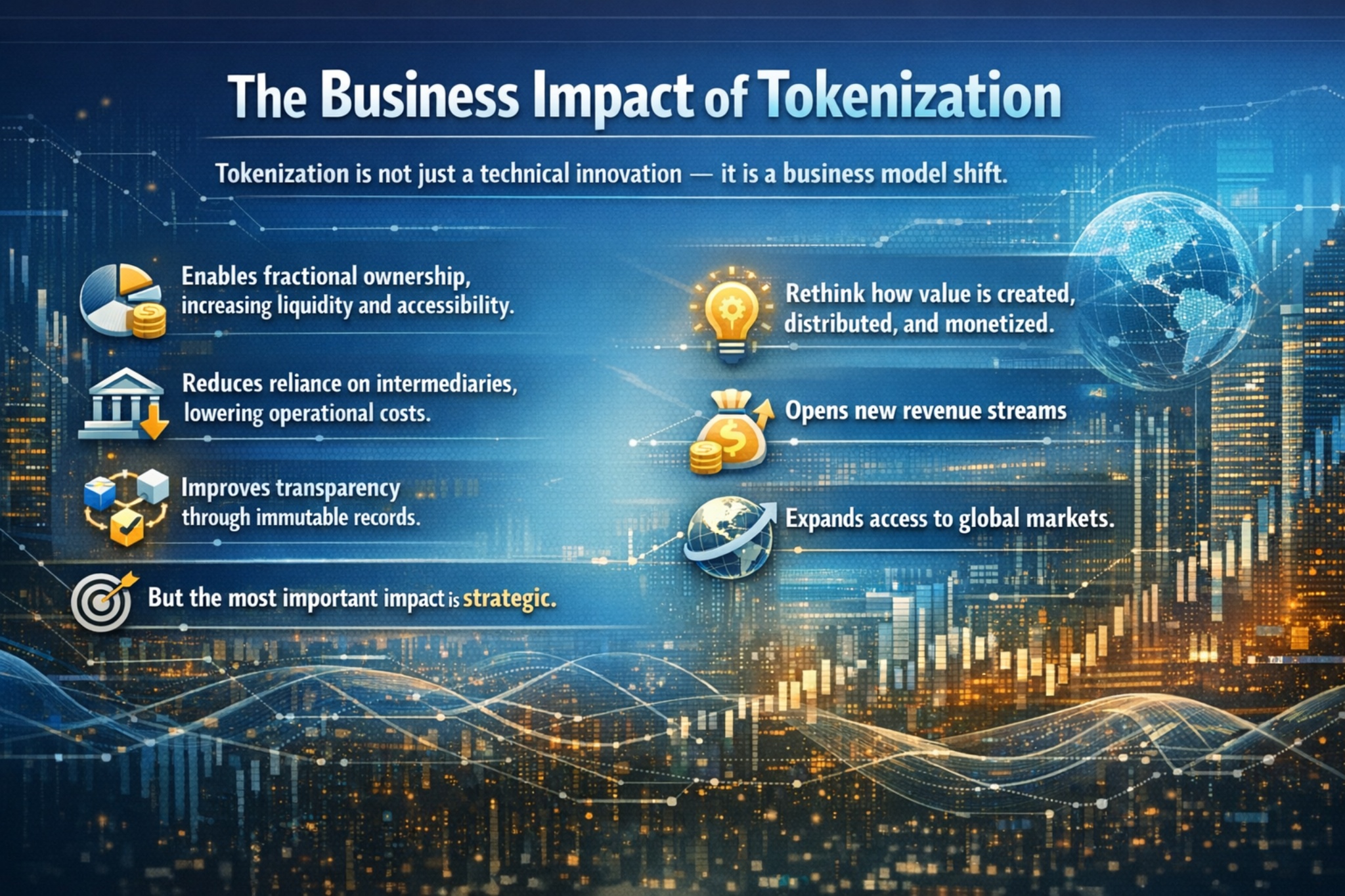
It improves transparency through immutable records. But the most important impact is strategic. Tokenization allows companies to rethink how value is created, distributed, and monetized. It opens new revenue streams and expands access to global markets.
The Gap Between Potential and Execution
Despite strong interest, many organizations struggle to move from concept to production. The gap is not about awareness — it is about execution.
Challenges include:
- unclear regulatory frameworks
- lack of integration with existing systems
- misalignment between business and technology
- absence of scalable architecture
Successful companies approach tokenization as a system, not a feature. They align legal, technical, and business components from the beginning.
From tokenization ideas to real systems — with Ficus Technologies.
Contact usConclusion
Tokenization is no longer a concept driven by hype — it is becoming a practical tool for reshaping how businesses create, manage, and exchange value.
In 2026, the key question is no longer whether tokenization matters. The real challenge is how to apply it in a way that is scalable, compliant, and aligned with business goals.
Organizations that succeed are not those that experiment with tokenization, but those that integrate it into real systems — combining technology, legal structure, and business logic into a unified model.
Tokenization has the potential to unlock new levels of liquidity, enable programmable ownership, and create entirely new digital economies.
Why Ficus Technologies?
Ficus Technologies helps businesses design and implement tokenization solutions that are scalable, secure, and aligned with regulatory requirements.
It is the process of representing assets as blockchain-based tokens.
Finance, real estate, supply chains, and digital ecosystems.
Regulation, legal ownership, and compliance.
Technology, legal alignment, and integration with business systems.




 Success...!