
In 2026, cloud computing is no longer just an enabler of digital transformation — it is the foundation of global digital ecosystems. Organizations are moving beyond simple “cloud adoption” into complex strategies that maximize flexibility, resilience, and compliance. Two dominant approaches have emerged at the center of this shift: multi-cloud and hybrid cloud.
While both provide agility, they serve different purposes. Multi-cloud distributes workloads across several public providers, ensuring vendor independence and performance optimization. Hybrid cloud, on the other hand, blends private infrastructure with public platforms, balancing security with scalability. In practice, businesses in 2026 increasingly use both, creating cloud-smart strategies that combine the strengths of each.
IT architects designing secure, resilient infrastructure.
4.Founders and product leaders exploring cost-efficient growth.
Compliance officers facing new regulations in data residency and AI governance.
- Multi-cloud in 2026 prioritizes vendor independence, global reach, and performance tuning.
- Hybrid cloud remains essential for security, compliance, and data-sensitive workloads.
- Cloud-smart businesses are blending both approaches into unified strategies.
What Is Multi-Cloud in 2026?
Multi-cloud strategies have matured. Businesses now view them not just as a way to avoid vendor lock-in, but as a performance optimization framework.
In 2026, multi-cloud has moved from being an experimental choice to a strategic necessity. Businesses are no longer asking whether to adopt multi-cloud but how to orchestrate it effectively. A multi-cloud strategy involves leveraging services from two or more public cloud providers — typically AWS, Microsoft Azure, and Google Cloud — to distribute workloads, reduce vendor lock-in, and maximize service availability.
Modern multi-cloud adoption is not just about redundancy. Organizations strategically pick best-of-breed services: Google Cloud’s AI models for advanced analytics, AWS for scalable infrastructure, and Azure for enterprise-grade compliance. This approach ensures companies can combine strengths while mitigating risks. In industries like e-commerce and fintech, multi-cloud is synonymous with agility, as businesses optimize latency, costs, and resilience simultaneously.
Cloud is about how you do computing, not where you do computing.
Paul Maritz, Former CEO of VMware
What Is Hybrid Cloud in 2026?
Hybrid cloud in 2026 represents the blending of private infrastructure with public cloud services into a single, unified environment. Unlike multi-cloud, which spans across multiple public vendors, hybrid focuses on the integration of on-premises systems with one or more clouds.
Enterprises continue to embrace hybrid because it supports regulatory compliance, data sovereignty, and mission-critical workloads that cannot fully transition to public cloud. For example, healthcare organizations maintain sensitive patient data in private data centers while running AI-driven diagnostic models on public cloud for scalability. Hybrid architectures also enable financial institutions to balance high-performance private servers with cloud-driven elasticity during peak demand.
Advances in orchestration tools, such as Kubernetes-based platforms and AI-driven automation, have made hybrid ecosystems seamless. By 2026, hybrid cloud is no longer viewed as a transitional step but as a permanent architecture for industries needing control, compliance, and flexibility.
Multi-Cloud vs. Hybrid: The Real Distinction
The distinction between multi-cloud and hybrid often causes confusion, but by 2026, the line is clearer:
- Multi-Cloud means multiple public cloud providers.
- Hybrid Cloud means blending private and public environments.
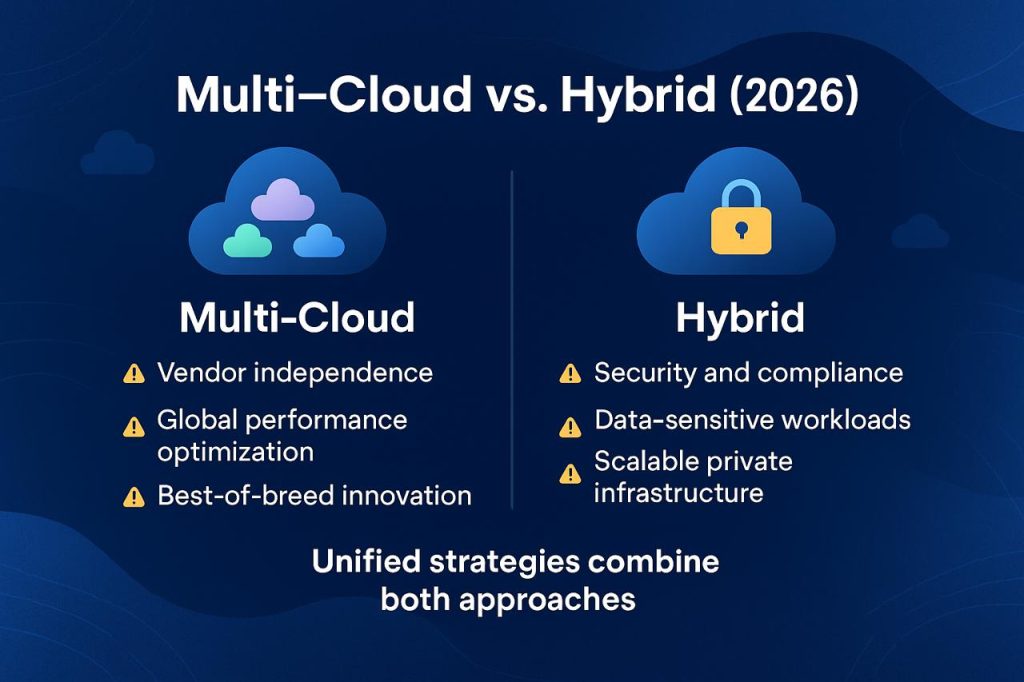
The difference is not merely technical but strategic. Multi-cloud is about flexibility and performance across vendors. Hybrid is about governance and integration between private control and public scalability.
Forward-thinking organizations increasingly combine both: adopting hybrid for sensitive data and compliance, while simultaneously running multi-cloud for customer-facing applications. This convergence is shaping a new paradigm known as the “poly-cloud era” — where companies layer multiple approaches into a single architecture tailored to business needs.
Industries Using Hybrid & Multi-Cloud
By 2026, the adoption of hybrid and multi-cloud strategies has become a defining factor across industries. Organizations are no longer debating whether to embrace these models but how best to integrate them into their operations. Each sector is leveraging the flexibility of hybrid and multi-cloud in ways that directly support its unique priorities — from compliance to performance, innovation, and customer experience.
- Finance and Banking
Financial institutions face strict regulatory frameworks and high demands for performance. Hybrid cloud allows them to keep sensitive data in private, compliant environments while leveraging the scalability of public clouds for real-time fraud detection, AI-driven trading, and customer-facing digital services. This balance ensures security without sacrificing speed. - Healthcare and Life Sciences
For healthcare providers, patient data security is paramount. A hybrid model ensures compliance with privacy laws while enabling research organizations to harness public cloud compute power for drug discovery, genomics, and telemedicine platforms. Hospitals also use multi-cloud to improve resilience, ensuring that critical systems remain available during outages. - Retail and E-commerce
Online retailers thrive on agility. Multi-cloud enables them to deploy applications across multiple providers, reducing downtime and avoiding vendor lock-in. Hybrid cloud further supports omnichannel strategies, where inventory, payments, and personalized recommendations are synchronized seamlessly across physical and digital platforms. - Manufacturing and Industry 4.0
Factories and logistics providers depend on IoT data for real-time decision-making. Hybrid cloud supports on-premises processing for latency-sensitive tasks like predictive maintenance, while public clouds handle large-scale analytics. Multi-cloud ensures global suppliers and plants remain connected, resilient, and able to scale production without bottlenecks. - Public Sector and Government
Governments worldwide are embracing hybrid models to modernize infrastructure while protecting classified information. Public clouds support citizen-facing applications, such as tax portals or e-government services, while private environments safeguard sensitive defense and law enforcement data. Multi-cloud adds redundancy, which is vital for mission-critical national services. - Media and Entertainment
Streaming platforms, gaming companies, and content producers rely on hybrid and multi-cloud strategies for scalability and global reach. Public clouds allow them to deliver content instantly to millions of users, while private clouds store proprietary assets securely. Multi-cloud deployments also provide flexibility to negotiate better performance and cost structures across providers.
The Future of Cloud in 2026 and Beyond
Looking ahead, the cloud ecosystem will evolve toward deeper automation and intelligent orchestration. AI-driven cloud managers already optimize workload placement in real time, predicting traffic spikes and shifting applications between providers or environments without human intervention.
Security is also entering a new phase. Zero-trust architectures, quantum-resistant encryption, and cross-cloud security fabrics are becoming the backbone of both multi-cloud and hybrid strategies. In parallel, sustainability is a top priority: hyperscalers are competing to deliver carbon-neutral or even carbon-negative services, while hybrid models reduce waste by maximizing existing infrastructure.
The next frontier is the edge-cloud continuum. As 5G and early-stage 6G networks expand, edge devices will seamlessly interact with both hybrid and multi-cloud platforms, enabling ultra-low-latency applications in autonomous vehicles, telemedicine, and industrial robotics.
By 2026, the future of cloud is not about choosing one model over the other — it’s about designing a fluid ecosystem that blends multi-cloud flexibility with hybrid control, creating the most resilient and adaptive digital foundation possible.
Conclusion
The debate between multi-cloud and hybrid cloud is no longer about which is better. Instead, it’s about recognizing that both play critical roles in a balanced digital strategy. Multi-cloud empowers businesses to innovate and stay agile across providers, while hybrid ensures compliance, control, and security. Together, they form the backbone of the digital economy in 2026.
Enterprises that master this balance will not only future-proof their IT infrastructure but also position themselves to thrive in a world where adaptability and resilience are the ultimate competitive advantages.
Why Ficus Technologies?
At Ficus Technologies, we help organizations build cloud strategies for the 2026 digital economy.
We deliver:
- Multi-cloud orchestration powered by AI.
- Hybrid architectures tailored to compliance and security needs.
- Seamless integration of legacy systems with modern cloud.
- Sustainability-focused solutions for responsible scaling.
We don’t just migrate to the cloud — we engineer ecosystems that last.
Healthcare, finance, and government — all heavily regulated sectors.
Not anymore. In 2026, orchestration platforms have made multi-cloud management more accessible.
AI automates workload placement, cost optimization, and compliance monitoring.
Poorly managed duplication of resources across providers. Strong governance is essential.
We blend technical expertise with business strategy, ensuring your cloud model is secure, efficient, and future-ready.




 Success...!