Cloud adoption has reached maturity. By the time companies start talking seriously about cloud governance, they are usually already deep into the cloud. Multiple providers, dozens of accounts, hundreds of services, and costs that grow faster than anyone expected. What once promised flexibility and savings often turns into complexity, fragmentation, and financial opacity.
In many organizations, cloud environments evolve faster than the operating model around them. Teams provision resources quickly, experiments turn into production systems, and temporary solutions quietly become permanent. Without clear ownership and visibility, costs drift away from business value, security boundaries blur, and leadership loses confidence in cloud as a controllable platform.
Cloud governance exists to solve this exact problem. Not by slowing teams down, but by restoring visibility, control, and accountability. When done correctly, governance reduces costs, limits risk, and enables teams to move faster with confidence. When done poorly, it becomes bureaucracy that teams work around. The difference lies in intent and execution.
It is also relevant for founders and product leaders who want to scale cloud usage without losing control over cost, security, and compliance.
- Cloud governance is not about restriction — it is about visibility and ownership.
- Cost overruns are usually a symptom of missing accountability, not excessive usage.
- Effective governance reduces risk while preserving team autonomy.
What Cloud Governance Really Means Today
Modern cloud governance is no longer defined by approval workflows or static policy documents. Today, it functions as an operating model that determines how cloud resources are created, used, monitored, and retired across the organization. As cloud environments scale, governance shifts from a control mechanism to a system property — one that directly affects cost predictability, security posture, and delivery speed.
The need for this shift is driven by measurable realities. Industry data consistently shows that a majority of cloud overspending — commonly estimated at 25–35% of total cloud spend — is not caused by misuse, but by a lack of enforced constraints at the point of provisioning. Similarly, a large share of security incidents in cloud environments originate from misconfigurations rather than from sophisticated attacks. These issues emerge early, when decisions are made, not later during reviews.
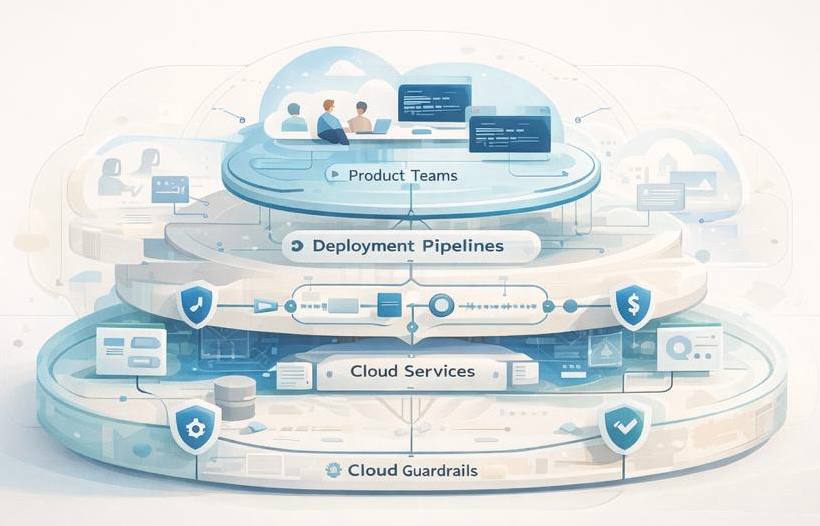
Cost Reduction Starts With Accountability
Most cloud cost problems are not caused by wasteful engineers or overprovisioning alone. They are caused by missing ownership. When teams don’t see costs tied to their decisions, optimization never becomes a priority.
Effective governance introduces cost visibility at the right level. Teams see what they spend, why they spend it, and how it changes over time. Budgets are defined per product, service, or domain — not as abstract global limits. Cost alerts trigger conversations early, while changes are still cheap and reversible.
Over time, this creates cost-aware engineering cultures. Teams begin to treat cloud resources as part of product design, not as an invisible backend detail. Decisions become intentional, trade-offs become explicit, and savings compound quietly without centralized pressure.
Successful organizations integrate cost awareness directly into design and delivery. Teams see the cost implications of their decisions before deployment, not weeks later in financial reports. Cloud budgets are aligned with product or service ownership, making accountability explicit. Automated policies enforce resource limits, lifecycle rules, and environment standards across development, staging, and production.
As a result, cost optimization becomes continuous and preventative. Instead of periodic cost-reduction initiatives, teams make informed trade-offs as part of everyday engineering decisions, long before costs spiral out of control.
Managing Risk Without Slowing Teams Down
Cloud risk is rarely about a single misconfiguration. It emerges from scale: too many permissions, inconsistent environments, unclear ownership during incidents, and undocumented dependencies between systems.
Strong governance defines security and compliance as defaults. Identity management, access rules, network boundaries, logging, and monitoring are standardized through templates and automation. Teams inherit safe configurations instead of assembling them manually under time pressure.
This approach reduces risk without introducing manual gates or slowing delivery. Security becomes part of how systems are built, not a review step at the end. Teams move faster because they operate within known, trusted boundaries.
Ready to Take Control of Your Cloud?
Contact us!Policy as Code and Automation
In mature cloud organizations, governance is enforced through code rather than documentation. Policies are versioned, tested, and applied automatically across environments, turning governance from a manual control function into part of the delivery system. Infrastructure-as-code provides the foundation for this approach, ensuring consistency and repeatability at scale.
The operational impact is measurable. Industry observations show that a large share of cloud incidents — often cited in the range of 60–70% — are caused by misconfigurations rather than software defects. Policy-as-code directly targets this class of risk by preventing non-compliant configurations from being deployed in the first place. As a result, organizations typically see a significant reduction in configuration-related incidents and less time spent on post-incident remediation.
Automation also changes the economics of governance. In manual models, governance effort grows roughly in proportion to the number of teams, environments, and deployments. In automated models, the marginal cost of enforcing an additional policy or supporting a new team is close to zero once guardrails are in place. This allows organizations to scale cloud usage without a corresponding increase in governance headcount or approval overhead.
The Role of FinOps in Cloud Governance
FinOps plays a central role in modern cloud governance. It connects engineering, finance, and leadership around shared metrics and shared responsibility.
Instead of asking teams to “spend less,” FinOps helps them understand the cost implications of architectural and product decisions. Trade-offs become visible: performance versus cost, speed versus efficiency, flexibility versus predictability.
When integrated properly, FinOps turns governance into a continuous feedback loop rather than a control mechanism. Teams learn, adjust, and improve over time.
Scaling Governance Across Teams
As organizations grow, governance must scale without centralizing every decision. The most effective models rely on shared standards and decentralized execution.
Platform teams provide tooling, templates, and guardrails. Product teams operate independently within those boundaries. This balance preserves delivery speed while maintaining consistency across environments.
Governance succeeds when teams don’t feel constrained — they feel supported. When rules make the right choice the easy choice, adoption happens naturally.
You can’t manage what you can’t see.
Werner Vogels, CTO, Amazon
The Business Value of Cloud Governance
For many organizations, cloud governance is still viewed as a technical or compliance-driven function. Its business value becomes visible only when something goes wrong — when cloud costs spike unexpectedly, security incidents occur, or regulatory concerns slow down delivery. In reality, cloud governance has a direct and measurable impact on business performance, long before any of these issues surface.
In 2026, mature cloud governance is one of the strongest predictors of financial predictability in digital operations. When governance is embedded into cloud platforms and delivery workflows, organizations gain consistent control over spending without relying on reactive cost-cutting initiatives. Budgets become easier to forecast, and trade-offs between speed, scale, and cost are made deliberately rather than under pressure. This predictability allows leadership teams to plan growth with greater confidence and fewer surprises.
Cloud governance also reduces operational risk by standardizing how systems are built, deployed, and operated. Clear rules around access, configuration, and data handling limit the likelihood of incidents caused by misconfiguration or ad hoc decisions. More importantly, automated enforcement ensures that these rules are applied consistently across teams and regions, even as systems evolve. This reduces the cost of failures, shortens recovery time, and improves overall system reliability.
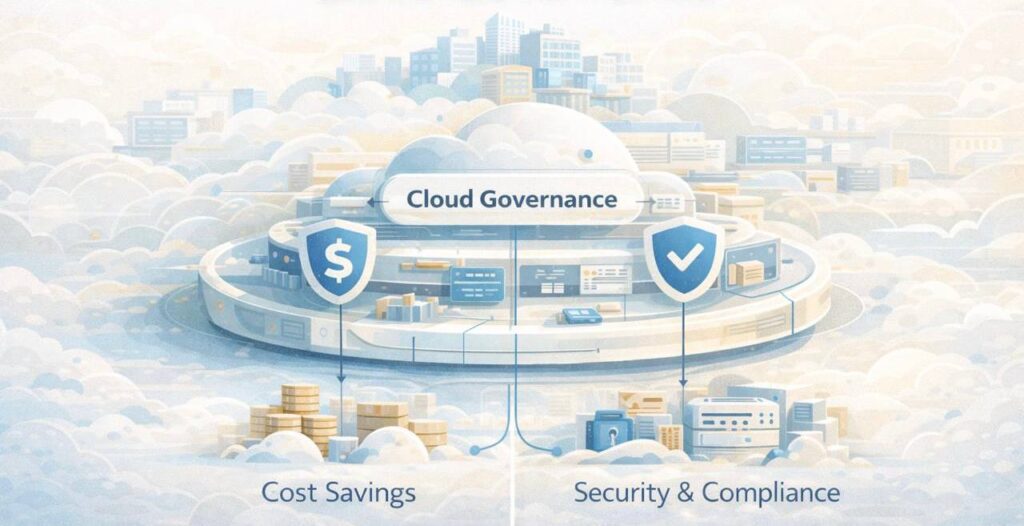
Beyond cost and risk, cloud governance enables organizational scale. As teams grow and become more distributed, informal coordination breaks down. Governance provides a shared framework that allows teams to work independently without fragmenting platforms or duplicating effort. Product teams move faster because expectations are clear, and platform teams focus on enablement rather than firefighting.
The business value of cloud governance lies not in control for its own sake, but in stability and trust. Leadership gains confidence in financial and operational outcomes. Teams gain autonomy within clear boundaries. The organization as a whole gains the ability to change continuously without destabilizing core systems. In this way, cloud governance becomes a foundation for sustainable growth rather than a constraint on innovation.
Conclusion
Cloud governance is no longer optional. As cloud environments grow, so do costs and risks. The choice is not whether to govern, but how.
Effective cloud governance focuses on visibility, ownership, and automation. It reduces cost without sacrificing speed and manages risk without creating friction. When treated as an operating model rather than a compliance exercise, governance becomes an enabler of scale — not an obstacle.
Why Ficus Technologies?
Ficus Technologies helps companies turn complex technology into stable, scalable systems. We work at the intersection of engineering, architecture, and business execution — focusing on long-term reliability rather than short-term wins.
Our teams build digital platforms that scale predictably, remain secure under growth, and adapt to change without constant rewrites. From cloud governance and AI-driven operations to mobile platforms and blockchain infrastructure, we approach technology as a system — not a collection of tools.
We don’t chase trends. We design foundations that last.
Cloud governance is an operating model that defines how cloud resources are created, managed, and retired. In practice, it combines cost visibility, security baselines, ownership rules, and automation to ensure cloud usage stays aligned with business goals.
When implemented correctly, it does the opposite. Governance removes ambiguity and rework by providing safe defaults, automation, and clear ownership. Teams move faster because they don’t need to reinvent decisions or fix avoidable issues later.
Costs usually grow because ownership is unclear.
FinOps is not mandatory, but it significantly strengthens governance. It provides shared language and metrics between engineering and finance, making cost trade-offs visible and actionable instead of abstract.





 Success...!