
Cloud computing has transformed how organizations build and scale digital infrastructure. Companies can deploy applications globally, provision resources on demand, and scale systems in minutes instead of months. However, the flexibility that makes the cloud so powerful can also lead to uncontrolled spending.
Many organizations discover that cloud costs grow faster than expected. Idle resources, inefficient architectures, and poorly managed workloads often result in unnecessary expenses. For CIOs and technology leaders, optimizing cloud spending has become a strategic priority rather than a purely operational task.
Cloud cost optimization is not simply about reducing spending. It is about aligning infrastructure costs with real business value — ensuring that every compute instance, storage volume, and data pipeline contributes to measurable outcomes.
The guide is also valuable for DevOps teams and platform engineers looking to implement better cost governance and infrastructure monitoring practices.
- Cloud cost optimization requires continuous monitoring and architectural discipline.
- Cloud spending often grows due to unused or over-provisioned resources.
- Cost optimization must combine technical improvements and financial governance.
Why Cloud Costs Spiral
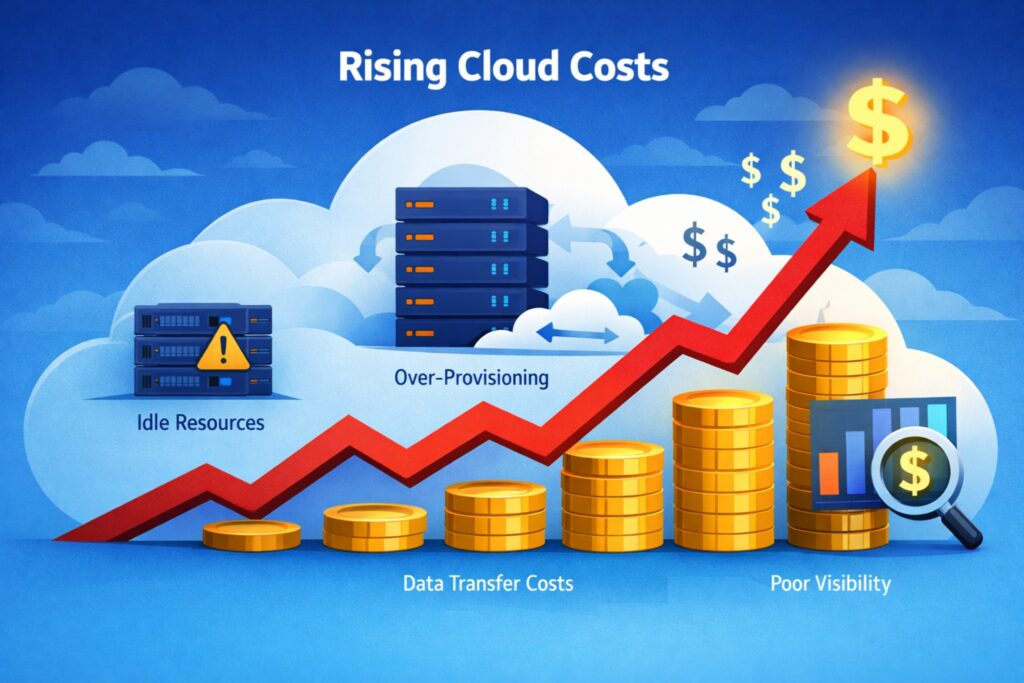
One of the main reasons cloud costs increase unexpectedly is the ease of provisioning resources. Engineers can spin up virtual machines, storage volumes, or data clusters in minutes. Without strong governance processes, these resources often remain active long after they are needed.
Another common issue is over-provisioning. Teams frequently allocate larger instances than required to avoid performance bottlenecks. While this approach may improve reliability, it often results in wasted compute capacity.
Data transfer and storage costs can also accumulate quickly. Large analytics pipelines, high-volume APIs, and cross-region traffic can generate significant expenses if not monitored carefully.
Understanding where these inefficiencies occur is the first step toward building an effective cost optimization strategy.
Visibility and Cost Monitoring
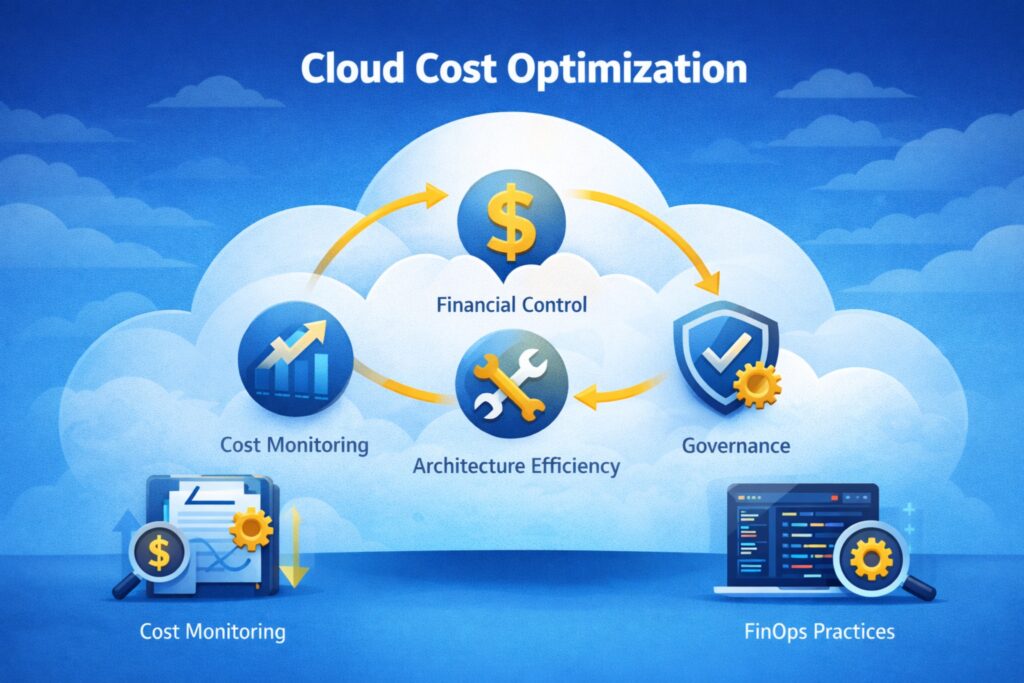
Effective cloud cost optimization begins with visibility. Organizations must understand where their cloud budget is being spent and which workloads generate the highest costs.
Cloud providers such as AWS, Microsoft Azure, and Google Cloud offer cost management tools that track resource usage and spending patterns. These platforms allow teams to identify idle resources, detect unusual spending patterns, and forecast future infrastructure costs.
Many companies also implement FinOps practices, which bring together engineering, finance, and operations teams to manage cloud spending collaboratively. FinOps encourages transparency, accountability, and continuous optimization across infrastructure environments.
When teams can clearly see where resources are being used, they can make informed decisions about optimization opportunities.
Architecture Strategies for Cost Efficiency
Cloud architecture has a major influence on infrastructure spending. Designing systems with cost efficiency in mind can significantly reduce long-term expenses.
One effective approach is adopting autoscaling architectures that adjust resource usage based on demand. Instead of running servers continuously at maximum capacity, autoscaling ensures that systems expand during peak usage and shrink during quiet periods.
Another strategy involves using serverless computing for certain workloads. Serverless platforms allow organizations to run code only when it is needed, eliminating the cost of idle infrastructure.
Containerization and orchestration platforms such as Kubernetes also help optimize resource allocation by packing workloads efficiently across compute nodes. Architectural decisions made early in the development lifecycle often determine whether cloud systems remain cost-efficient as they scale.
Automation and Governance
Automation plays an essential role in cloud cost optimization. Many organizations implement automated policies that shut down unused environments, archive inactive data, or adjust instance sizes based on real usage patterns.
Infrastructure-as-code tools allow teams to manage resources consistently and prevent configuration drift that leads to inefficiencies.
Governance policies also ensure that teams follow best practices when provisioning resources. Tagging policies, budget alerts, and access controls help organizations maintain accountability across departments.
These governance mechanisms ensure that optimization efforts remain consistent even as infrastructure environments grow more complex.
Balancing Cost and Performance
Cost optimization should never compromise system reliability or user experience. The goal is not simply to reduce spending but to find the optimal balance between cost and performance.
Organizations must carefully evaluate workloads before downsizing infrastructure resources. Performance monitoring tools can help identify safe opportunities for optimization without affecting system stability.
In many cases, improving efficiency can actually enhance performance. Optimized architectures often reduce latency, eliminate redundant processing, and streamline infrastructure management.
When optimization strategies are implemented thoughtfully, they support both financial and operational goals.

Looking to improve visibility and efficiency in your cloud infrastructure?
Contact usConclusion
Cloud platforms provide extraordinary flexibility, but they also require disciplined management to prevent costs from escalating.
Organizations that implement strong monitoring, architecture optimization, and governance practices can transform cloud cost management into a strategic advantage.
For CIOs and technology leaders, the goal is not simply to reduce infrastructure spending — it is to ensure that cloud investments directly support business growth and innovation.
Why Ficus Technologies?
At Ficus Technologies, we help organizations design and manage cloud infrastructures that are both scalable and cost-efficient.
Our teams combine expertise in cloud architecture, DevOps automation, and infrastructure optimization to identify cost-saving opportunities without compromising system reliability. From infrastructure audits to automated cost management frameworks, we help companies gain full visibility into their cloud environments.
By aligning technology architecture with business priorities, we enable organizations to reduce unnecessary spending while maintaining the performance and flexibility that modern cloud systems require.
Cloud cost optimization is the process of reducing unnecessary cloud spending while maintaining system performance and reliability.
Cloud costs often increase due to unused resources, over-provisioned infrastructure, inefficient architectures, and poor visibility into usage patterns.
Major cloud providers offer built-in cost monitoring tools. Examples include AWS Cost Explorer, Azure Cost Management, and Google Cloud Billing tools.
FinOps is a financial operations framework that brings together engineering, finance, and operations teams to manage cloud spending collaboratively.





 Success...!