
Artificial intelligence is transforming how organizations build digital products, analyze data, and automate operations. AI systems now support everything from cybersecurity monitoring and fraud detection to software development and customer service automation.
However, the rapid adoption of AI technologies is also creating new security risks. Threat actors are increasingly using AI to automate attacks, generate convincing phishing content, bypass security controls, and identify vulnerabilities in complex systems.
In 2026, cybersecurity strategies must account not only for traditional threats but also for AI-driven attack methods. Organizations need new approaches that combine advanced security practices, continuous monitoring, and responsible AI implementation.
Protecting digital systems in the age of artificial intelligence requires both technological innovation and a strong understanding of emerging threat landscapes.
Technology executives evaluating AI adoption risks.
Security engineers and DevOps teams managing modern platforms.
Organizations integrating AI into business operations.
- AI is increasingly used by attackers to automate cyber threats and exploit system vulnerabilities.
- Security strategies must evolve to address AI-powered phishing, automated reconnaissance, and adversarial AI attacks.
- Organizations should integrate AI governance, threat monitoring, and secure system design to reduce emerging risks.
The Rise of AI-Driven Cyber Threats
Cyber threats are evolving alongside advances in artificial intelligence. Attackers now use machine learning models and automated tools to accelerate traditional attack techniques.
AI can generate realistic phishing emails, impersonate voices, and produce deepfake content capable of bypassing traditional identity verification methods. Automated vulnerability scanning tools powered by AI can also analyze large infrastructures quickly, identifying weaknesses that attackers may exploit.
These capabilities allow threat actors to scale attacks more efficiently than in the past. Instead of targeting individual systems manually, attackers can automate reconnaissance, payload generation, and social engineering campaigns.
As AI technology becomes more accessible, the barrier to launching sophisticated cyberattacks continues to decrease.
AI-Powered Phishing and Social Engineering
One of the most visible security risks associated with AI is the rapid evolution of phishing and social engineering attacks.
Generative AI models can produce highly convincing emails, messages, and documents that mimic legitimate communication from organizations or colleagues. Attackers can personalize phishing attempts using publicly available information or leaked datasets.
Voice synthesis and deepfake technologies further increase the effectiveness of social engineering campaigns. Fraudsters can simulate executive voices in phone calls or video meetings, making it harder for employees to verify identity.
Traditional phishing detection methods, which rely on identifying grammatical errors or suspicious wording, are becoming less effective against AI-generated content.
Organizations must therefore implement stronger identity verification systems and employee awareness training to mitigate these risks.
AI will be the most powerful tool in cybersecurity — both for defenders and attackers.
Kevin Mandia, cybersecurity expert
Key Statistics on AI-Driven Cyber Threats
The rapid development of artificial intelligence is significantly changing the cybersecurity landscape. While AI technologies improve threat detection and security automation, they are also increasingly used by attackers to accelerate cyber operations.
Industry reports indicate that AI-powered phishing campaigns are growing rapidly, with security researchers estimating that up to 70% of phishing messages may soon be generated or enhanced using AI tools. These messages are often more convincing, personalized, and harder for traditional filters to detect.
Another growing risk is the use of AI in automated malware development. Security analysts estimate that AI-assisted tools could increase malware production by around 30%, allowing attackers to generate malicious code faster and adapt it to different targets.
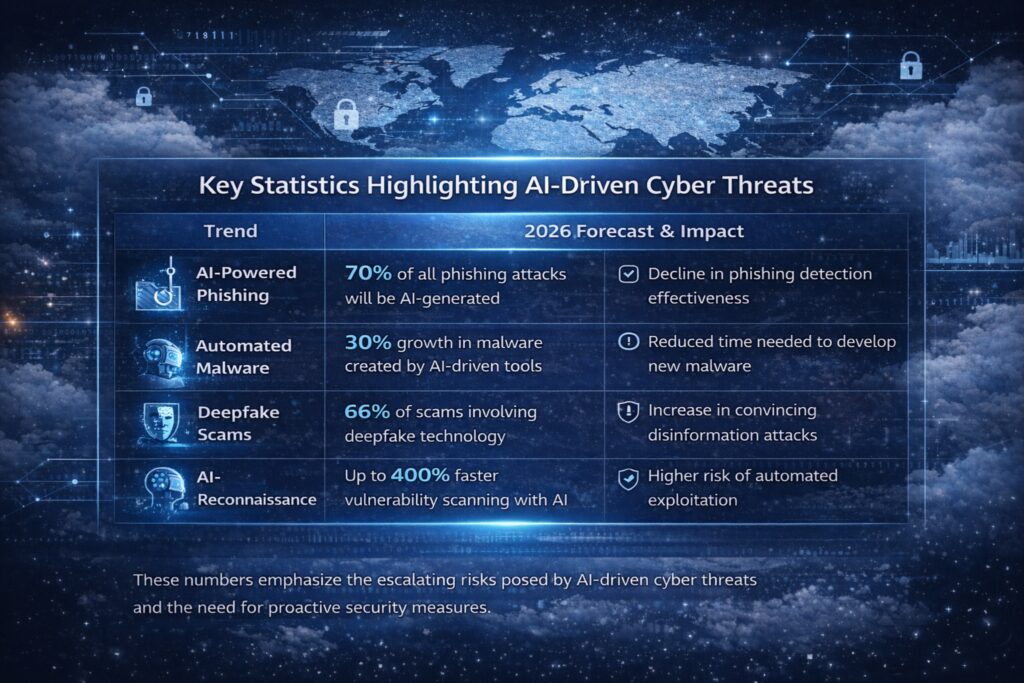
Deepfake technologies are also becoming a serious security concern. Studies show that more than 60% of fraud cases involving synthetic media rely on deepfake audio or video, enabling attackers to impersonate executives or trusted individuals in financial or social engineering scams.
Finally, AI significantly accelerates the reconnaissance phase of cyberattacks. Automated vulnerability scanning powered by AI can identify potential system weaknesses up to four times faster than traditional manual methods, allowing attackers to map digital infrastructure more efficiently.
These trends demonstrate how artificial intelligence is reshaping both offensive and defensive cybersecurity strategies. Organizations must therefore combine advanced security technologies with strong governance and continuous monitoring to mitigate emerging AI-driven threats.
Securing AI Systems Themselves
In addition to external threats, AI systems can introduce new internal security challenges.
Machine learning models rely heavily on training data. If malicious actors manipulate or poison datasets, the resulting AI models may produce incorrect or biased outputs.
Another risk involves model theft or model extraction, where attackers attempt to replicate proprietary machine learning models by querying them repeatedly.
AI systems can also be vulnerable to adversarial attacks, in which carefully crafted inputs manipulate model predictions or outputs.
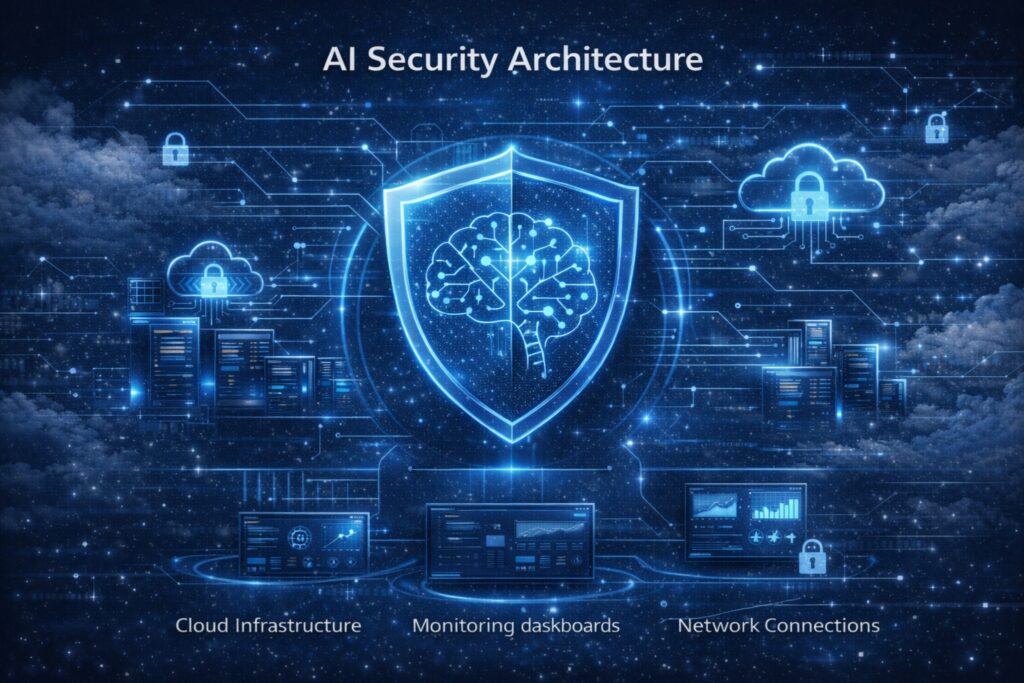
Protecting AI infrastructure requires secure data pipelines, controlled model access, and monitoring mechanisms that detect unusual interactions with AI services.
Security Strategies for the AI Era
To mitigate AI-driven threats, organizations must evolve their cybersecurity strategies.
First, security teams should adopt AI-assisted threat detection systems capable of analyzing large volumes of security telemetry. AI can help identify abnormal patterns in network traffic, login behavior, and system activity.
Second, organizations should implement strong identity and access management controls. Multi-factor authentication, behavioral monitoring, and device verification help reduce the risk of social engineering attacks.
Third, secure development practices must extend to AI systems. This includes data validation, model monitoring, and regular testing for vulnerabilities or adversarial manipulation.
Finally, organizations should establish AI governance frameworks that define how AI technologies are developed, deployed, and monitored across the organization.
The Role of Human Expertise
Despite advances in automation, human expertise remains critical in cybersecurity.
AI tools can analyze large datasets and detect anomalies, but interpreting complex attack patterns and responding effectively still requires experienced security professionals.
Security teams must combine automated threat detection with human oversight, threat intelligence analysis, and strategic decision-making.
The most resilient cybersecurity strategies integrate technology, skilled professionals, and strong organizational processes.
Build secure AI-powered systems with modern cloud and data architecture!
Contact usConclusion
Artificial intelligence is reshaping both the opportunities and risks within modern cybersecurity.
While AI enables powerful new tools for threat detection and automation, it also allows attackers to launch more sophisticated and scalable attacks.
Organizations must therefore adopt proactive security strategies that address AI-driven threats, protect machine learning systems, and strengthen identity verification mechanisms.
In the evolving cybersecurity landscape, the combination of advanced technology and skilled security teams will remain essential for protecting digital infrastructure.
Why Ficus Technologies?
Ficus Technologies helps organizations design secure digital platforms that integrate modern AI capabilities while maintaining strong cybersecurity standards.
Our teams support companies in implementing secure cloud architectures, AI-powered monitoring systems, and resilient DevOps practices. By combining cybersecurity expertise with modern technology frameworks, organizations can adopt AI technologies while minimizing emerging risks.
Through architecture consulting, security automation, and infrastructure design, Ficus Technologies helps businesses operate safely in an increasingly AI-driven digital environment.
AI-driven threats involve the use of artificial intelligence to automate cyberattacks, generate phishing content, analyze vulnerabilities, or manipulate digital systems.
AI can analyze large volumes of security data, detect anomalies, and help identify potential threats faster than traditional monitoring systems.
Adversarial AI refers to techniques that manipulate machine learning models by providing carefully crafted inputs designed to produce incorrect outputs.
AI governance helps organizations define policies for how AI systems are developed, monitored, and protected, reducing the risk of misuse or vulnerabilities.






 Success...!