
Most organizations already collect large volumes of data, run analytics workloads in the cloud, and invest in modern tools. Yet the impact on business growth remains uneven. Some companies use analytics to shape strategy, accelerate decisions, and scale predictably. Others generate reports that look impressive but rarely influence outcomes.
The difference is not access to data or technology. It is how analytics is positioned within the organization. Cloud analytics drives growth only when it is treated as a decision-making capability, not as a technical function or a reporting layer.
Growth today depends on speed and clarity. Markets change faster than annual plans can adapt. Products evolve continuously. Customer behavior shifts in real time. In this environment, analytics must shorten the distance between data and action. When insights arrive too late, require manual interpretation, or contradict each other across teams, they fail to support growth — even if the underlying data is accurate.
Cloud platforms make analytics scalable, but scale alone does not create value. The real advantage of cloud analytics lies in its ability to connect data across systems, teams, and regions without slowing the organization down. When analytics is designed well, teams operate with a shared understanding of performance, risk, and opportunity.
It is particularly relevant for organizations operating cloud-native or data-driven products that want analytics to actively support scaling efforts rather than remain a passive reporting layer.
- Cloud analytics drives growth when it reduces uncertainty and accelerates decision-making.
- What works in 2026 is trusted data, clear ownership of metrics, and analytics that reflects how the business actually operates.
- What limits growth is fragmented measurement, delayed insights, and analytics systems that evolve separately from products and teams.
What Cloud Analytics Really Means for Growth in 2026
In 2026, cloud analytics is no longer about visibility alone. Dashboards and reports are table stakes. Real growth now depends on how quickly organizations can turn data into confident, organization-wide decisions.
Leading companies treat analytics as a continuous capability, not a reporting function. Markets shift in days, sometimes hours. Customer behavior changes in real time. Risks compound fast. In this environment, growth belongs to organizations that can detect change early, understand its impact immediately, and respond before small signals become large problems—or missed opportunities.
By 2026, more than 70% of high-growth organizations rely on cloud analytics platforms that operate continuously, ingesting data streams in near real time rather than in daily or weekly batches. These companies shorten the feedback loop between action and outcome by 5–10×, allowing teams to test, adjust, and scale decisions without slowing execution.
Modern cloud analytics environments are designed to:
– Process millions of events per second across products, customers, and operations.
– Surface actionable insights within minutes, not weeks.
– Embed analytics directly into workflows, where decisions are made.
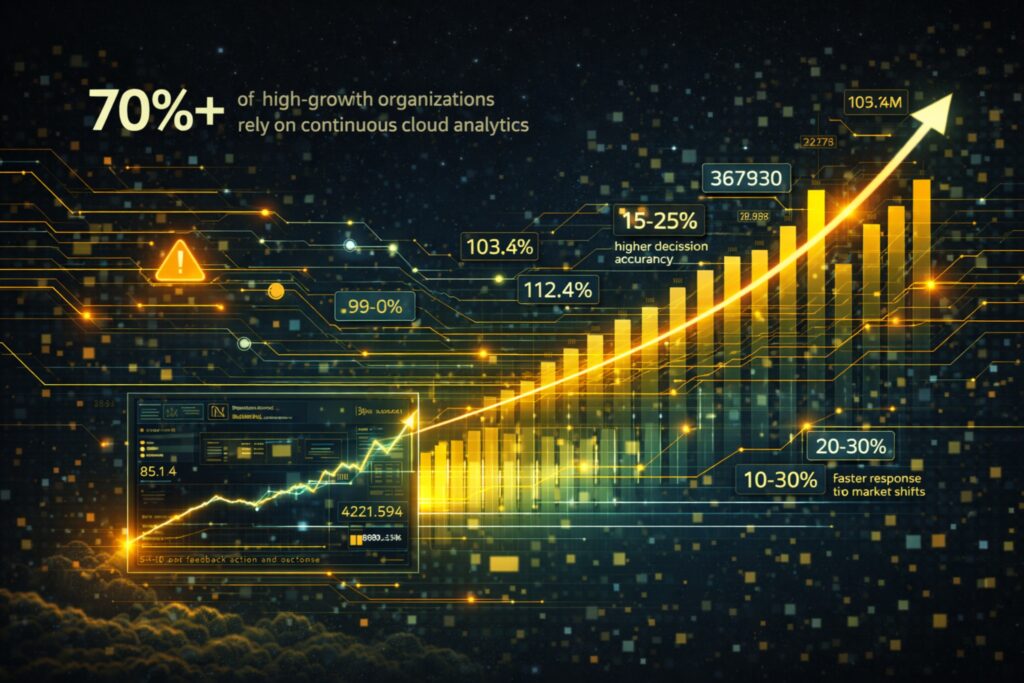
Insights that arrive weeks after an event has already influenced customers or markets provide limited value. In contrast, organizations using real-time cloud analytics see up to 20–30% faster response times to market shifts and 15–25% higher decision accuracy, according to industry benchmarks.
Most importantly, cloud analytics in 2026 enables alignment at scale. When leadership, product, operations, and go-to-market teams work from the same live signals, decisions become coordinated rather than reactive. Growth becomes intentional, not accidental.
Cloud analytics supports growth when it removes delay—from data collection, from interpretation, and from action. The companies that win in 2026 are not the ones with the most data, but the ones that can act on it first, with confidence.
Analytics as a Foundation for Scalable Decision-Making
As organizations scale, informal alignment inevitably breaks down. What once worked through shared context and close communication becomes fragile as teams grow, specialize, and move faster. Different functions adopt different metrics, interpret the same data in conflicting ways, and optimize for local outcomes rather than global impact. Leadership may have access to more dashboards than ever before, yet still struggle to answer a simple question: are we moving in the same direction?
Cloud analytics creates business value when it becomes the foundation for scalable decision-making, not just a reporting layer. Its role is to establish a common language for performance—one that is consistent across teams, products, and regions. Shared definitions, trusted data pipelines, and clear ownership of metrics reduce friction and eliminate time spent reconciling numbers instead of acting on them.

In mature analytics organizations, teams are empowered to move independently because the underlying signals are aligned. Product, marketing, operations, and finance can make fast decisions locally while remaining coordinated globally. This balance—autonomy without fragmentation—is critical for sustained growth.
Trust, Ownership, and the Cost of Fragmented Insights
One of the most common barriers to growth is lack of trust in data. When metrics conflict or data quality is inconsistent, teams revert to intuition. Analytics becomes decorative — present, but ignored.
Organizations that grow successfully through analytics invest in trust before sophistication. Ownership of key metrics is explicit. Accountability for data quality is clear. When teams trust analytics, they use it to guide everyday decisions, not just quarterly reviews. This trust compounds over time, increasing the speed and confidence of execution.
Cloud Analytics and Continuous Growth
Growth in 2026 is rarely linear. It emerges through experimentation, iteration, and adaptation. Cloud analytics supports this process by making outcomes visible quickly and reliably. Teams can evaluate the impact of changes, validate assumptions, and course-correct without waiting for manual analysis or centralized approval.
This capability allows growth to become continuous rather than episodic. Instead of relying on large initiatives, organizations improve steadily, guided by real-time signals and measurable results.
Conclusion
In 2026, cloud analytics is no longer a differentiator by itself. Its value lies in how effectively it supports growth through clarity, trust, and responsiveness. Organizations that treat analytics as a core operating capability gain the ability to scale predictably and adapt continuously.
Growth belongs to companies that do not just collect data, but use it to reduce uncertainty and act with confidence. Cloud analytics enables this advantage only when it is aligned with ownership, decision-making, and the realities of how teams work.
Looking for a cloud analytics team to support your growth initiatives?
Contact us!Why Ficus Technologies?
Ficus Technologies works with cloud platforms and data systems at the level where architecture, analytics, and operating models intersect. This perspective matters because cloud analytics and growth are rarely limited by tools alone. In practice, they are constrained by how platforms are designed, how responsibilities are distributed, and how decisions are translated into execution at scale.
It is the use of cloud-based data platforms to support continuous, organization-wide decision-making rather than static reporting.
By reducing uncertainty, shortening feedback loops, and enabling faster, more confident decisions.
No. Its effectiveness depends on ownership, trust, and how well analytics reflects business priorities.
Poorly designed analytics can. Well-aligned cloud analytics accelerates execution and adaptation.





 Success...!