
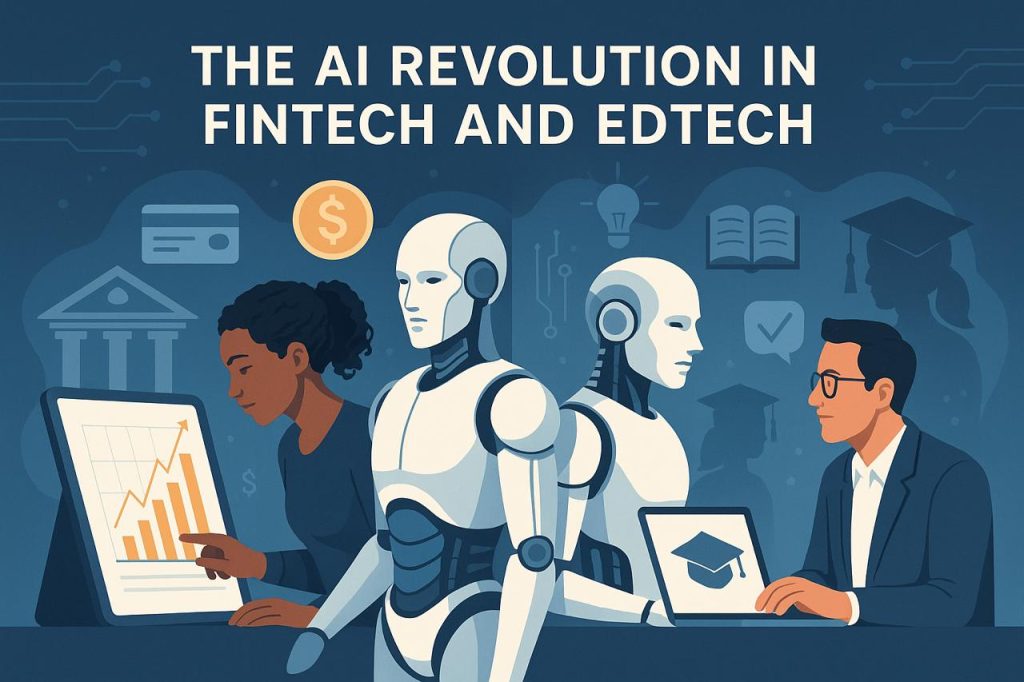
Artificial Intelligence (AI) has become more than a digital assistant — it’s a strategic driver that transforms entire industries. In 2026, two sectors stand out as the most disrupted and reimagined by AI: financial technology (FinTech) and educational technology (EdTech). Both deal with high volumes of data, require fast decision-making, and thrive on personalization. AI delivers all three, enabling businesses to build smarter, safer, and more adaptive ecosystems.
Investors and policymakers evaluating AI’s long-term impact.
Students and educators preparing for digital-first learning environments.
Tech professionals building platforms that connect money, learning, and trust.
- FinTech is using AI to fight fraud, democratize credit, and personalize banking.
- EdTech leverages AI for adaptive learning, virtual tutoring, grading, and inclusivity.
- The future is AI-driven ecosystems where finance and education reinforce one another.
AI in FinTech: Reimagining the Financial Landscape
In 2026, artificial intelligence is no longer an optional add-on in finance — it is the engine behind almost every competitive product and service. The financial sector has always revolved around numbers, risk assessment, and trust, but the scale and complexity of today’s global economy have pushed traditional systems to their limits. AI is filling this gap by providing the speed, precision, and foresight that manual processes and legacy IT infrastructures cannot match.
One of the most profound transformations is in real-time fraud detection. Banks and payment providers now operate in an environment where billions of microtransactions occur simultaneously across borders. Human oversight or rule-based systems cannot keep pace with this activity, but AI models trained on vast datasets of behavioral patterns can identify anomalies in milliseconds. Suspicious activity, whether it is unusual spending in a customer account or large transfers across multiple jurisdictions, is flagged instantly and blocked before damage occurs. This ability has turned fraud prevention from a reactive function into a proactive one.
Finally, AI is tackling one of the biggest historical barriers in finance: accessibility of credit. Conventional credit scoring systems often excluded individuals and small businesses with limited formal financial histories. By analyzing alternative data — utility payments, mobile transactions, or even e-commerce activity — AI systems can build more inclusive risk profiles. This has opened the door for millions of underbanked individuals worldwide, giving them access to loans, credit cards, and growth opportunities that traditional banking would have denied.
In short, AI is not only improving efficiency in FinTech; it is fundamentally reshaping the relationship between financial institutions and their customers. Trust, personalization, and inclusion are no longer aspirations — they are becoming the default standard of digital finance.
AI in EdTech: Learning Without Limits
The education sector has historically been slow to change, bound by rigid curricula, standardized assessments, and physical classroom limitations. By 2026, artificial intelligence has broken these barriers, enabling a shift from uniform teaching models to deeply personalized, adaptive learning ecosystems. The essence of this transformation is that learning is no longer defined by what a teacher can deliver in a fixed classroom setting but by what each student requires to succeed in real time.
One of the most powerful applications of AI in education is adaptive learning technology. Instead of progressing through a static syllabus, learners now engage with platforms that constantly assess their understanding, identify knowledge gaps, and adjust lesson plans dynamically. A student who struggles with algebra, for example, is given extra practice, alternative explanations, and immediate feedback, while a peer who excels is pushed toward more advanced challenges. This personalization ensures that neither group is held back nor left behind, creating a more equitable system where progress is measured by mastery rather than time spent in class.
Finally, AI is creating immersive and interactive experiences. Virtual classrooms augmented by AI-powered simulations allow students to experiment with real-world scenarios — from performing virtual surgeries to conducting chemistry experiments safely online. These environments are not only engaging but also prepare students for practical applications in their chosen fields.
Together, these innovations redefine what education means in the digital era. It is no longer about memorizing facts for standardized tests but about fostering adaptability, curiosity, and skills tailored to individual potential. With AI, education evolves from being system-centered to learner-centered, ensuring that knowledge is not limited to the few but accessible to all.
Where FinTech and EdTech Intersect
At first glance, finance and education seem worlds apart. Yet in 2026, the convergence of FinTech and EdTech through AI is creating new possibilities that neither sector could achieve alone. This intersection is driven by a common thread: both rely on data-rich environments and require trust to succeed.
One clear area of overlap is financial literacy education. EdTech platforms powered by AI are now partnering with FinTech firms to teach users how to manage money, understand credit, and make investment decisions. Gamified mobile apps simulate real-world financial decisions, allowing students and young professionals to practice budgeting, saving, and investing in a risk-free environment. By combining financial tools with adaptive learning, these hybrid solutions prepare individuals not just to earn money, but to manage it wisely.
Another powerful example is the rise of education financing powered by AI. Access to higher education often depends on student loans, which historically have been blunt instruments based on limited credit history. AI-enabled FinTech systems can now analyze a wider range of data — academic performance, potential career outcomes, and even micro-behaviors in learning platforms — to offer tailored financing solutions. This creates a fairer model where students are assessed not just by their past but by their potential.
Risks and Ethical Considerations
As AI becomes deeply embedded in both FinTech and EdTech, the opportunities it brings are matched by significant risks and ethical dilemmas. Financial data and educational records are among the most sensitive forms of personal information — misusing or mishandling them can lead to severe consequences for individuals and institutions alike.
In FinTech, the key risks revolve around bias in algorithms and financial exclusion. If training data reflects existing inequalities, AI credit-scoring models may reinforce them, denying loans to applicants from disadvantaged backgrounds or misclassifying risk based on geography, gender, or socio-economic status. Moreover, the concentration of financial data in centralized AI platforms makes them attractive targets for cybercriminals. A single breach could compromise millions of users, leading to both financial loss and erosion of trust.
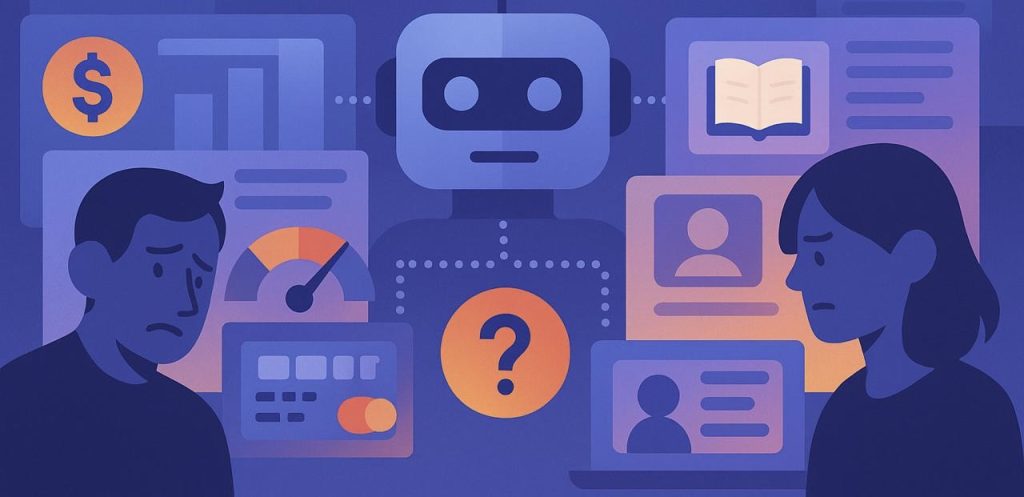
In EdTech, the challenges are different but equally complex. Student profiling raises concerns about how much control learners retain over their data. Systems that track performance and behavior across years can inadvertently pigeonhole students into categories — such as “low performer” or “at risk” — that may limit opportunities instead of unlocking them. Additionally, the reliance on AI-driven assessments raises the issue of accountability: if an algorithm unfairly grades or recommends learning paths, who is responsible for correcting the error?
The Future of AI: 2026 and Beyond
By 2026, AI has moved from experimental technology to foundational infrastructure in nearly every sector. What lies ahead is not just refinement but the emergence of AI-driven ecosystems that connect industries, institutions, and individuals in real time.
The next wave of FinTech innovation will likely focus on self-regulating financial systems, where AI not only executes trades or approves loans but also enforces compliance with evolving global regulations automatically. Imagine an AI agent that updates its risk models the moment a new financial rule is enacted, removing the lag between legislation and implementation.
In EdTech, the horizon points toward lifelong adaptive learning companions. These AI systems won’t just support students in classrooms but will evolve into personal knowledge advisors that follow individuals throughout their careers. They will track skills, suggest reskilling paths as industries shift, and even match learners with job opportunities — effectively blending education with workforce development in one continuous loop.
Want to build AI solutions that redefine how people learn and manage money?
Contact UsConclusion
AI in 2026 has moved far beyond isolated applications. In FinTech, it secures transactions, democratizes credit, and builds trust through personalization. In EdTech, it breaks barriers of geography, language, and ability, making learning limitless and adaptive. At their intersection, these two industries prove that AI is not only a tool for efficiency but also a driver of inclusion, accessibility, and opportunity.
Yet with these advancements come profound challenges — from algorithmic bias and privacy risks to the danger of overreliance on opaque systems. The lesson is clear: innovation without governance leads to fragility. Organizations that balance speed with responsibility, and automation with transparency, will define the next era of digital transformation.
Why Ficus Technologies?
At Ficus Technologies, we help organizations harness AI not just as a technical upgrade, but as a strategic advantage.
Our approach is built on three pillars:
- Trust by Design – We embed security, compliance, and transparency into every AI-driven solution, whether it’s a financial risk model or an adaptive learning platform.
- Industry-Specific Expertise – With proven experience in both FinTech and EdTech, we design systems that understand the unique demands of each sector while bridging them where it matters.
- Future-Ready Architecture – From blockchain integrations in student financing to AI-powered fraud detection in banking, we build scalable, sustainable solutions that evolve with technology and regulation.
We don’t just implement AI — we make it work for your business goals, your users, and your long-term growth.
AI automates fraud detection, improves risk scoring, and enables hyper-personalized products like dynamic loans and tailored investment advice.
Adaptive learning — AI tutors adjust in real time to a learner’s pace, style, and goals, making education more effective and inclusive.
They intersect in areas like financial literacy training and AI-driven student loan solutions, combining finance and education for broader access.







 Success...!