
Artificial intelligence is rapidly becoming embedded in modern products, services, and decision-making systems. From recommendation engines and financial risk models to medical diagnostics and generative AI tools, organizations are increasingly relying on AI to power critical operations.
However, as AI adoption grows, so do concerns around bias, transparency, privacy, and accountability. Governments, regulators, and industry leaders are recognizing that deploying AI responsibly requires more than technical innovation — it requires governance.
Responsible AI governance refers to the policies, processes, and technical controls that ensure AI systems are developed and used ethically, safely, and transparently. Without these frameworks, organizations risk regulatory penalties, reputational damage, and unintended harm caused by poorly controlled AI systems.
The challenge for many organizations is not understanding the importance of responsible AI — it is building governance systems that actually work in practice.
The guide also helps business leaders understand how responsible AI governance can protect organizations while enabling innovation.
- Responsible AI governance requires more than ethical guidelines — it requires operational processes.
- AI governance frameworks must combine technical controls, policies, and oversight mechanisms.
- Transparency and explainability are critical for building trust in AI systems.
What Responsible AI Governance Means Today
Responsible AI governance refers to the systems that ensure AI technologies operate safely, ethically, and in alignment with legal and organizational standards.
In practice, this means implementing policies that govern the entire AI lifecycle — from data collection and model development to deployment, monitoring, and retirement.
Governance frameworks must address several core challenges. First, AI systems often operate as “black boxes,” making it difficult to understand how decisions are made. Second, training data may contain biases that lead to unfair outcomes. Third, generative AI tools introduce new risks related to misinformation, intellectual property, and data privacy.
As a result, organizations are moving toward governance models that combine technical safeguards with policy frameworks, ensuring AI systems remain accountable and transparent.
Building Effective AI Governance Policies
Successful AI governance begins with clearly defined policies that guide how AI systems are developed and used.
These policies typically cover several key areas. Data governance policies ensure that training data is collected ethically and complies with privacy regulations. Model governance policies establish requirements for validation, documentation, and risk assessment before models are deployed.
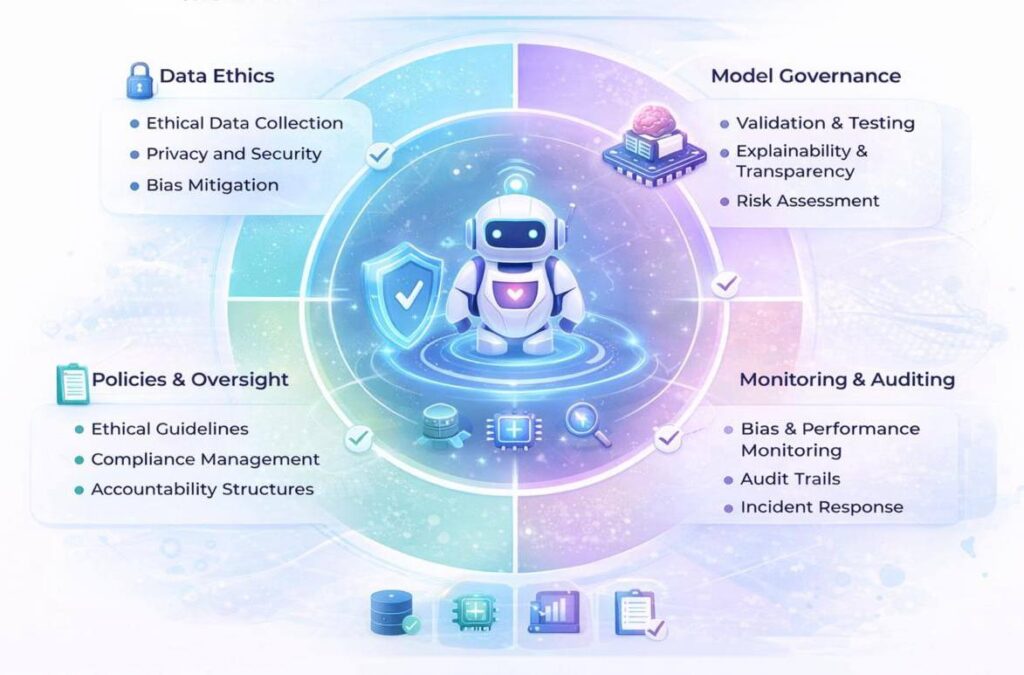
Another important component is defining accountability. Organizations must clearly identify who is responsible for approving, monitoring, and auditing AI systems. This often involves cross-functional collaboration between engineering teams, legal departments, compliance officers, and product leaders.
Effective governance policies also establish review processes for high-risk AI applications, particularly those affecting financial decisions, healthcare outcomes, or public safety.
Technical Controls for Responsible AI
Policies alone are not sufficient to ensure responsible AI. Technical controls are necessary to operationalize governance principles.
Model explainability tools help teams understand how AI systems reach their conclusions. Techniques such as feature importance analysis, model interpretability frameworks, and explainable AI dashboards allow engineers and regulators to examine decision-making processes.
Bias detection tools analyze training data and model outputs to identify unfair patterns or demographic disparities. Continuous monitoring systems track model performance over time and detect issues such as data drift or unexpected behavior.
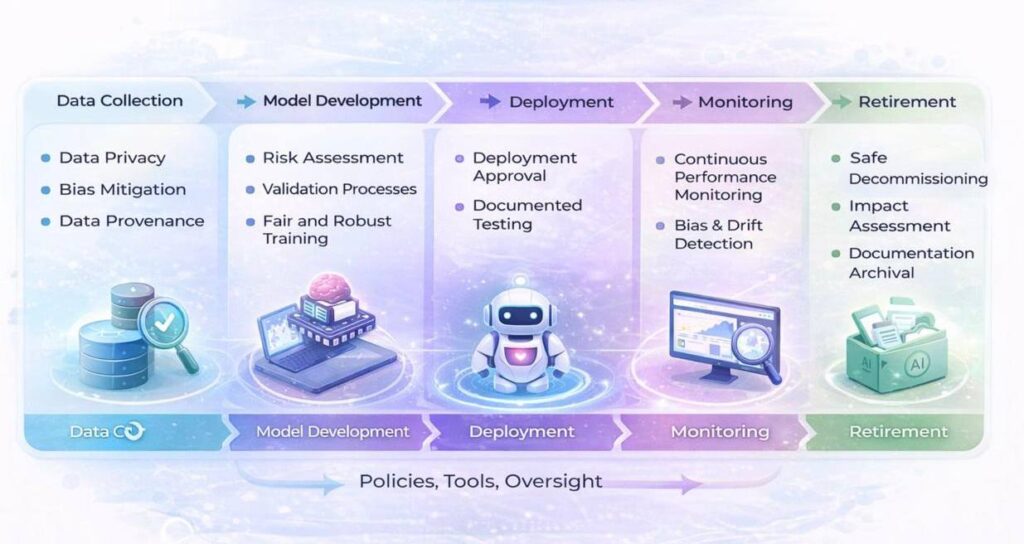
Organizations increasingly deploy AI observability platforms that provide real-time visibility into how models behave in production environments.
These technical tools allow governance policies to move from theoretical guidelines to enforceable operational practices.
Key Statistics on AI Governance
The rapid expansion of artificial intelligence across industries has made governance and oversight a growing priority for organizations. As AI systems become more deeply integrated into products, services, and operational decision-making, companies are increasingly recognizing the importance of implementing structured governance frameworks. Recent research highlights the scale of this challenge.
According to the McKinsey Global AI Survey, approximately 78% of organizations already use AI in at least one business function, demonstrating how quickly AI adoption has become mainstream. However, adoption has grown faster than governance frameworks.
Studies from Deloitte and PwC show that over 60% of companies now consider AI governance and risk management a top strategic priority. Leadership teams are becoming more aware that AI systems can introduce risks related to bias, transparency, data privacy, and regulatory compliance.
At the same time, the IBM Global AI Adoption Index reports that less than 30% of organizations currently have formal governance structures for AI systems deployed in production environments. This gap between adoption and governance creates potential vulnerabilities for companies operating with AI-driven products or automated decision systems.
Let’s build AI systems that are powerful and trustworthy!
Contact usCompliance and Regulatory Frameworks
AI governance is becoming a regulatory requirement in many regions. Governments and international organizations are introducing frameworks designed to ensure that AI systems are safe, transparent, and accountable.
The EU AI Act, for example, classifies AI applications based on risk levels and introduces strict requirements for high-risk systems. Similarly, regulatory guidance from organizations such as the OECD, NIST, and ISO outlines best practices for responsible AI development and oversight.
Companies operating globally must align their governance frameworks with these evolving regulations. This requires maintaining documentation, risk assessments, and audit trails that demonstrate responsible AI practices.
Organizations that proactively implement governance frameworks are better prepared to meet these regulatory expectations.
Balancing Innovation and Responsibility
One of the biggest misconceptions about AI governance is that it slows innovation. In reality, strong governance frameworks often accelerate innovation by creating clear guidelines for responsible development.
When teams understand the boundaries and expectations for AI systems, they can experiment more confidently without risking compliance violations or ethical failures.
Responsible AI governance also builds trust among customers, partners, and regulators. Transparent systems that demonstrate fairness and accountability are more likely to gain public acceptance.
In this sense, governance does not restrict AI development — it creates the foundation for sustainable innovation.
AI systems must be built with safety, transparency, and accountability at their core.
Sundar Pichai, CEO of Google & Alphabet
Conclusion
Responsible AI governance is becoming a critical component of modern technology strategy. As AI systems become more powerful and more widely deployed, organizations must ensure that these technologies operate in ways that are transparent, fair, and accountable.
Building governance frameworks that combine policy, technology, and oversight allows companies to manage AI risks while continuing to innovate.
Organizations that invest in responsible AI governance today will be better prepared for the regulatory, ethical, and technological challenges of the AI-driven future.
Why Ficus Technologies?
At Ficus Technologies, we help organizations implement AI systems that are not only powerful but also responsible and trustworthy.
Our teams combine expertise in AI development, data governance, and regulatory compliance to design frameworks that support responsible AI adoption. From establishing governance policies to implementing monitoring and explainability tools, we help organizations build AI systems that meet both technical and ethical standards.
By integrating governance into the AI lifecycle from the beginning, companies can deploy intelligent systems with confidence — knowing they are aligned with best practices and emerging regulatory requirements.
Responsible AI governance refers to the policies, processes, and technical safeguards that ensure AI systems operate ethically, transparently, and in compliance with legal and organizational standards.
Without proper governance, AI systems can introduce risks such as bias, privacy violations, or unintended decision outcomes. Governance frameworks help organizations monitor AI behavior and maintain trust with users and regulators.
Most governance models include:
– ethical data practices
– model validation and explainability
– continuous monitoring and auditing
– regulatory compliance and documentation
Organizations typically combine policy frameworks, technical monitoring tools, and cross-functional oversight teams to ensure AI systems remain transparent, fair, and reliable throughout their lifecycle.







 Success...!