
In modern software development, innovation and risk often go hand in hand. Before committing significant resources to a full-scale product, businesses need a reliable method to validate assumptions, test feasibility, and reduce uncertainty. This is where a Proof of Concept (PoC) becomes essential.
A PoC is a small-scale project aimed at demonstrating whether an idea or functionality can work in real-world conditions. Unlike prototypes or MVPs, a PoC focuses strictly on technical viability—not design, not scalability, just the core question: Can this be built, and will it function as expected?
In this article, we explore the strategic role of PoCs in the software development lifecycle, their benefits and limitations, and best practices for implementing a successful PoC.
More than 66% of startups fail to deliver value to investors. Often, this happens because businesses skip the foundational steps and jump straight into development without validating their ideas. A Proof of Concept (PoC) is a crucial part of software development that reduces this risk by verifying the technical feasibility and market relevance of a proposed solution before committing significant resources.
- A Proof of Concept (PoC) is an early-stage project designed to test whether an idea or technology is feasible and viable before investing in full-scale development.
- PoCs help identify potential technical challenges, validate assumptions, and reduce risks early in the software development lifecycle.
- Unlike prototypes or MVPs, a PoC focuses specifically on proving the core concept’s feasibility, not on delivering a finished product.
What Is a PoC in Software Development?
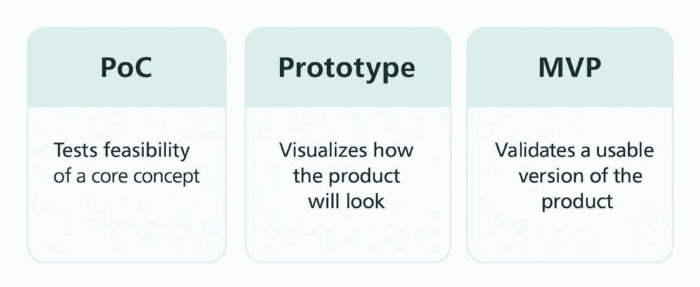
A Proof of Concept in software development is a tightly scoped experiment that demonstrates whether a technology or feature can function in practice. It is not a finished product, not even a prototype—it is a technical validation exercise. The objective is straightforward: to prove whether the core idea is feasible under real-world conditions. In other words, while a prototype asks “What will this look like?” and an MVP asks “Will users adopt this?”, a PoC asks only “Can this actually work?”
This distinction is important because many teams confuse these concepts and waste resources by blending them. A PoC strips away design, scalability, and market polish to focus solely on functionality. If a business is experimenting with a new AI model, a blockchain-based process, or a compliance-heavy integration in healthcare or finance, the PoC is the quickest way to validate the foundation before any real investment. By answering this narrow question with evidence, teams gain clarity on technical risks, identify integration challenges, and decide whether to move forward—or pivot—before time and money are lost.
Proof of Concept in Software Development: Reducing Risk Through Validation
Innovation has always been the engine of software development, but innovation also carries uncertainty. For a business, the real question is not only whether an idea looks promising but whether it can actually be built and deliver value in practice. This is where a Proof of Concept (PoC) becomes essential. A PoC is a small, focused experiment that answers the most important question at the earliest stage of the development lifecycle: is this technically possible, and does it work in real conditions?
Unlike prototypes or MVPs, which are created to explore design, usability, or scalability, a PoC has a narrower but critical mission. It demonstrates feasibility. In industries where technology barriers are high—whether in fintech with secure transaction systems, medtech with compliance-heavy integrations, or AI with complex models—a PoC provides clarity before resources are invested. Without it, companies risk building on assumptions rather than facts.
Why a PoC Matters
The statistics are sobering: more than two-thirds of startups fail to deliver value, often because they move directly to building products without validating the foundation. A PoC changes that dynamic. It allows teams to stress-test ideas, confirm whether key integrations are workable, and identify constraints before they become expensive mistakes. It also serves as a communication tool between technical teams, business leaders, and investors. Instead of pitching a vision in slides, companies can demonstrate evidence in code, even if it is a minimal form.
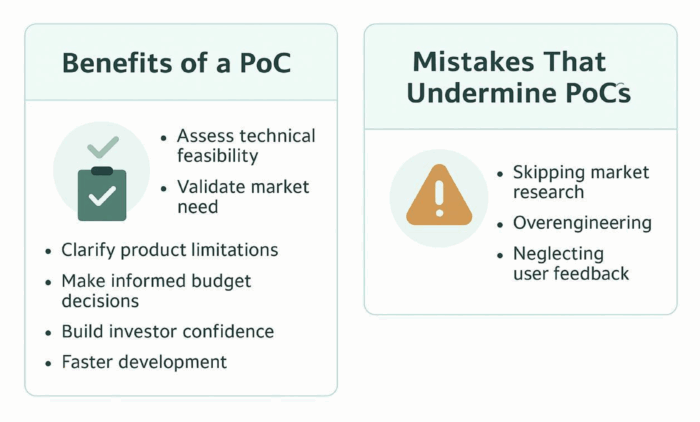
The benefits are clear. PoCs expose technical challenges early, help validate market demand, define the real boundaries of a solution, and provide realistic data for budgets and timelines. Most importantly, they build trust: both within teams aligning around a common goal and with stakeholders who need proof before releasing funding.
When to Use a PoC
Not every project requires a PoC, but the cases where it does are easy to identify. Whenever a team is working with untested technologies, evaluating critical integrations, or pitching ambitious projects to investors, a PoC offers a risk buffer. High-budget or high-risk initiatives in particular benefit from this early validation, since they are the least forgiving of failure. By compressing risk into a short, controlled experiment, companies can make smarter decisions about what to build and how to build it.
The Process of Building a PoC
A well-executed PoC is lean but structured. It starts with defining the problem and aligning it with business goals. Teams must ask what problem they are solving, how success will be measured, and what resources are available. From there, they ideate solutions, explore feasibility, and compare approaches. A basic visualization—whether in the form of wireframes or simplified workflows—helps clarify direction. Testing with stakeholders provides feedback and exposes blind spots. Finally, the learnings are compiled into a roadmap that defines requirements, risks, and the logical next steps for development.
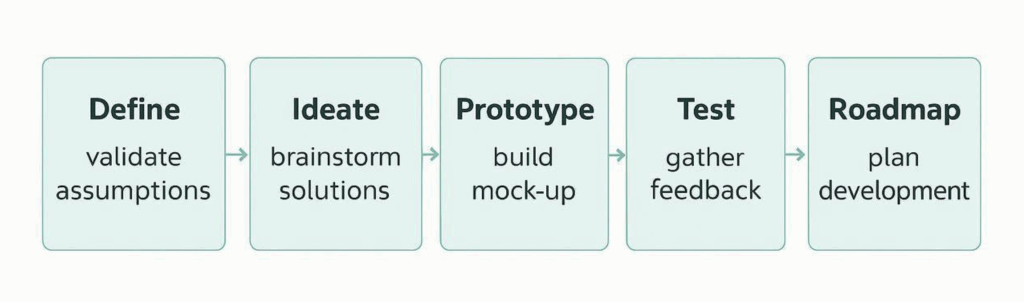
This cycle usually takes no more than two to four weeks. The goal is not completeness but insight. A PoC earns its value by delivering clarity fast, not by producing code ready for deployment.
Benefits of a PoC
A Proof of Concept creates value not by producing a finished product but by giving organizations the confidence to move forward. Its greatest strength lies in eliminating uncertainty. At the technical level, it shows whether an idea can actually be built, uncovering limitations and guiding engineers toward the most reliable approach. For the business side, it provides a reality check on market demand, ensuring that resources are invested only in solutions that solve tangible problems.
Beyond validation, a PoC helps teams see the boundaries of what is possible. It defines early what the product will and will not be able to do, which prevents inflated expectations later in the process. It also sharpens financial planning: by providing concrete data on complexity, required resources, and likely timelines, it helps companies allocate budgets responsibly. This clarity translates directly into credibility with investors and stakeholders. When a team demonstrates a functioning proof, even at a minimal scale, it proves that the idea is not just theoretical—it works. That evidence accelerates decision-making, secures funding, and lays the foundation for faster, more efficient development.
Mistakes That Undermine PoCs
Many teams fail by misusing the PoC stage. Some skip market research, proving technology without confirming that the solution has real-world demand. Others overengineer, turning what should be a quick experiment into a pseudo-product. Still others neglect to gather feedback, leaving assumptions untested. In each case, the opportunity to reduce risk is lost. The strength of a PoC lies in focus: it must remain simple, lean, and validated by external input.
Proofs That Made a Difference
Real-world cases show how PoCs shape outcomes. Walmart worked with IBM to test blockchain for food traceability and reduced tracking time to seconds. The German startup Naontek validated its healthcare learning platform through a PoC that helped them scale to over 20,000 users. A law firm reduced legal research time from eight hours to forty seconds by testing an AI assistant in a controlled proof. A Swiss bank built a secure networking app for an industry event in just 13 weeks, confirming the feasibility of encrypted messaging at scale. Each example demonstrates the same truth: with a PoC, teams can validate ambition without gambling resources.

Ready to turn your idea into a successful Proof of Concept?
Contact UsConclusion
A Proof of Concept is not a shortcut to a finished product—it is a decision-making tool. It provides clarity about technical feasibility, market relevance, and investment readiness. By delivering evidence early, PoCs save months of wasted work and thousands in unnecessary costs. They also create alignment between stakeholders and reduce uncertainty for investors.
Nowadays, where technologies evolve faster than ever and the cost of missteps is high, PoCs are no longer optional. They are a strategic requirement for startups chasing new markets and enterprises adopting disruptive tools. Companies that approach PoCs with discipline and the right expertise gain an edge in innovation: they move faster, spend smarter, and scale with confidence.
Why Ficus Technologies?
Building a Proof of Concept is not just about testing technology — it’s about doing it quickly, efficiently, and with the right expertise. At Ficus Technologies, we specialize in transforming early-stage ideas into validated proofs that serve as a solid foundation for product development.
Our approach combines technical excellence with business insight:
- Cross-functional expertise — from AI and blockchain to fintech, logistics, and healthcare, we bring specialists who understand both code and industry context.
- Lean, structured delivery — we design PoCs in 2–4 weeks, ensuring fast results without wasted effort.
- End-to-end partnership — from ideation and technical validation to integration and scaling, we guide you through every step.
- Stakeholder-ready outcomes — we deliver not just code, but clear documentation, metrics, and roadmaps you can present to investors, boards, or executive teams.
- Security-first mindset — every PoC is built with compliance, data protection, and scalability in mind, so it can evolve into a full product safely.
With over 12 years in custom software development and 70%+ senior engineers, we help companies reduce risk, validate bold ideas, and accelerate innovation. Partnering with us means turning uncertainty into opportunity — and moving from concept to market with confidence.
PoC tests technical feasibility; a prototype focuses on design and user flow; an MVP is a functional product with core features ready for user feedback.
This depends on your internal capabilities. Many companies partner with specialized development firms to create PoCs faster and reduce technical risk.
Typically, a PoC is completed in 2–4 weeks. The timeline may vary based on project complexity and goals.
Not always. A PoC is most valuable when there’s uncertainty around technology, architecture, or integration. For well-understood systems, it may be skipped in favor of direct prototyping.
A successful PoC should include a clear goal, minimal but functional code, key success metrics, documentation of outcomes, and stakeholder feedback.







 Success...!