
Software outsourcing has transformed into a strategic engine for growth and innovation. Businesses no longer view it as a way to cut costs, but as a method to gain specialized expertise, scale rapidly, and accelerate time-to-market. With global demand for digital products at an all-time high and competition intensifying, outsourcing is now about collaboration, agility, and measurable results. Forward-looking companies partner with outsourcing vendors not just to deliver code, but to co-create solutions, shape strategy, and build resilient digital ecosystems. This shift marks a new era where outsourcing is central to competitiveness, enabling organizations to innovate faster while maintaining quality and compliance.
- Global outsourcing is now value-driven, not just cost-driven.
- Nearshore and hybrid models are overtaking traditional offshore setups.
- Trust, transparency, and domain expertise are key outsourcing success factors in 2025.
Why Businesses Outsource in 2025: Beyond Cost Efficiency
While saving money remains relevant, businesses today outsource primarily to gain agility and accelerate innovation. Outsourcing provides access to talent pools skilled in areas such as AI, cloud engineering, blockchain, embedded systems, and cybersecurity—skills often scarce or expensive to maintain in-house.
Outsourcing also solves operational bottlenecks. By partnering with mature teams that already follow Agile and DevOps best practices, companies shorten delivery cycles and reduce risks of delays. Furthermore, distributed teams ensure round-the-clock development, as time zone diversity enables 24/7 progress.
Simply put: outsourcing in 2025 is about speed, specialization, and scalability—with cost efficiency being an additional benefit rather than the primary driver.
Top Outsourcing Trends to Watch in 2025
- Nearshoring and Hybrid Teams
Businesses increasingly prefer geographically close partners with cultural and time-zone alignment. For example, Western European companies choose Eastern Europe, while North American companies turn to Latin America. This ensures smoother communication and fewer delays. - AI-Enhanced Outsourcing
Artificial intelligence now plays an active role in outsourcing management. From automated sprint tracking and predictive project monitoring to code quality validation, AI tools provide transparency and reduce risks. - Outcome-Based Partnerships
Traditional hourly billing is fading. Companies want measurable value—KPIs tied to business results, not just development output. Vendors are now evaluated on product success, time-to-market, and user adoption.
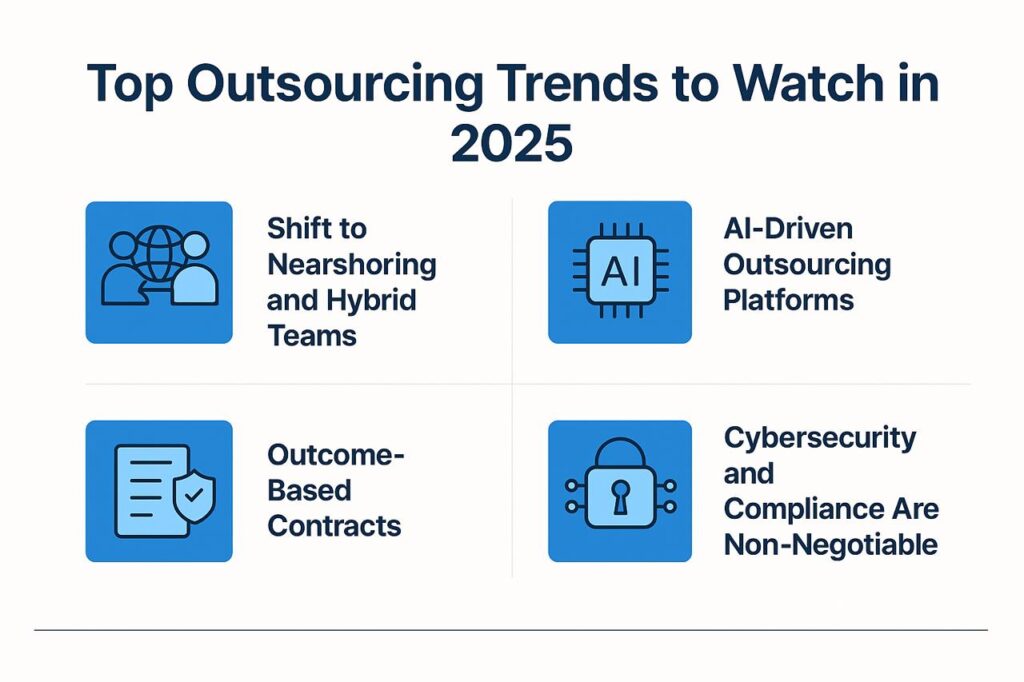
- Security and Compliance as Standard
Global regulations like GDPR, HIPAA, and SOC 2 have made cybersecurity non-negotiable. Outsourcing vendors must embed compliance into workflows from day one, ensuring resilience against data breaches and regulatory risks. - Domain-Specific Expertise
Outsourcing is increasingly specialized. Businesses favor partners with proven track records in FinTech, HealthTech, logistics, and SaaS, rather than generic “all-purpose” vendors. Deep sector knowledge reduces ramp-up time and improves product-market fit.
Common Outsourcing Models in 2025
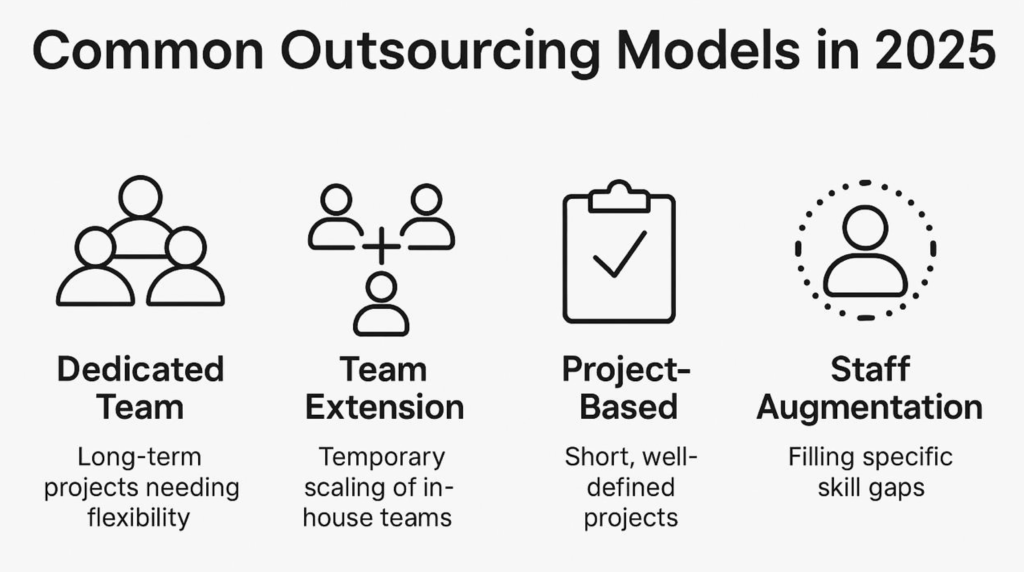
Different business needs require different engagement models. By 2025, outsourcing has matured into flexible frameworks that allow companies to decide how deeply an external team integrates into their workflows. Each model offers a balance between control, scalability, and ownership, and the right choice often depends on the stage of product development or organizational goals.
- Dedicated Team
A dedicated team operates as a long-term extension of your organization. It is ideal for projects that require ongoing development, product evolution, or constant innovation. Businesses gain not only technical expertise but also strategic input, as the team becomes embedded in the company’s culture and processes.
Example: A fintech company building a multi-year payments platform hires a dedicated team to manage continuous releases, integrations, and compliance updates.
- Team Extension
Team extension models allow companies to temporarily scale capacity by adding specialists to in-house teams. This ensures agility during peak demand or when specialized skills are required for a limited period.
Example: A SaaS provider integrating AI-powered analytics brings in data scientists for six months to support their in-house development team.
- Project-Based Outsourcing
Best for well-defined projects with fixed scope and deadlines, this model suits companies looking to deliver a one-off product, feature, or prototype. It offers predictability in budget and outcomes, but less flexibility if requirements change mid-project.
Example: A retail company outsources the development of a promotional mobile app to coincide with a seasonal campaign.
- Staff Augmentation
A cost-efficient way to fill immediate skill gaps without long-term commitments. Staff augmentation is especially useful for bringing in niche expertise—such as cybersecurity, DevOps, or blockchain—without undergoing lengthy recruitment cycles.
Example: A healthcare startup hires a DevOps engineer through staff augmentation to ensure HIPAA-compliant deployment pipelines.
By combining or shifting between these models, companies can tailor outsourcing to align with their strategic roadmap, financial planning, and operational flexibility.
Best Practices for Successful Outsourcing in 2025
While outsourcing brings flexibility and expertise, success depends on execution. In 2025, outsourcing is not about delegating tasks blindly—it’s about co-creation, transparency, and measurable value.
- Start with Discovery Workshops
Before writing a single line of code, discovery workshops align both client and vendor on goals, scope, and user needs. This early alignment prevents costly missteps and ensures every feature maps directly to business outcomes. - Prioritize Transparent Communication
Effective outsourcing relies on clarity. Weekly syncs, real-time dashboards, and co-managed tools (e.g., Jira, Slack, Notion) establish a shared single source of truth. Transparent reporting keeps both sides accountable and minimizes misunderstandings. - Embed Agility into Delivery
Short sprints, CI/CD pipelines, and iterative development ensure rapid adaptation to market changes. By breaking projects into increments, teams can deliver value faster while continuously refining based on feedback. - Bake in Security from Day One
In 2025, security-first development is standard. Compliance checks, penetration testing, data encryption, and access control should be part of the design phase—not an afterthought. Early adoption of secure coding practices reduces long-term risks significantly. - Measure Value, Not Hours
The era of tracking billable hours is fading. Instead, companies measure outsourcing ROI by outcomes: faster time-to-market, improved user adoption, reduced downtime, or higher revenue. Value-driven KPIs ensure both client and vendor focus on impact, not just activity.
By following these practices, businesses transform outsourcing into a strategic growth driver, not just a support function.
Want to build software that performs and scales?
Contact UsConclusion
Software outsourcing in 2025 is no longer a secondary tactic. It is a core strategy for innovation, resilience, and competitiveness. Organizations that treat outsourcing partners as collaborators—not just contractors—unlock far greater value: specialized expertise, cultural fit, and measurable business outcomes.
Emerging trends like AI-powered project oversight, hybrid outsourcing models, and domain-driven specialization are shaping the industry. At the same time, challenges like data security, compliance, and distributed-team coordination must be addressed with strong governance and proactive management.
Companies that embrace value-driven outsourcing will not only lower risks and costs but also build more innovative, adaptive, and future-ready products.
Why Ficus Technologies?
At Ficus Technologies, outsourcing is about building strategic partnerships.
- Agile squads and tech consultants embedded into your workflows.
- Expertise across SaaS, AI, IoT, FinTech, and Healthcare.
- Security-first engineering and QA automation.
- Transparent delivery with flexible contracts and clear KPIs.
We don’t just deliver software—we co-create scalable solutions that accelerate growth and align with your business vision.
Eastern Europe, Latin America, and Southeast Asia are leading thanks to strong talent pools and better infrastructure.
Use code reviews, CI pipelines, and maintain shared ownership of codebases. Work with partners who prioritize testing and documentation.
Yes—but the ROI now comes from faster releases, innovation, and fewer delays—not just cheaper labor.





 Success...!