
The rise of AI agents is not happening in isolation. It sits at the intersection of several major technological currents. Real-time analytics allow companies to see what’s happening in their operations the moment it occurs, not weeks later. Machine learning personalizes customer experiences to a level previously impossible, while sustainable technologies are reshaping not only cost structures but also brand reputations. In this environment, agencies like Ficus Technologies step in not just as consultants but as partners — integrating AI into the bloodstream of everyday business.
Teams looking to automate routine tasks or improve decision-making.
Anyone curious how ChatGPT agents can boost productivity, innovation, and customer experience.
- ChatGPT agents are revolutionizing how businesses communicate, analyze data, and automate workflows.
- 2025 is the year to combine AI agents with real-time analytics, automation, and sustainable technology for measurable impact.
- Ficus Technologies helps businesses implement these solutions in a practical, scalable way.
What is a ChatGPT Agent and How to Use It
A ChatGPT agent is an AI-powered assistant capable of understanding context, generating human-like responses, and interacting with multiple systems simultaneously. It acts as a virtual team member, able to:
- Automate customer support: Answer questions instantly, triage issues, and provide 24/7 assistance.
- Generate content: Draft reports, emails, marketing copy, or meeting summaries quickly and accurately.
- Analyze data: Summarize datasets, extract trends, and provide actionable recommendations.
- Automate tasks: Schedule meetings, follow up on tasks, or integrate with business tools to streamline workflows.
How to get started with a ChatGPT agent:
- Define the purpose: Identify repetitive tasks, content needs, or workflows where AI can save time.
- Provide access to relevant data: Agents perform best when they can reference accurate information.
- Start small: Begin with a single team or workflow to measure impact before scaling.
- Iterate and improve: Fine-tune prompts, integrate feedback, and expand capabilities gradually.
ChatGPT Agents as Virtual Teammates
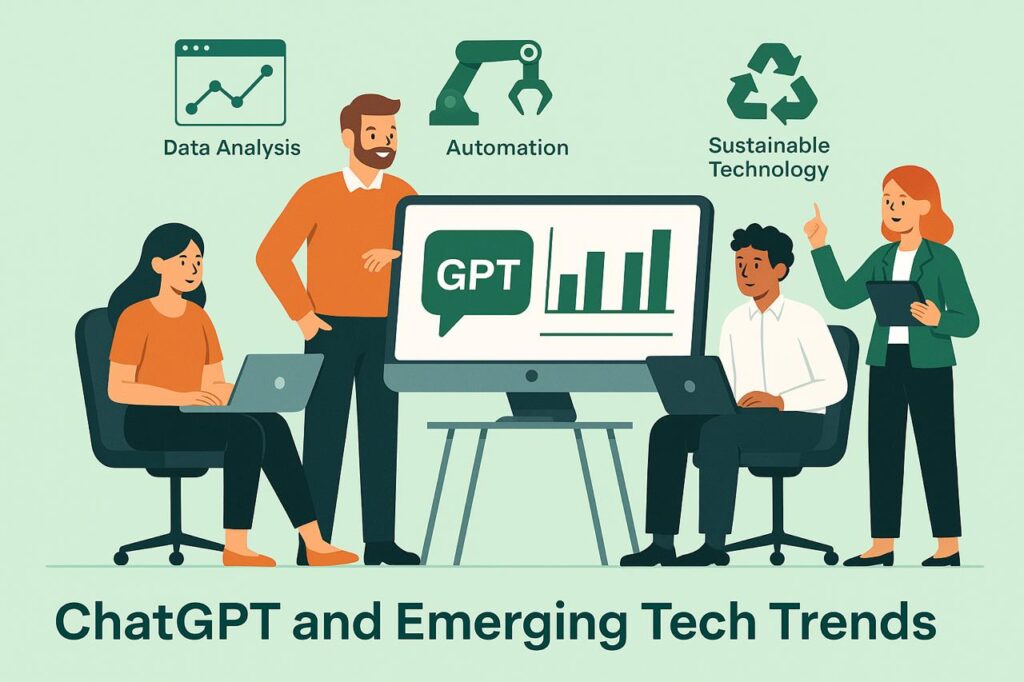
Imagine an assistant that doesn’t get tired, doesn’t make careless mistakes, and can learn faster than any human. That is what a ChatGPT agent offers. Instead of spending hours drafting emails, answering repetitive customer queries, or combing through endless spreadsheets, companies can let an AI agent take over. Customer support is transformed with 24/7 responsiveness. Data analysis, once requiring teams of specialists, is now delivered instantly, with patterns and risks highlighted before managers even ask. The outcome isn’t about replacing staff, but about releasing people from low-value work and letting them focus on vision and decision-making.
The best part is that adoption doesn’t need to be overwhelming. Businesses can begin with a single process — say, automating first-line customer responses — and scale gradually. Each iteration compounds the benefits: costs fall, errors decrease, and employees redirect energy to projects that drive innovation.
The Bigger Picture: Tech Trends Redefining 2025
To understand why AI agents matter, you have to see the larger shifts in technology. Companies today operate in real-time. Dashboards powered by analytics mean managers no longer wait for monthly reports — they respond to today’s numbers today. At the same time, cybersecurity has become existential: one misstep can destroy years of brand equity. Here too, AI plays a silent but vital role, detecting anomalies before they escalate. And then there is sustainability, once seen as a PR checkbox, now firmly established as an economic advantage. Intelligent systems cut energy consumption, optimize logistics, and lower waste, making companies leaner, greener, and more profitable.
What connects these trends is urgency. Businesses can’t afford to move slowly, and they can’t afford to treat AI as a side project. Companies that wait risk not just losing ground but becoming irrelevant.

Eager to unlock the power of ChatGPT for your operations?
Contact UsHow Ficus Technologies Turns Theory into Reality
Plenty of firms talk about AI. Ficus Technologies is different because it embeds these systems directly into operations. That means real-world results, not endless pilot programs. In one manufacturing project in Germany, AI agents integrated with IoT sensors predicted machine failures before they happened, saving half a million dollars in downtime. In retail, a Spanish chain saw a 15% revenue boost in just one quarter thanks to AI-driven inventory optimization. And in Canada, a fintech company overwhelmed by growth used ChatGPT agents to handle customer queries, cutting response times by 20% and raising satisfaction.
These examples highlight something crucial: AI isn’t futuristic — it’s practical. It’s about making business run better right now.
Business Impact of AI in 2025: Numbers that Matter
AI is not just a trend — it’s already driving measurable business outcomes.
According to global research in 2025:
- 65% of companies report that AI agents cut routine workload by at least 30%.
- 40% of customer interactions are now managed fully or partially by AI assistants.
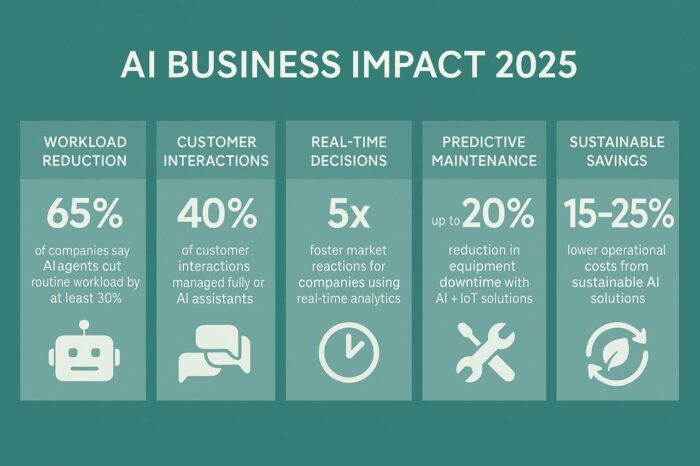
Companies using real-time analytics react to market changes 5x faster than competitors.
Predictive maintenance powered by AI + IoT saves industries billions, with up to 20% reduction in equipment downtime.
Sustainable AI solutions cut operational costs by 15–25%, proving that efficiency and eco-responsibility can align.
These numbers highlight a simple truth: AI agents are no longer experiments — they are measurable growth engines.
The Human Side of AI
One of the fears surrounding AI is that it will replace people. The reality is different. Properly implemented, ChatGPT agents become amplifiers of human potential. They don’t replace strategy meetings, creative brainstorming, or visionary leadership. What they do is free up hours, reduce stress, and ensure that when people gather to make decisions, they are informed by real-time insights rather than guesswork. This partnership between human judgment and machine intelligence is what makes the technology transformative.
Conclusion
Business in 2025 is defined by speed, adaptability, and resilience. ChatGPT agents, combined with real-time analytics, predictive systems, and sustainable technologies, give companies the ability to move faster and smarter than ever before. They allow leaders to anticipate challenges instead of reacting to them, to scale without chaos, and to serve customers with precision and care.
And this is where Ficus Technologies comes in — turning abstract ideas into working systems that deliver measurable impact. For companies seeking not just to survive but to lead, working with the right AI partner is no longer optional. It is a strategic necessity.
Why Ficus Technologies?
What separates Ficus Technologies is not only the technology but the way it is delivered. Implementation is hands-on: agents are built into workflows, not layered on top like a temporary patch. Each solution is customized to the industry, whether fintech, logistics, retail, or manufacturing. And everything is designed with longevity in mind — systems that grow and adapt as technology evolves, avoiding costly rebuilds in a few years’ time. In other words, Ficus Technologies builds AI into the foundations of a business, not its facade.
Absolutely. Ficus Technologies scales solutions to the size of your company, from SMEs to large enterprises.
Depending on workflow complexity, measurable improvements often appear within 3–6 months.
Yes. Optimizing energy and resource use is built into every implementation.




 Success...!