
In 2025, blockchain is no longer seen as just the technology behind Bitcoin and other cryptocurrencies. It has evolved into a foundational layer for trust, transparency, and automation across industries. From supply chain tracking to digital identity management, blockchain has proven its ability to secure data, reduce fraud, and improve efficiency in ways traditional systems cannot match. Businesses are now leveraging blockchain not for speculation, but for solving real-world challenges.
Business leaders & executives exploring blockchain beyond digital assets.
Product managers & innovation leads evaluating blockchain-powered solutions in logistics, healthcare, or real estate.
Investors & consultants seeking insights into real-world blockchain adoption trends.
Developers & tech strategists who want to understand where blockchain is headed in 2025 and how to align with industry demand.
- Blockchain has moved far beyond cryptocurrencies, becoming a foundation for trust, transparency, and automation across industries.
- Supply chain, healthcare, finance, real estate, and smart cities are leading sectors adopting blockchain in 2025.
- Benefits include faster transactions, reduced fraud, improved traceability, and better compliance.
Blockchain Beyond Crypto: Real Use Cases in 2025
Blockchain has matured from powering cryptocurrencies into a multi-industry enabler that drives transparency, trust, and efficiency across critical sectors. In 2025, its role is no longer experimental—it is foundational.
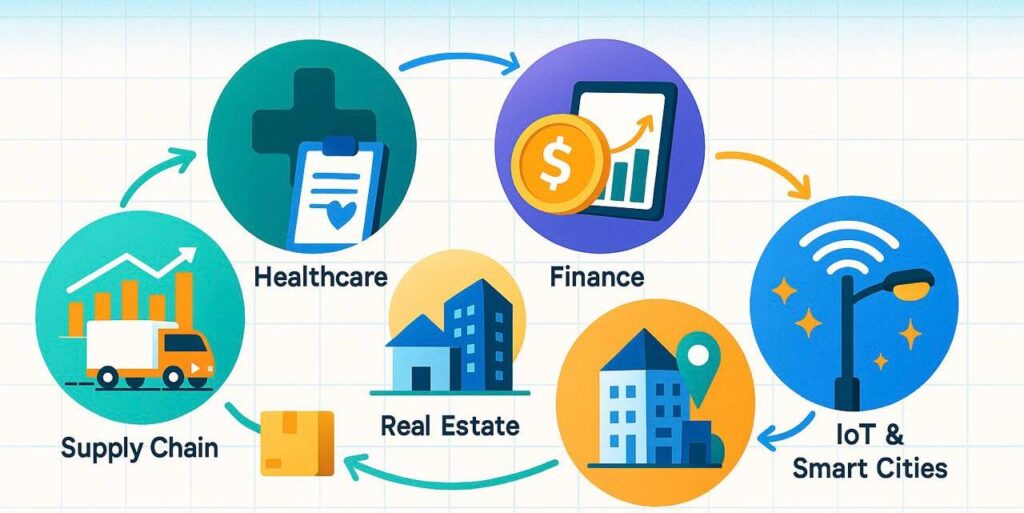
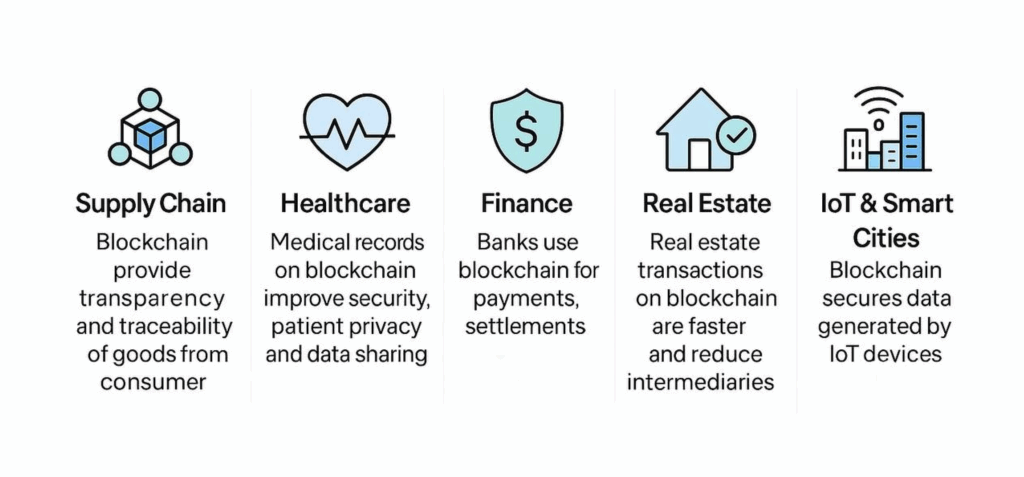
Across supply chains, blockchain ensures product authenticity and compliance. In healthcare, it secures sensitive medical records and improves patient outcomes. Finance leverages it for instant settlements, fraud prevention, and digital identity. Real estate gains liquidity through tokenization and automated contracts, while IoT and smart cities rely on blockchain as the trust layer for billions of connected devices.
What ties these use cases together is blockchain’s core strength: immutable, decentralized, and transparent data exchange. By eliminating intermediaries, reducing fraud, and automating processes through smart contracts, blockchain has become a strategic tool that reshapes how businesses and governments operate.
In other words, blockchain in 2025 is not just about technology—it’s about building trust in the digital economy, powering innovation across industries, and setting the foundation for a more secure, efficient, and inclusive future.
Supply Chain
Supply chains are among the biggest beneficiaries of blockchain adoption in 2025. Global trade still suffers from inefficiencies like manual paperwork, fragmented tracking systems, and lack of trust between partners. Blockchain solves these problems by creating immutable, transparent records of every step in the process—from raw material sourcing to last-mile delivery. For example, companies now use blockchain to verify the authenticity of luxury goods, trace food origins in seconds, and monitor the movement of pharmaceuticals to prevent counterfeiting. Smart contracts automatically trigger payments once conditions are met, reducing delays and disputes. By 2025, blockchain is not just a nice-to-have for supply chain—it has become a standard for traceability, compliance, and sustainability reporting.
Healthcare
Healthcare systems handle enormous volumes of sensitive patient data, which must remain secure and interoperable across multiple providers. Blockchain introduces tamper-proof medical records that patients can control and share securely across hospitals, insurers, and specialists.
In 2025, hospitals increasingly use blockchain to track clinical trials, ensure the authenticity of drugs, and reduce insurance fraud. Patients benefit from faster onboarding when moving between providers, while insurers gain confidence in data integrity. For life sciences companies, blockchain-powered research registries speed up collaboration while ensuring compliance with HIPAA and GDPR.
The result: greater trust, lower administrative overhead, and better patient outcomes.
Finance
Finance remains the most mature blockchain sector, but in 2025 it goes far beyond cryptocurrency. Banks use blockchain for instant cross-border transactions, cutting settlement times from days to minutes. Trade finance platforms rely on smart contracts to eliminate paper-heavy processes and fraud-prone intermediaries.
Auditing and compliance have also become faster and cheaper. Regulators can review immutable transaction logs in real time, reducing human error and ensuring accountability. Meanwhile, blockchain-based digital identity systems make KYC and AML processes more efficient by allowing customers to verify their identity once and reuse it across multiple institutions.
In short, blockchain is evolving into the invisible backbone of global finance, driving transparency, speed, and trust.
Real Estate
The real estate industry, notorious for paperwork and inefficiency, is undergoing transformation. Blockchain enables tokenized property ownership, allowing investors to purchase fractions of high-value real estate and trade them like stocks. This opens new opportunities for small investors while increasing liquidity in an otherwise rigid market.
Property transfers that used to take weeks now happen within hours, with blockchain-based registries ensuring authenticity of titles and eliminating fraud. Rental agreements and mortgages are increasingly managed through smart contracts that automate payments, enforce compliance, and reduce disputes between landlords and tenants.
By 2025, blockchain is breaking down barriers to entry in real estate, making the sector more accessible, transparent, and global.
IoT & Smart Cities
As cities embrace digital transformation, blockchain provides the trust layer for millions of IoT devices that constantly exchange data. From traffic lights and energy grids to autonomous vehicles and environmental sensors, blockchain ensures secure communication, prevents tampering, and guarantees data integrity.
For instance, smart meters now log energy consumption directly on blockchain, allowing citizens to trade surplus electricity with neighbors in peer-to-peer energy markets. Municipalities use blockchain to verify sensor data for air quality monitoring, ensuring accuracy for both residents and regulators. Autonomous fleets in logistics and public transportation depend on blockchain for secure, real-time coordination.
This combination of IoT and blockchain forms the foundation of smart, sustainable cities, where data is reliable, transparent, and actionable.
Want to know how to use blockchain beyond crypto to unlock real-world innovation and resilience in 2025?
Contact UsConclusion
In 2025, blockchain has firmly stepped beyond cryptocurrency into mainstream adoption. It is shaping industries by enabling transparency, automation, and security where traditional systems fall short. From healthcare to real estate, blockchain is driving innovation and solving long-standing challenges.
The future of blockchain is not about speculation—it’s about practical impact. Companies that embrace blockchain today are not just experimenting; they are building trust-driven ecosystems that define the digital economy of tomorrow. With the right partner, blockchain becomes more than technology — it becomes a competitive advantage.
Why Ficus Technologies?
Adopting blockchain requires more than just technical knowledge — it demands strategic thinking, secure implementation, and industry-specific expertise. At Ficus Technologies, we help businesses move beyond experimentation and implement blockchain where it truly adds value.
Our strengths include:
- Custom blockchain development — from smart contracts to decentralized applications tailored to your needs.
- Cross-industry expertise — proven experience in FinTech, HealthTech, Logistics, Real Estate, and Entertainment.
- Security-first approach — compliance with GDPR, HIPAA, and ISO standards to ensure safe and trustworthy solutions.
- Scalable architectures — cloud-native blockchain platforms designed for growth and high-volume transactions.
- Agile delivery — rapid prototyping, Proof of Concept (PoC) design, and fast deployment to reduce time-to-market.
We don’t just integrate blockchain — we turn it into a business enabler that drives measurable outcomes, from transparency and compliance to cost reduction and customer trust.
No. While crypto remains important, blockchain’s biggest growth areas are in supply chains, healthcare data, smart contracts, and enterprise applications.
It provides real-time tracking, immutable records, and smart contracts that reduce delays, fraud, and paperwork.
Yes. Blockchain enables encrypted patient records, consent management, and secure data exchange, reducing risks of breaches.
Blockchain supports trade finance, digital identity, fraud prevention, and compliance auditing, cutting settlement times from days to minutes.
Yes. By digitizing titles, automating transactions, and reducing fraud, blockchain is transforming how properties are bought and sold.





 Success...!