
The combination of analytics and artificial intelligence is transforming how organizations operate, make decisions, and create value. While analytics provides visibility into data, AI enables automation, prediction, and optimization at scale.
Individually, these technologies are powerful. Together, they create a foundation for data-driven organizations capable of responding to change in real time.
In 2026, companies are no longer asking whether to adopt analytics or AI. The focus has shifted toward how to integrate them effectively to improve decision-making, operational efficiency, and business outcomes.
Organizations that successfully combine analytics and AI gain a competitive advantage through faster insights, smarter automation, and better customer experiences.
Data and analytics teams implementing AI solutions.
Product managers working with data-driven products.
Organizations investing in AI and business intelligence.
- Analytics and AI together enable faster and more accurate decision-making.
- Organizations can automate complex processes while gaining deeper insights into business performance.
- The real value comes from integrating data, analytics, and AI into a unified ecosystem.
Why Analytics Alone Is Not Enough
Traditional analytics focuses on understanding past performance. Dashboards, reports, and visualizations help organizations identify trends and measure results.
However, analytics alone is often reactive. It answers questions about what has already happened but does not always provide guidance on what to do next.
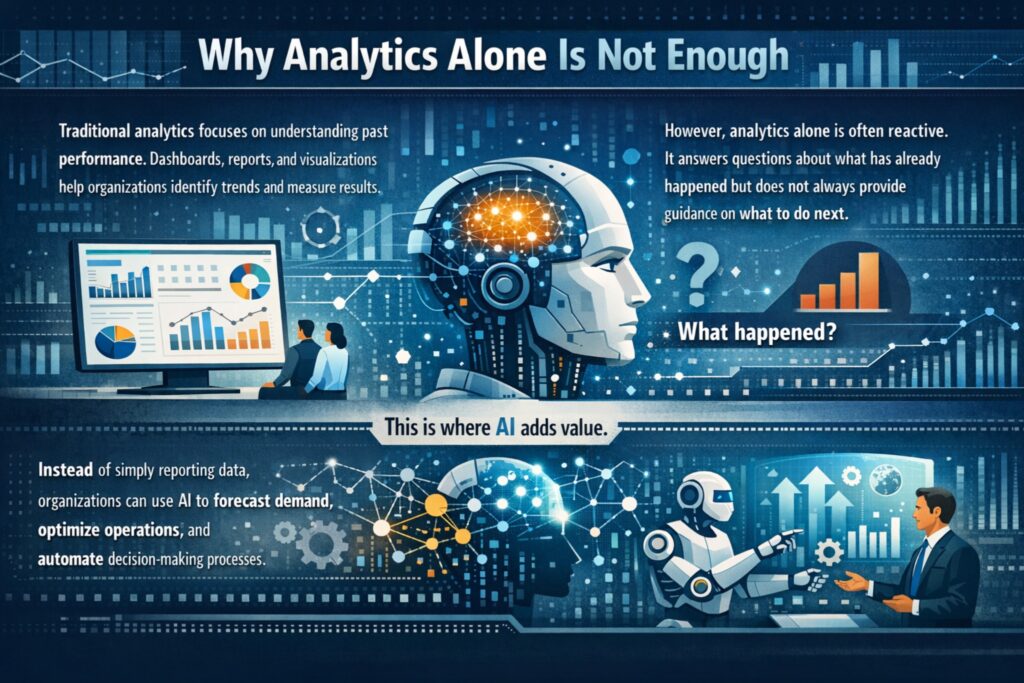
This is where AI adds value. AI systems can analyze large datasets, detect patterns, and generate predictions. Instead of simply reporting data, organizations can use AI to forecast demand, optimize operations, and automate decision-making processes.
The combination of analytics and AI transforms data from a reporting tool into a strategic asset.
How AI Enhances Business Analytics
AI extends the capabilities of analytics by enabling predictive and prescriptive insights.
Predictive models allow organizations to anticipate future outcomes based on historical data. For example, companies can forecast customer behavior, detect anomalies, or predict system failures.
Prescriptive analytics goes further by recommending actions. AI systems can suggest optimal pricing strategies, marketing decisions, or operational adjustments.
Automation is another key benefit. AI can process large volumes of data in real time, reducing the need for manual analysis and accelerating decision-making.
As a result, organizations move from static reporting to dynamic, intelligent systems.
Key Statistics: Analytics + AI Business Impact
The integration of analytics and AI is rapidly becoming a core driver of business performance.
Recent industry research shows that over 75% of organizations now invest in AI-driven analytics platforms, reflecting the growing demand for advanced data capabilities.
Companies that combine analytics with AI report significant performance improvements. Studies indicate that data-driven organizations are up to 5 times more likely to make faster decisions than their competitors.
Automation is also a major factor. Analysts estimate that AI-powered analytics can reduce manual data processing by up to 40%, allowing teams to focus on strategic tasks rather than routine analysis.
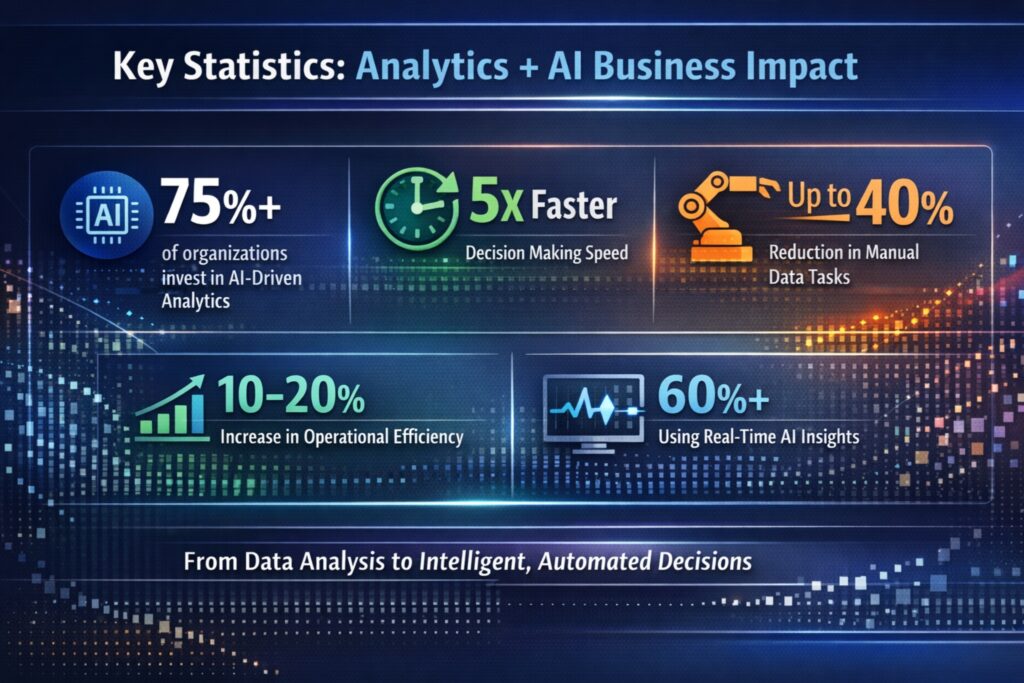
In terms of revenue impact, organizations using AI and analytics together report 10–20% improvements in operational efficiency and measurable increases in customer engagement.
Another key trend is real-time decision-making. More than 60% of enterprises now prioritize real-time analytics combined with AI models to support dynamic business environments.
These numbers highlight a clear shift: organizations are moving from data analysis to intelligent, automated decision systems.
From Data to Intelligent Decision-Making
The real value of combining analytics and AI lies in decision-making. Instead of relying on static reports, organizations can build systems that continuously analyze data and generate insights.
For example, in marketing, AI-driven analytics can automatically adjust campaigns based on performance data. In operations, systems can optimize supply chains in real time. In finance, AI can detect anomalies and reduce risk.
This shift enables organizations to act faster and more accurately. Decision-making becomes continuous rather than periodic.
Challenges in Implementation
Despite the benefits, integrating analytics and AI presents challenges.
Data quality is one of the most important factors. AI models require clean, structured, and reliable data to produce accurate results.
Integration complexity is another challenge. Organizations often use multiple data sources and platforms, making it difficult to create a unified system.
There is also a skills gap. Teams need expertise in data engineering, analytics, and AI to build and maintain these systems.
Finally, governance and transparency are critical. Organizations must ensure that AI-driven decisions are explainable, secure, and aligned with business objectives.
Transform your data into intelligent, real-world systems.
Contact usConclusion
The combination of analytics and AI is redefining how organizations use data.
Analytics provides visibility, while AI enables prediction, automation, and optimization. Together, they create intelligent systems that support faster, more effective decision-making.
Organizations that successfully integrate these technologies can improve efficiency, enhance customer experiences, and gain a competitive advantage.
In a data-driven world, the future belongs to companies that move beyond analysis and toward intelligent action.
Why Ficus Technologies?
Ficus Technologies helps organizations design and implement data platforms that combine analytics and AI into unified, scalable systems.
Our teams support companies in building modern data architectures, integrating AI capabilities, and enabling real-time decision-making.
By combining expertise in data engineering, cloud infrastructure, and AI development, we help organizations turn data into measurable business value.
Analytics focuses on understanding data, while AI enables prediction, automation, and intelligent decision-making.
Combining both allows organizations to move from reporting to predictive and automated decision systems.
Faster decisions, improved efficiency, automation, and better customer insights.
Data quality, integration complexity, skills gaps, and governance requirements.




 Success...!