
By 2026, digital transformation is no longer a strategic ambition — it’s an operational baseline. Most companies already rely on cloud infrastructure, digital products, and data-driven workflows. Yet results remain uneven. Some organizations move with confidence, ship consistently, and adapt to change without disruption. Others struggle with slow delivery, fragmented systems, and rising operational costs — despite using the same modern tools.
The gap is no longer defined by access to technology. It’s defined by execution quality. In 2026, digital transformation works only when it is treated as a system — not as a collection of tools, initiatives, or isolated upgrades. Companies that fail rarely lack platforms or expertise; they lack coherence. Systems don’t evolve together, teams don’t own outcomes end-to-end, and change becomes expensive instead of routine.
For founders and CTOs who want to understand why some transformation efforts scale over time, while others quietly stall after an initial phase of success.
- Digital transformation succeeds when it is driven by business outcomes, not by technology adoption alone.
- What works in 2026 is clarity of ownership, modular systems, and continuous delivery practices.
- What fails is large, one-time transformation programs and tool-first thinking without organizational change.
What Digital Transformation Really Means in 2026
In 2026, digital transformation is no longer about “going digital.” That transition already happened. The real challenge is making digital systems work together without friction — across teams, products, and platforms. This includes not only technology, but also decision-making, ownership, and the cost of change itself.
Modern transformation focuses on adaptability. Teams must be able to ship independently without breaking shared systems. Architecture must evolve without requiring organization-wide coordination. Decisions must be made close to the product, informed by real data rather than assumptions. When every change requires alignment meetings, approvals, or manual coordination, transformation quietly stalls — even if the stack looks modern on paper.
Companies that succeed treat transformation as an ongoing capability — something continuously refined — not as a milestone to be completed. They optimize for steady progress rather than dramatic launches, knowing that sustainable speed is built through consistency, not acceleration bursts.

What Works in 2026
Successful organizations share a consistent set of patterns — regardless of industry. They establish clear ownership, where product teams are responsible for outcomes, not just delivery tasks. Platform teams enable scale without becoming bottlenecks. Responsibility is explicit, and accountability is visible in both metrics and decision-making.
They design modular, composable systems. Products are built from well-defined components and services that can evolve independently. This reduces coordination overhead and allows teams to move faster without sacrificing stability. Modularity is not only a technical choice — it is what allows organizations to decentralize decisions without increasing risk.
They treat data as infrastructure. Reliable pipelines, shared metrics, and trusted analytics are part of the foundation, not optional add-ons. AI, automation, and personalization only deliver value when data quality and governance are already in place. Without this foundation, advanced tooling amplifies noise instead of insight.
They embed security by default. Security is integrated into development and delivery pipelines, not added later as a control layer. This reduces risk without slowing teams down and prevents security reviews from becoming a last-minute blocker.
Most importantly, they measure progress continuously. Delivery speed, reliability, cost efficiency, and user impact are tracked and reviewed, allowing teams to adapt before problems scale. Transformation works when feedback is fast and consequences are visible.
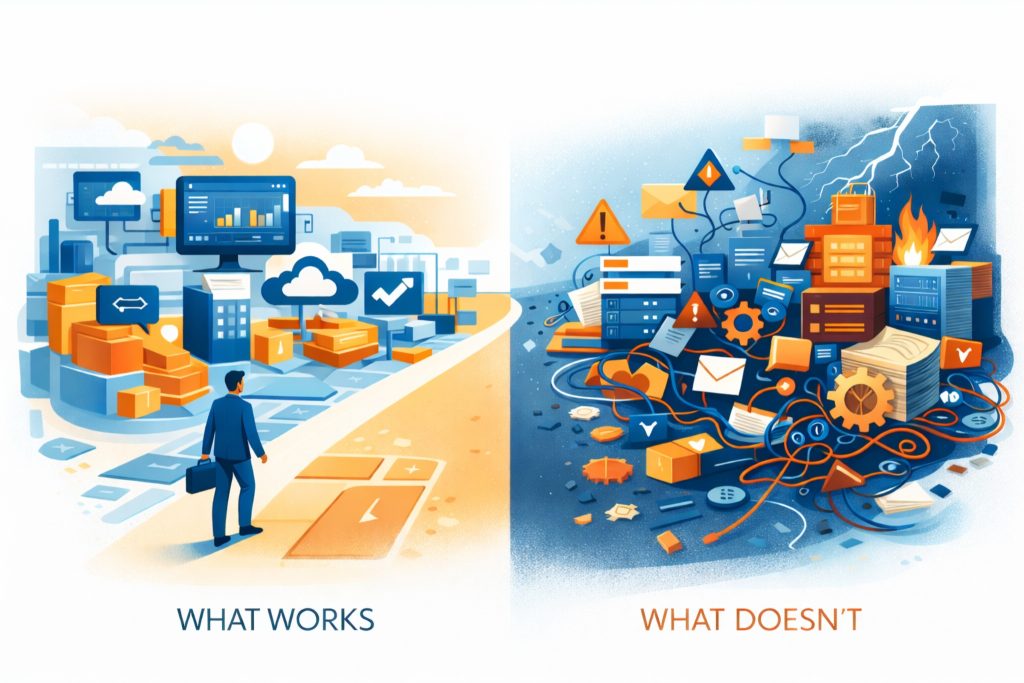
What Doesn’t Work Anymore
Large, multi-year transformation programs consistently fail in 2026. They generate early momentum but collapse under changing priorities and market conditions. By the time they deliver results, those results are often already outdated, forcing organizations to restart the cycle under a new name.
Tool-driven change without process change also fails. New platforms layered on top of old workflows inherit the same inefficiencies — only at a higher cost. Teams spend more time learning tools than improving outcomes, and frustration grows quietly.
Excessive centralization slows everything down. When every decision requires approval, teams lose autonomy and transformation becomes performative rather than real. Speed is replaced by compliance, and innovation becomes risk management.
Ignoring organizational debt is equally damaging. Unclear responsibilities, misaligned incentives, and siloed teams quietly undermine even the most advanced technology stack. Unlike technical debt, organizational debt compounds invisibly — until delivery grinds to a halt.
The Role of AI and Automation in 2026
By 2026, AI is no longer experimental — but it is also no longer treated as a breakthrough on its own. Most organizations already use some form of automation or machine learning in production environments. The difference lies in how these capabilities are applied. What delivers value is not general-purpose AI, but focused, applied automation that supports existing processes rather than attempting to replace them wholesale.
In practice, AI creates the most impact when it removes friction from routine operations. Automating repetitive tasks, supporting operational decision-making, detecting anomalies, and optimizing known workflows produce incremental improvements that compound over time. These gains rarely look dramatic in isolation, but together they increase efficiency, reduce error rates, and free teams to focus on higher-value work. AI succeeds when it is embedded quietly into daily operations rather than positioned as a visible transformation initiative.
What consistently fails is the expectation that AI can compensate for structural weaknesses. Automation does not fix unclear ownership, fragmented data, or poorly designed workflows. Instead, it amplifies them. When data quality is inconsistent, AI systems generate unreliable signals. When decision-making processes are unclear, automation creates false confidence rather than clarity. In such environments, AI increases noise, accelerates bad decisions, and makes underlying problems harder to diagnose.
By 2026, organizations have learned that AI is highly sensitive to context. It rewards discipline. Clean data pipelines, well-defined processes, and clear accountability allow AI systems to operate predictably and safely. Without these foundations, even advanced models struggle to deliver value. As a result, AI becomes a multiplier of organizational maturity rather than a shortcut around it.
Conclusion
Digital transformation in 2026 is not about adopting modern tools — it’s about building systems that support continuous change. What works is clarity, modularity, ownership, and measurable progress. What doesn’t work is treating transformation as a one-time initiative or a technology upgrade.
The companies that succeed are not those that transform aggressively — but those that transform continuously, without exhausting their teams or destabilizing their systems. In a world where change is constant, the real advantage is not speed once, but resilience over time.
Why Ficus Technologies?
At Ficus Technologies, we approach digital transformation as a long-term system — not a short-term initiative. We help companies design architectures, processes, and delivery models that scale predictably and adapt to change. Our focus is on execution, clarity, and foundations that last.
In 2026, digital transformation means building systems that can adapt continuously. It’s no longer about adopting cloud tools or launching digital products.
Most initiatives fail because they focus on tools instead of execution. New platforms are introduced without changing ownership models, decision-making processes, or delivery practices.
No. In 2026, treating transformation as a one-time initiative is one of the most common failure patterns. Successful companies view it as an ongoing capability that evolves alongside the business.
Organization. Modern technology is widely available, but without clear ownership, aligned incentives, and modular ways of working, even the best tools create limited value.





 Success...!