

Multi-cloud is no longer a trend. By 2026, it has become a strategic decision that affects architecture, cost structure, resilience, and vendor relationships. Most large organizations already operate across more than one cloud provider — intentionally or not. The real question is no longer whether to adopt multi-cloud, but how to structure it deliberately rather than inherit it accidentally.
A multi-cloud strategy can increase resilience and negotiation leverage. It can also multiply complexity and cost if implemented without architectural clarity. Choosing the right model requires understanding not only technology trade-offs, but operating realities.
It is particularly relevant for organizations that are expanding globally, operating in regulated industries, or seeking to reduce vendor concentration risk without compromising delivery speed.
- Multi-cloud is a structural decision, not a tooling choice.
- What works in 2026 is intentional architecture, clear workload placement logic, and operational discipline.
- What fails is reactive multi-cloud adoption driven by isolated teams or vendor pressure.
What Is a Multi-Cloud Model?
A multi-cloud model refers to the intentional use of two or more cloud providers within a single organizational architecture. It does not simply mean having accounts in multiple clouds. It describes how workloads, data, identity, networking, and governance are structured across providers.

In practice, multi-cloud can take different forms. Some organizations distribute workloads based on functionality — for example, running customer-facing applications in one cloud and analytics in another. Others replicate critical services across providers to reduce dependency on a single vendor. More mature organizations implement platform layers that abstract provider differences and enforce consistent policies across environments.
Why Multi-Cloud Becomes Inevitable
In many organizations, multi-cloud emerges organically. Different business units adopt different providers. Acquisitions introduce new environments. Regulatory requirements require regional hosting diversity. Over time, the environment becomes multi-cloud by default.
Industry surveys indicate that more than 75% of enterprise organizations now operate workloads across two or more cloud providers. However, a significant portion of these environments were not designed as coherent multi-cloud architectures. They are the result of accumulated decisions rather than strategy.
Without clear design principles, multi-cloud increases operational burden. Identity models diverge. Networking becomes fragmented. Observability tools multiply. Cost tracking becomes inconsistent. The benefits of diversification are offset by coordination overhead.
The Three Multi-Cloud Models
Not all multi-cloud strategies are the same. In practice, organizations tend to adopt one of three structural models.
1. Segmented Multi-Cloud
Different clouds are used for different purposes. One provider may host core applications, another supports analytics, and a third is used for regional compliance.
This model reduces overlap and limits cross-cloud dependency. It simplifies accountability but can create silos if integration patterns are weak.
2. Redundant Multi-Cloud
Critical workloads are deployed across multiple providers to increase resilience and reduce vendor lock-in risk.
While attractive in theory, this model significantly increases architectural complexity. True cross-cloud redundancy requires consistent deployment pipelines, identity models, and data replication strategies. Without disciplined engineering, costs can rise by 20–40% due to duplication and synchronization overhead.
3. Platform-Abstraction Multi-Cloud
Organizations build internal platforms or use orchestration layers (e.g., Kubernetes-based platforms) to abstract provider differences.
This approach reduces vendor dependency but shifts complexity inward. It requires mature platform engineering capabilities and strong governance to avoid becoming another layer of fragmentation.
Choosing the right model depends less on ambition and more on operational maturity.
How to Choose the Right Multi-Cloud Model
Choosing a multi-cloud strategy is less about technology preference and more about operational reality. The right model depends on business objectives, regulatory exposure, workload characteristics, and platform maturity.
The first step is clarity of intent. Is multi-cloud driven by regulatory requirements, availability targets, geographic expansion, or vendor negotiation leverage? Each driver leads to a different architectural pattern. Without a defined objective, multi-cloud becomes an accumulation of environments rather than a strategy.
Second, organizations must assess operational readiness. Running workloads across providers requires consistent identity management, unified observability, and disciplined infrastructure automation. Without these foundations, complexity grows faster than resilience. Multi-cloud increases coordination overhead unless governance and platform standards are already mature.
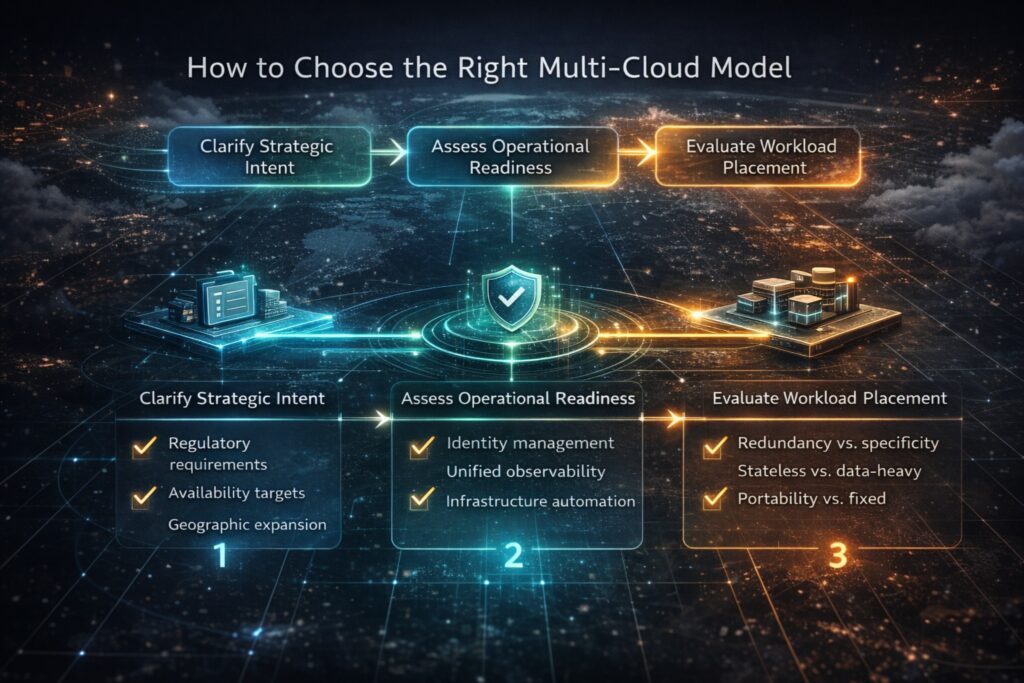
Third, workload placement must be intentional.
Not every system benefits from redundancy or portability. Stateless services and customer-facing APIs may justify cross-cloud resilience. Data-heavy systems with tight latency requirements often do not. Strategic clarity means deciding what must be portable, what must be redundant, and what can remain provider-specific.
Finally, cost transparency must be built into the model. Multi-cloud does not reduce lock-in if switching costs are opaque or operational duplication is hidden. Visibility into cross-cloud networking, data transfer, security tooling, and support overhead determines whether diversification strengthens or weakens financial control.
In practice, the right multi-cloud model is rarely the most complex one. It is the one aligned with measurable business outcomes and supported by operational discipline.
Cost and Control: The Hidden Variables
Multi-cloud is often justified as a hedge against vendor lock-in. However, diversification does not automatically translate into cost leverage.
Cloud waste already represents a significant percentage of enterprise cloud spend. Adding providers multiplies the risk of underutilized resources, inconsistent tagging, and duplicated environments. Cross-cloud data transfer fees, separate compliance tooling, and multi-provider support contracts introduce additional overhead that is rarely visible in initial business cases.
More importantly, operational control becomes harder to maintain. Incident response requires cross-provider visibility. Identity governance must remain consistent across boundaries. Without unified monitoring and logging, root-cause analysis slows significantly.
The real question is not whether multi-cloud reduces dependency. It is whether the organization can maintain coherent governance across environments.
Looking for a team to design or optimize your multi-cloud architecture?
Contact us!Conclusion
Multi-cloud is not inherently good or bad. It is a structural decision that reshapes architecture, governance, and cost models.
Organizations that approach multi-cloud deliberately — with clear workload placement logic, unified governance, and disciplined platform engineering — gain resilience and flexibility.
Those that drift into multi-cloud without design accumulate complexity that erodes both speed and control.
The right model is not the most ambitious one. It is the one aligned with business objectives, regulatory realities, and operational maturity.
Why Ficus Technologies?
Ficus Technologies operates at the intersection of cloud architecture, governance, and scalable platform engineering.
In complex environments, multi-cloud success depends less on vendor selection and more on architectural clarity, workload placement logic, and operational discipline. By aligning cloud strategy with governance and platform design, organizations can scale across providers without multiplying risk.
Multi-cloud becomes sustainable when architecture, automation, and accountability evolve together.
A multi-cloud strategy is the intentional use of two or more cloud providers within a structured architectural and governance model.
No. Hybrid cloud typically refers to integration between on-premise infrastructure and public cloud. Multi-cloud refers to operating across multiple public cloud providers.
It can — but only if workload portability, identity consistency, and governance are intentionally designed.
Multi-cloud can increase costs if environments are duplicated without discipline. Cross-cloud networking, duplicated security tooling, and fragmented monitoring often create hidden overhead.





 Success...!