
At Ficus Technologies, we’ve helped dozens of startups and enterprises validate ideas and build successful MVPs using Agile. In this article, we’ll walk you through the key concepts, practical benefits, common pitfalls, and real-world examples — plus when not to use an MVP, and also how combining Agile methodology with the Minimum Viable Product (MVP) approach enables businesses to bring ideas to market faster, reduce risk, and scale based on real-world demand — not assumptions.
In a fast-evolving digital economy, delivering a complete product before engaging users often leads to wasted time, money, and effort. The smarter path? Build lean, iterate quickly, and learn from real feedback.
Whether you’re launching a startup or driving innovation within an enterprise, this strategic guide shows how MVPs powered by Agile help teams move faster and smarter.
- Agile is an iterative approach ideal for delivering value early and often.
- MVPs help validate ideas with minimal investment and real user feedback.
- Combining Agile and MVP leads to faster launches, lower risks, and smarter growth.
What Is Agile?
Agile is not just a methodology but a philosophy of adaptive product development. Introduced in 2001 with the Agile Manifesto, it redefined software engineering by rejecting rigid linearity in favor of iteration, flexibility, and ongoing feedback. Agile enables teams to operate in cycles of short sprints, validate outcomes step by step, and evolve the product continuously in response to user and market signals.
Unlike traditional approaches, Agile treats uncertainty as a constant factor. The method assumes that requirements will change, customer needs will shift, and competitive pressures will intensify. Its strength lies in transforming this uncertainty into a driver of adaptability and speed.
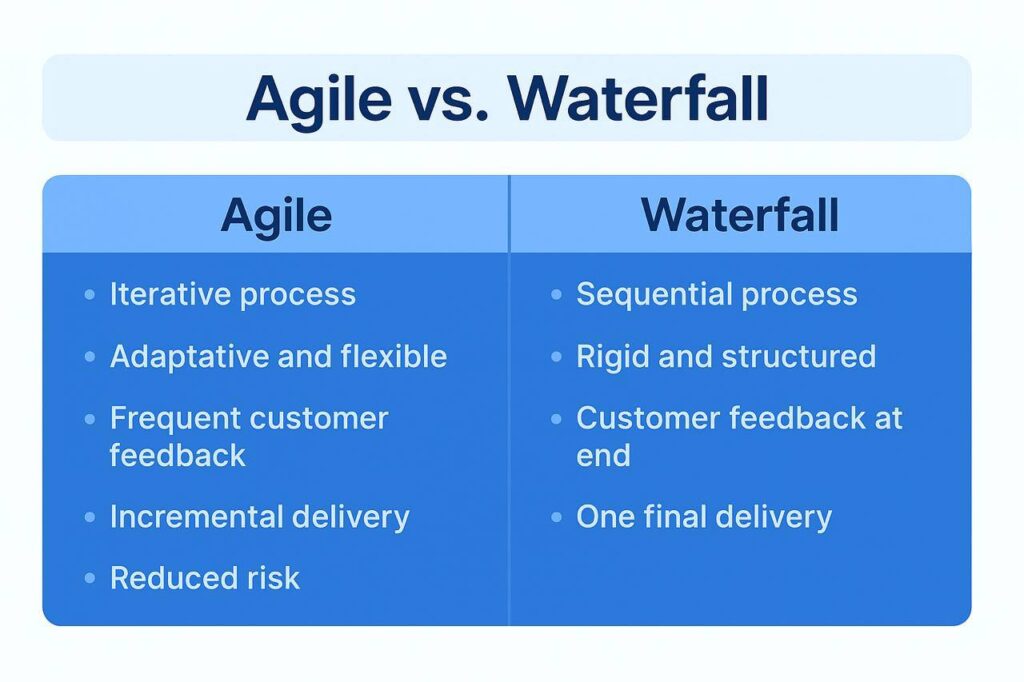
Agile vs. Waterfall: A Quick Comparison
Waterfall represents predictability but also rigidity: sequential phases, late testing, and minimal customer engagement until the very end. This makes it unsuitable for environments where requirements evolve. Agile, by contrast, is iterative and incremental. Value is delivered early, customer input is integrated from the start, and the cost of mistakes is reduced because adjustments happen continuously rather than after months of investment.
The comparison illustrates why Agile dominates modern product development: it provides resilience, responsiveness, and the ability to validate assumptions while building.
What Is an MVP?
A Minimum Viable Product (MVP) is the leanest form of a product that still solves a real user problem. Unlike a prototype, which demonstrates functionality, or a concept, which remains theoretical, the MVP delivers value immediately while testing whether a market truly exists. Its purpose is validation: confirming that the core proposition resonates with users before scaling further.
The principle behind the MVP is efficiency of learning. Instead of building a complete solution that may miss the mark, teams create a focused product to gather evidence. The result is not only faster delivery but also an empirical foundation for strategic decisions.
MVP vs. Increment: What’s the Difference?
In Agile development, increments are outcomes of sprints. They add functionality but may not yet be meaningful to real users. An MVP, however, is specifically designed to face the market. It is a complete, usable version that invites feedback and tests demand.
This distinction is critical. Increments improve internal progress tracking, but MVPs validate external relevance. Confusing one for the other often leads to overconfidence in features that have never been tested with actual customers.
Why Build an MVP?
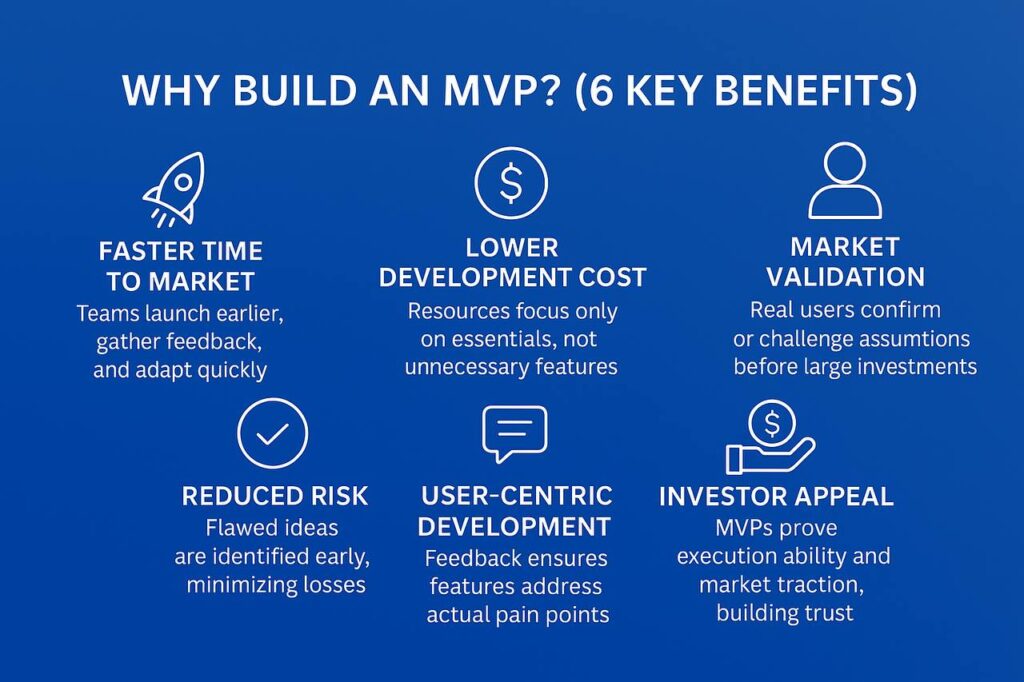
Building an MVP is a strategic decision aimed at balancing speed, cost, and evidence. The six key benefits are not independent; they reinforce one another. Faster time to market enables early validation, which reduces costs by eliminating unnecessary features. Lower cost and quicker feedback together reduce risk. Evidence from users aligns development with actual needs, which in turn strengthens investor confidence.
The result is a product roadmap shaped not by assumptions but by verified demand. For startups, this is survival; for enterprises, it is the difference between innovation and waste.
How to Build an MVP Using Agile
An Agile-driven MVP is created through disciplined iteration. The process begins with identifying the target audience and isolating the exact pain points that must be solved. From there, the value proposition is defined in measurable terms. Core features are prioritized not by desirability but by necessity — only the essentials required to validate the concept are included.
Development typically spans one to three sprints, after which the MVP is tested with real users. Feedback is collected systematically, analyzed against business goals, and used to refine the roadmap. Crucially, this is not a one-off event but a cycle: each iteration narrows the gap between user needs and the product’s value proposition.
Common MVP Mistakes
The most damaging error is treating an MVP as a smaller version of the final product. Overbuilding leads to wasted resources and delayed validation. Other frequent mistakes include failing to gather structured feedback, ignoring business metrics during testing, or assuming that the MVP can scale unchanged. Each misstep undermines the core principle: an MVP is not about delivering “less” but about learning more, faster.
Can You Have an MVP Without a Product?
Yes. Pretotyping demonstrates that market interest can be tested even before building an MVP. Landing pages with sign-up calls to action, explainer videos simulating functionality, or crowdfunding campaigns can validate demand. These methods offer early evidence and help prioritize whether building a full MVP is justified.

Ready to test your product idea — fast and effectively?
Contact UsWhen Not to Build an MVP
MVPs are unsuitable when the problem space is fixed and the requirements are well defined, such as in regulatory or compliance-driven projects. They also add limited value when developing custom enterprise tools for a single client, where user input is predetermined. In such cases, direct execution is more efficient than iterative validation.
Investors love MVPs
For investors, MVPs reduce uncertainty. They prove that a team can execute, that the concept resonates with a target market, and that there is real momentum to build upon. An MVP transforms abstract ideas into tangible opportunities, making it a critical factor in securing funding.
Real-World MVP Examples
Spotify validated music streaming with a simple desktop app offering a single playlist. Its success demonstrated the viability of streaming as a business model before the company scaled globally.
Minecraft began as a barebones prototype built in less than a week. Despite its simplicity, the MVP attracted early gaming communities, validated demand, and evolved into one of the most successful games in history.
Both examples show how lean experiments, validated early, can scale into global platforms.
Conclusion
Agile and MVP are complementary approaches. Agile supplies the framework for iteration, while the MVP provides focus for validation. Together they enable businesses to minimize risk, accelerate delivery, and build products that resonate with users. Instead of committing extensive resources upfront, teams learn quickly, adapt effectively, and grow intelligently.
Why Ficus Technologies?
Ficus Technologies supports startups and enterprises in designing and delivering MVPs within Agile frameworks. Our expertise spans scoping and defining MVP features, building scalable solutions, managing Agile delivery from sprint planning to launch, and enabling iteration based on structured feedback. By partnering with us, businesses can transform ideas into validated, market-ready products faster and with greater confidence.
A Minimum Viable Product (MVP) is the simplest version of a product that includes only the core features necessary to validate a business idea and gather real user feedback.
Agile enables faster iterations, flexibility in changing requirements, and continuous user involvement — all of which are essential for building and refining MVPs efficiently.
Typically, 2 to 4 months depending on the project’s scope, complexity, and level of technical readiness.
We offer end-to-end services: from business analysis and UI/UX design to development and QA. Our Agile-driven approach ensures a fast, low-risk MVP launch, backed by scalable architecture and deep technical expertise.





 Success...!