
In the past decade, the speed of innovation in connectivity has reshaped the way people and businesses interact. Today, 5G is no longer a futuristic promise but a deployed reality that supports millions of devices and critical systems worldwide. At the same time, 6G is already being tested in research centers, hinting at a future where connectivity becomes not only faster but also more intelligent. This transformation is not simply about streaming videos faster or reducing lag in online games. It is about creating an entirely new digital fabric where industries, governments, and societies operate in real time.
CTOs and IT strategists integrating next-gen connectivity into digital transformation programs.
Product managers and innovators building solutions that rely on ultra-fast, low-latency networks.
Investors and consultants evaluating opportunities in infrastructure, telecom, and connected industries.
- 5G is the current foundation, already powering IoT, smart factories, healthcare, and logistics.
- 6G is coming with terabit speeds, AI-driven networks, and integrated sensing capabilities.
- Every sector—transportation, healthcare, finance, entertainment, education—will transform.
5G Today: From Connectivity to Ecosystems
By 2025, 5G has matured into the backbone of digital services across multiple industries. In healthcare, doctors can consult and operate remotely thanks to reliable high-speed connections that support real-time video and robotics. In logistics, entire supply chains are tracked minute by minute, allowing businesses to respond instantly to disruptions. In manufacturing, predictive maintenance powered by connected sensors has cut downtime and reduced waste. What 5G has truly enabled is the shift from isolated processes to interconnected ecosystems, where information flows seamlessly between machines, people, and platforms.
The significance of 5G lies not only in its technical speed but also in its ability to handle massive volumes of data from billions of devices. Unlike previous generations of mobile networks, 5G has made edge computing and IoT practical at scale. That means smart cities, autonomous fleets, and real-time financial systems are no longer pilot projects—they are daily operations.
6G: A Leap Toward Intelligent Networks
If 5G has been the catalyst for connection, 6G represents the next leap toward cognition. Expected to roll out commercially by 2030, 6G promises terabit-per-second speeds and latency measured in microseconds. But the real revolution is that 6G networks will not only transmit data, they will analyze it in real time. Built-in artificial intelligence will make networks capable of optimizing themselves, detecting anomalies, and even providing predictive insights before problems occur.
This cognitive leap means industries will not just use connectivity—they will rely on networks as decision-making partners. For example, in transportation, 6G could allow autonomous vehicles to exchange and process environmental data instantly, coordinating movement across entire cities. In healthcare, biometric sensing embedded into the network could track patient conditions continuously and alert doctors before a crisis occurs. 6G is therefore less about faster communication and more about embedding intelligence into the very infrastructure of society.
Industry Transformation Through 5G and 6G
The industries most visibly transformed by these networks are transportation, finance, healthcare, entertainment, and public infrastructure. Connected vehicles already rely on 5G for near-instant communication between cars and traffic systems, reducing accidents and congestion. Finance firms have adopted low-latency networks for fraud detection and real-time settlement of cross-border payments. In healthcare, remote diagnostics and robotic surgery are increasingly available, especially in regions where specialist doctors are scarce.
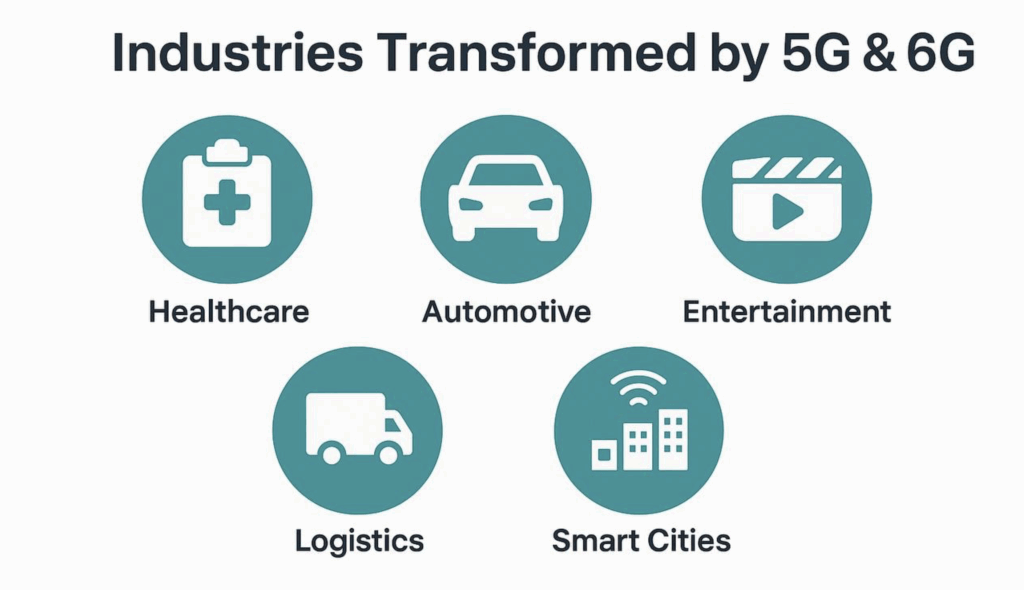
Entertainment has also undergone a dramatic shift. Streaming platforms, gaming companies, and event organizers now offer fully immersive experiences using virtual and augmented reality. These services demand enormous bandwidth and near-zero delay—something only 5G and the upcoming 6G can provide. Meanwhile, cities themselves are being redesigned as smart ecosystems, where sensors manage traffic lights, monitor pollution, and optimize energy grids. These transformations underline that the impact of advanced connectivity is not confined to technology firms—it touches every aspect of human life.
The Challenges of Adoption
Despite its promise, the path toward universal 5G and 6G adoption is complex. Infrastructure remains one of the largest barriers. Building networks dense enough to support billions of connected devices is costly and uneven across regions. Developing economies in particular risk being left behind, widening the digital divide.
Security is another pressing concern. With billions of devices connected simultaneously, the attack surface for cybercriminals grows exponentially. Protecting sensitive information in healthcare, finance, and government requires robust encryption, zero-trust frameworks, and constant vigilance. Finally, regulation and global standardization remain incomplete. Without clear agreements on spectrum allocation and compliance requirements, progress could be fragmented, leading to inefficiencies and incompatibility between markets.
Conclusion
The arrival of 5G and the upcoming era of 6G are not simply technological milestones. They are turning points in how societies function, how industries operate, and how individuals experience the digital world. The companies that adapt early, experiment with connected solutions, and invest in resilient infrastructures will shape the future economy.
Connectivity is no longer a utility—it is the foundation of innovation. As 5G builds today’s digital ecosystems and 6G promises to create cognitive networks, the challenge for businesses is clear: prepare now, or risk being left behind in a world that moves at the speed of data.
The future will be defined by those who embrace ultra-connectivity—not just faster networks, but smarter ecosystems.
Satya Nadella, CEO of Microsoft
Why Ficus Technologies?
At Ficus Technologies, we see 5G and 6G not as abstract buzzwords but as real opportunities for businesses to transform. Our teams design applications that make the most of high-speed, low-latency networks, from IoT-powered logistics platforms to AI-driven healthcare systems. We prepare companies for the 6G era by building infrastructures that are flexible and scalable, ensuring that today’s investments remain relevant tomorrow.
What sets us apart is our ability to bridge technical depth with business strategy. We not only deploy secure, high-performing systems but also guide clients in aligning connectivity with their long-term growth goals. With a track record across industries such as healthcare, fintech, and logistics, Ficus Technologies helps companies future-proof their digital ecosystems and stay ahead of the competition.
5G focuses on speed and low latency, while 6G will add intelligence and sensing capabilities, turning networks into active participants in decision-making.
The first commercial deployments are expected around 2030, but pilot programs are already underway in leading tech nations.
Healthcare, automotive, logistics, finance, and entertainment are positioned for the greatest impact, though all sectors will see transformation.
Yes. Affordable IoT solutions and cloud-based services already make 5G accessible, and 6G is expected to further lower barriers by offering plug-and-play intelligence.
Absolutely. With billions of connected devices, advanced encryption and security protocols are critical to safeguarding networks and data.






 Success...!