As organizations continue to adopt cloud platforms, remote work, and distributed infrastructure, traditional network security models are becoming less effective. The concept of a clearly defined network perimeter is rapidly disappearing.
In response to this shift, Secure Access Service Edge (SASE) has emerged as a modern approach to networking and security. SASE combines wide-area networking (WAN) capabilities with cloud-delivered security services into a unified architecture.
In 2026, SASE is no longer just a trend — it is becoming a core component of enterprise IT strategy. Organizations are increasingly adopting SASE to improve security, simplify infrastructure, and support distributed work environments.
Understanding how SASE works and what IT teams need to implement it is essential for building secure and scalable digital systems.
Cybersecurity teams responsible for access control and data protection.
Network engineers implementing modern connectivity solutions.
Organizations adopting cloud-first or hybrid infrastructure.
- SASE combines networking and security into a unified, cloud-delivered architecture.
- It enables secure access for users regardless of location, device, or network.
- SASE helps organizations simplify infrastructure while improving visibility and control.
The Shift Toward SASE
Traditional network security models were built around centralized data centers and well-defined network perimeters. Users accessed applications from within corporate networks, and security controls were focused on protecting those boundaries.
However, modern environments are fundamentally different. Applications are hosted in the cloud, employees work remotely, and data flows across multiple platforms and locations. As a result, network perimeters have become fragmented or nonexistent.
SASE addresses this challenge by moving security controls closer to users and delivering them through cloud-based services.
This approach allows organizations to secure access regardless of where users or applications are located.
What SASE Includes
SASE is not a single product or tool, but a unified architecture that combines multiple networking and security capabilities into a single cloud-delivered platform.
Instead of deploying separate solutions for network connectivity, access control, and threat protection, SASE integrates these functions into a cohesive system designed for distributed environments.
Core components of SASE typically include:
- Secure Web Gateways (SWG)
SWG solutions protect users from web-based threats by filtering traffic, blocking malicious content, and enforcing acceptable use policies. They ensure that employees can safely access internet resources regardless of their location. - Cloud Access Security Brokers (CASB)
CASB provides visibility and control over how cloud applications are used within an organization. It helps enforce security policies, protect sensitive data, and ensure compliance when employees interact with SaaS platforms. - Zero Trust Network Access (ZTNA)
ZTNA replaces traditional VPN-based access by granting access to specific applications rather than entire networks. It verifies identity, device posture, and context before allowing access, significantly reducing the risk of unauthorized entry. - Software-Defined Wide Area Networking (SD-WAN)
SD-WAN optimizes network traffic across multiple locations and cloud environments. It improves performance, reduces latency, and ensures reliable connectivity for distributed teams and applications. - Firewall-as-a-Service (FWaaS)
FWaaS delivers firewall capabilities through the cloud, allowing organizations to enforce consistent security policies without relying on physical hardware. It provides scalable protection across all users and locations.
Individually, each of these technologies addresses a specific challenge. However, when deployed separately, they often create fragmented architectures that are difficult to manage and scale.
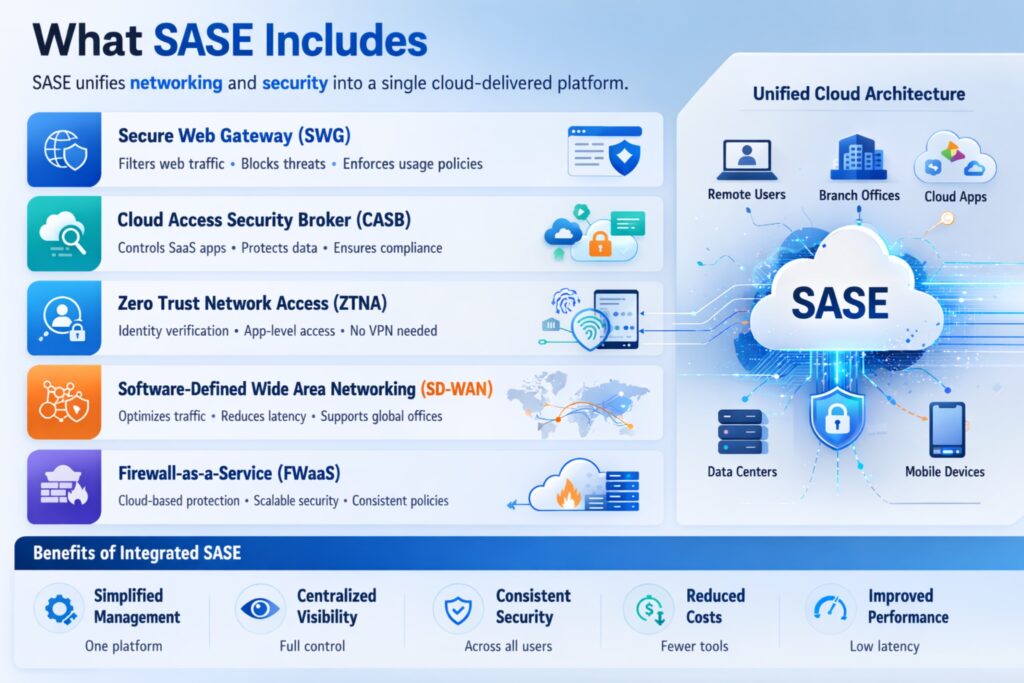
SASE brings these components together into a single, integrated framework. This consolidation allows organizations to apply consistent security policies, gain centralized visibility, and reduce operational complexity.
For IT teams, this means fewer tools to manage, simplified architecture, and improved alignment between networking and security. Instead of maintaining disconnected systems, organizations can operate within a unified platform designed for modern, cloud-first environments.
In practice, SASE transforms security from a collection of isolated controls into a coordinated system that adapts to how applications, users, and data actually operate today.
SASE Adoption and Market Shift
The adoption of SASE is accelerating as organizations modernize their network and security strategies in response to cloud computing and remote work.
Recent research shows that only around 14% of enterprises have fully deployed SASE today, but an additional 47% plan to implement it by 2027, indicating rapid near-term growth.
At the same time, the market is shifting toward simplified architectures. By 2026, up to 60% of new SD-WAN deployments are expected to be part of single-vendor SASE platforms, compared to just 15% a few years earlier.
Investment in SASE is also increasing significantly. Industry data shows that around 50% of enterprises are increasing spending on SASE and network security initiatives year over year, reflecting its growing strategic importance.
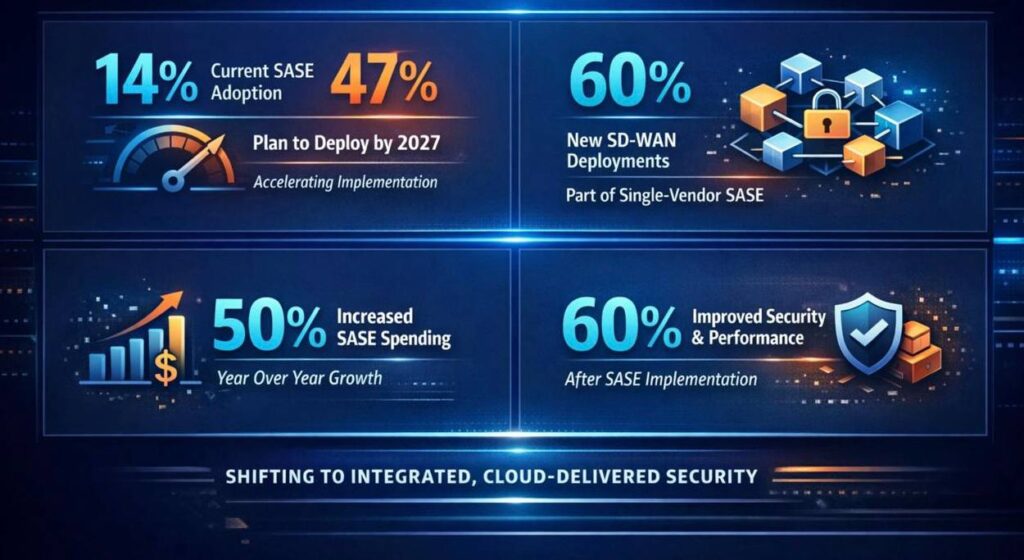
From an operational perspective, organizations adopting SASE report measurable improvements. Studies indicate that over 60% of companies see improved security posture and network performance after implementing SASE architectures.
These trends highlight a clear shift: organizations are moving away from fragmented security stacks toward integrated, cloud-delivered security and networking models that support distributed teams and modern applications.
SASE Adoption and Impact
The adoption of SASE is accelerating as organizations modernize their security and networking strategies.
Industry research shows that more than 60% of enterprises are actively evaluating or implementing SASE architectures, reflecting the growing need for unified security solutions.
At the same time, over 70% of organizations report increased complexity in managing multiple security tools, which SASE aims to address through consolidation.
Remote work continues to drive adoption. Studies indicate that more than 65% of enterprises prioritize secure remote access as a key factor in their security strategy, making SASE an attractive solution.
In terms of operational efficiency, organizations adopting SASE report up to 30% reduction in infrastructure complexity and management overhead.
These trends highlight a clear shift toward integrated, cloud-based security models.
Never trust, always verify.
John Kindervag, creator of Zero Trust
Benefits of SASE for IT Teams
SASE provides several advantages for IT teams managing modern infrastructure.
First, it simplifies security architecture by consolidating multiple tools into a unified platform. This reduces the need for managing separate solutions and improves operational efficiency.
Second, SASE improves visibility across networks and users. IT teams can monitor activity, enforce policies, and respond to threats more effectively.
Third, it supports scalability. As organizations grow and adopt new technologies, SASE can adapt without requiring significant infrastructure changes.
Finally, SASE enables consistent security policies across distributed environments, ensuring that all users and devices are protected regardless of location.
Challenges in SASE Implementation:
Despite its benefits, implementing SASE requires careful planning. Integration with existing systems can be complex, especially for organizations with legacy infrastructure. Transitioning to a cloud-based model may also require changes in network design and security policies.
Performance is another consideration. Organizations must ensure that SASE solutions provide low latency and reliable connectivity.
Vendor selection is also important. Not all SASE providers offer the same capabilities, and organizations must evaluate solutions based on their specific requirements.
Finally, teams need the right skills to manage and operate SASE environments effectively.
Make security and connectivity work as one!
Contact usSASE and Zero Trust
SASE is closely aligned with the Zero Trust security model, and in many cases, it serves as the infrastructure that makes Zero Trust possible at scale.
Traditional security models were built on the assumption that users inside a corporate network could be trusted. Once inside the perimeter, access to systems and data was often loosely controlled. In modern environments, where users work remotely and applications are distributed across cloud platforms, this model is no longer effective.
Zero Trust fundamentally changes this approach. Instead of relying on network location, Zero Trust requires continuous verification of every user, device, and application attempting to access resources. Access is granted based on identity, context, and security posture rather than physical or network boundaries.
SASE enables this model by delivering identity-based security controls through cloud infrastructure. Authentication, authorization, and policy enforcement happen closer to the user, regardless of where they are located. This ensures consistent protection across remote work environments, branch offices, and cloud applications.
Another key advantage of combining SASE with Zero Trust is the ability to reduce lateral movement within systems. Even if a user or device is compromised, strict access controls prevent attackers from easily moving across the network.
Conclusion
Secure Access Service Edge represents a significant shift in how organizations approach networking and security.
By combining cloud-based networking with integrated security services, SASE provides a scalable and flexible solution for modern digital environments.
Organizations that adopt SASE can simplify infrastructure, improve security, and better support remote and distributed workforces.
As digital systems continue to evolve, SASE will play an increasingly important role in enterprise IT strategy.
Why Ficus Technologies?
Ficus Technologies helps organizations design and implement modern security architectures that align with cloud and distributed infrastructure.
Our teams support companies in adopting SASE frameworks, integrating security solutions, and building scalable network architectures.
By combining expertise in cloud platforms, cybersecurity, and DevOps, we help organizations create secure and resilient digital environments.
SASE is a framework that combines networking and security services into a unified, cloud-delivered architecture.
It enables secure access for distributed users and simplifies security infrastructure.
SWG, CASB, ZTNA, SD-WAN, and FWaaS are key components.
SASE supports Zero Trust by enforcing identity-based access controls across distributed environments.






 Success...!