

The decision between cloud infrastructure and on-premise systems remains one of the most important strategic choices for organizations building modern digital platforms. While cloud adoption continues to grow, many companies still rely on on-premise infrastructure for control, compliance, or legacy system requirements.
In 2026, this is no longer a simple “cloud vs on-prem” debate. Technology leaders must evaluate a combination of factors including scalability, cost, security, regulatory constraints, and operational complexity.
Choosing the wrong approach can lead to performance limitations, increased costs, or reduced flexibility. As a result, organizations must align infrastructure decisions with long-term business goals and operational needs.
IT managers evaluating cloud migration or hybrid environments.
DevOps and platform engineers managing infrastructure operations.
Organizations balancing legacy systems with modern cloud platforms.
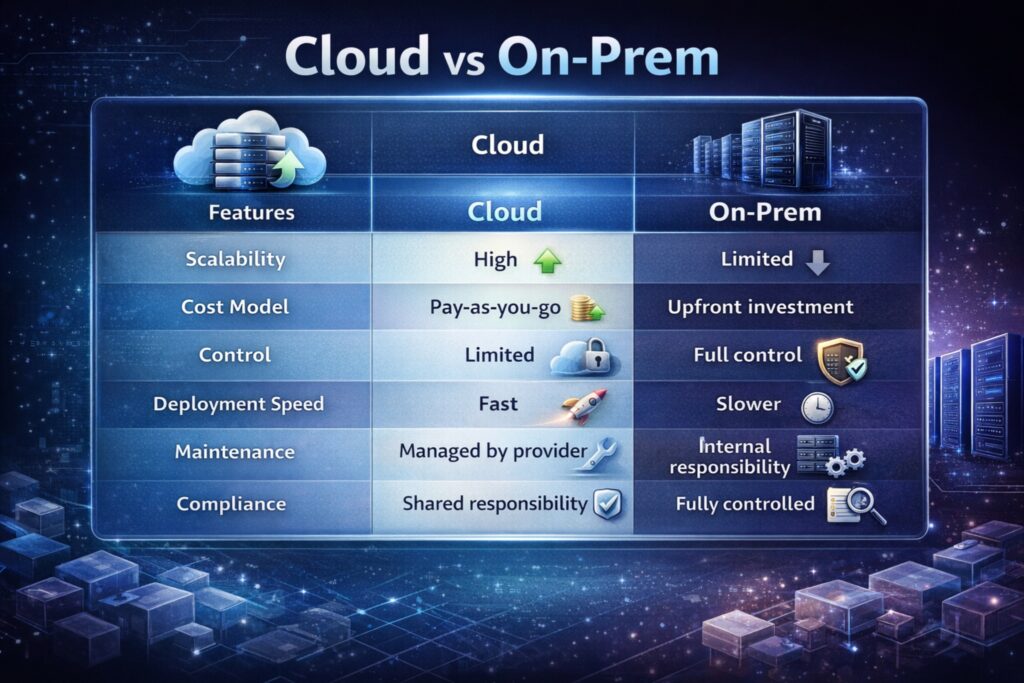
- Cloud infrastructure provides scalability, flexibility, and faster deployment, while on-premise systems offer control and customization.
- Infrastructure decisions should be driven by business requirements, regulatory constraints, and long-term operational strategy.
- Hybrid models are increasingly common as organizations balance cloud benefits with on-premise needs.
The Infrastructure Landscape in 2026
The infrastructure landscape has evolved significantly over the past decade. Cloud computing has become the default choice for many new applications due to its flexibility and scalability.
At the same time, on-premise infrastructure continues to play a critical role in industries with strict compliance requirements or legacy systems that are difficult to migrate.
Organizations are no longer choosing a single approach. Instead, they operate across hybrid environments where workloads are distributed between cloud platforms and on-premise systems.
This shift reflects the need to balance performance, cost, and regulatory requirements in increasingly complex digital ecosystems.
Cloud Infrastructure: Flexibility and Scalability
Cloud platforms allow organizations to scale resources on demand, deploy applications quickly, and reduce the need for physical infrastructure management.
One of the main advantages of cloud infrastructure is its flexibility. Teams can provision resources instantly, adapt to changing workloads, and experiment with new technologies without significant upfront investment.

Cloud providers also offer built-in services such as data storage, analytics, and machine learning tools, enabling organizations to accelerate development and innovation.
However, cloud environments can introduce challenges. Costs may become unpredictable without proper governance, and organizations must carefully manage security and compliance across distributed systems.
On-Premise Infrastructure: Control and Customization
On-premise infrastructure provides full control over hardware, data, and system configurations. Organizations can customize environments to meet specific performance, security, or regulatory requirements.
This approach is often preferred in industries such as finance, healthcare, and government, where data sensitivity and compliance standards are critical.
On-premise systems can also offer predictable costs over time, especially for stable workloads.
However, maintaining physical infrastructure requires significant investment in hardware, maintenance, and internal expertise. Scaling systems can also be slower compared to cloud environments.
Key Statistics: Cloud vs On-Prem Adoption
The shift toward cloud infrastructure continues, but on-premise systems remain relevant for many organizations.
Industry research shows that over 70% of enterprises now use cloud platforms for the majority of their workloads, reflecting the growing adoption of cloud-native technologies.
At the same time, around 40% of organizations still maintain significant on-premise infrastructure, particularly for sensitive data and legacy systems.
Hybrid strategies are becoming the norm. Studies indicate that more than 80% of companies operate in hybrid environments, combining cloud services with on-premise systems.
Cost management is also a key factor. Reports suggest that over 60% of organizations struggle with cloud cost optimization, highlighting the importance of governance and resource management.
These trends demonstrate that infrastructure decisions are no longer binary. Organizations must evaluate how to combine cloud and on-premise solutions effectively.
How Leaders Make the Decision
Technology leaders evaluate infrastructure decisions based on business priorities rather than purely technical factors.
Scalability requirements are critical for organizations expecting rapid growth or variable workloads. Cloud platforms often provide the flexibility needed to support these scenarios.
Regulatory and compliance requirements may push organizations toward on-premise or hybrid solutions, particularly when data must remain within specific environments.
Cost considerations also play a major role. While cloud reduces upfront investment, long-term costs must be carefully managed.
Finally, operational complexity and team expertise influence decision-making. Organizations must choose solutions that align with their internal capabilities.

Build a balanced infrastructure strategy tailored to your business needs.
Contact usConclusion
The choice between cloud and on-premise infrastructure is no longer about selecting a single model. Modern organizations operate across hybrid environments that combine the strengths of both approaches.
Cloud platforms provide scalability and speed, while on-premise systems offer control and customization. The key is understanding how these models align with business goals, regulatory requirements, and operational needs.
By making informed infrastructure decisions, organizations can build systems that are both flexible and resilient.
Why Ficus Technologies?
Ficus Technologies helps organizations design and implement infrastructure strategies that balance cloud flexibility with on-premise control.
Our teams support companies in building hybrid architectures, optimizing cloud costs, and ensuring secure, scalable infrastructure.
By combining cloud expertise with deep infrastructure knowledge, we help organizations create systems that support long-term growth and operational efficiency.
Cloud infrastructure is hosted by providers and offers scalability and flexibility, while on-premise infrastructure is managed internally and provides full control.
On-premise solutions are suitable for organizations with strict compliance requirements or specific performance needs.
Hybrid models allow organizations to combine the scalability of cloud platforms with the control of on-premise systems.
Not necessarily. Cloud reduces upfront costs but requires proper management to avoid high operational expenses.





 Success...!