
Data has become one of the most valuable assets in modern organizations. It drives decision-making, powers AI systems, and shapes customer experiences across industries. However, as data usage expands, so do the risks associated with mismanagement, lack of transparency, and ethical misuse.
In 2026, businesses are no longer asking how to collect more data — they are asking how to manage, control, and use it responsibly.
Data governance and data ethics have moved from technical concerns to board-level priorities. Organizations must now balance innovation with accountability, ensuring that data is accurate, secure, compliant, and used in ways that build trust.
The companies that succeed are those that treat data not just as a resource, but as a responsibility.
Compliance and legal teams managing regulatory requirements.
Data and AI teams working with large-scale datasets.
Organizations developing data-driven products and platforms.
- Data governance ensures control, quality, and compliance across data systems.
- Data ethics defines how data should be used responsibly, transparently, and fairly.
- Modern organizations must integrate governance and ethics into architecture, processes, and decision-making.
Why Data Governance Is Now a Strategic Function
Data governance is no longer limited to policies and documentation. It has become a core operational function that directly impacts business performance.
Organizations today operate across multiple data sources — cloud platforms, analytics tools, AI systems, and third-party integrations. Without governance, this complexity leads to inconsistent data, security gaps, and regulatory exposure.
Effective governance provides structure. It defines who owns the data, how it is accessed, how long it is stored, and how it is protected. It ensures that data is reliable enough to support analytics and AI-driven decisions.
More importantly, governance enables scale. As organizations grow, they need systems that maintain consistency across distributed environments. Governance frameworks allow businesses to expand data usage without losing control.
Data Ethics: From Compliance to Trust
While governance focuses on control, data ethics focuses on responsibility — and increasingly, on trust.
In modern digital ecosystems, data is not just processed; it is used to make decisions that directly affect people. AI systems influence hiring, pricing, recommendations, fraud detection, and customer interactions. As a result, ethical considerations are no longer theoretical — they have real-world impact.
Organizations must ensure that their data practices are transparent, fair, and aligned with user expectations. This requires moving beyond regulatory compliance toward a more proactive and principled approach to data usage.
Ethical data use goes beyond legal requirements.
It includes:
- How data is collected and whether users understand it.
Organizations must be clear about what data is collected, why it is collected, and how it will be used. Consent should be meaningful, not hidden in complex terms and conditions. - How algorithms make decisions and whether they are explainable.
AI-driven decisions should be transparent and interpretable. Users and stakeholders need to understand how outcomes are generated, especially in high-impact scenarios such as finance, healthcare, or hiring. - Whether datasets introduce bias into AI systems.
Biased data can lead to unfair outcomes and reinforce existing inequalities. Organizations must actively monitor datasets and models to detect and mitigate bias. - How organizations protect user privacy.
Privacy is a core component of ethical data use. This includes secure data storage, controlled access, and minimizing data collection to what is strictly necessary.
Beyond these factors, ethical data practices also require accountability. Organizations must be able to justify decisions, audit systems, and take responsibility when issues arise.
Customer expectations are evolving rapidly. Users are increasingly aware of how their data is used and are more selective about which companies they trust. Transparency, fairness, and responsible data use are becoming key differentiators in competitive markets.
Trust is no longer a byproduct of good service — it is a strategic asset. Organizations that fail to address ethical concerns risk not only regulatory penalties but also long-term reputational damage, loss of customer loyalty, and reduced adoption of their products.
In contrast, companies that prioritize data ethics can build stronger relationships with users, enable responsible innovation, and create sustainable, trust-driven business models.
Build data platforms with governance, security, and ethics at the core.
Contact usData Governance & Ethics in 2026
The shift toward responsible data practices is supported by strong market trends and measurable business impact.
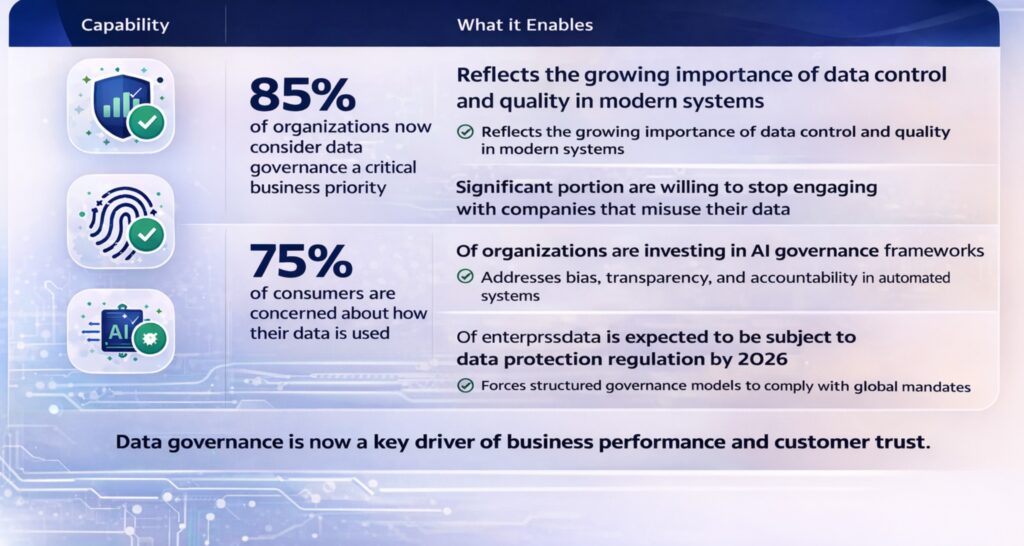
Recent research shows that over 85% of organizations now consider data governance a critical business priority, reflecting the growing importance of data control and quality in modern systems.
At the same time, trust is becoming a defining factor in customer relationships. Studies indicate that more than 75% of consumers are concerned about how their data is used, and a significant portion are willing to stop engaging with companies that misuse their data.
AI adoption is accelerating ethical challenges. Reports show that over 65% of organizations are actively investing in AI governance frameworks to address bias, transparency, and accountability in automated systems.
Regulatory pressure continues to increase globally. By 2026, over 80% of enterprise data is expected to be subject to some form of data protection regulation, forcing organizations to implement structured governance models.
From a business perspective, the impact is clear. Organizations with mature data governance practices are up to 2.5 times more likely to make faster, more accurate decisions compared to those with fragmented data environments.
These numbers highlight a major shift: data governance and ethics are no longer compliance tasks — they are key drivers of business performance and customer trust.
Governance and Ethics as a Unified System
Traditionally, governance and ethics were treated as separate initiatives. Governance focused on control and compliance, while ethics was often addressed through high-level policies or corporate values.
In modern organizations, this separation no longer works.
Governance without ethics creates systems that are controlled but not trusted. Ethics without governance creates principles that cannot be enforced.
A unified approach ensures that data is both well-managed and responsibly used. Governance provides the structure, while ethics provides direction. Together, they form the foundation of trustworthy data systems.
Technology as an Enabler of Governance
Managing data governance at scale is not possible without technology.
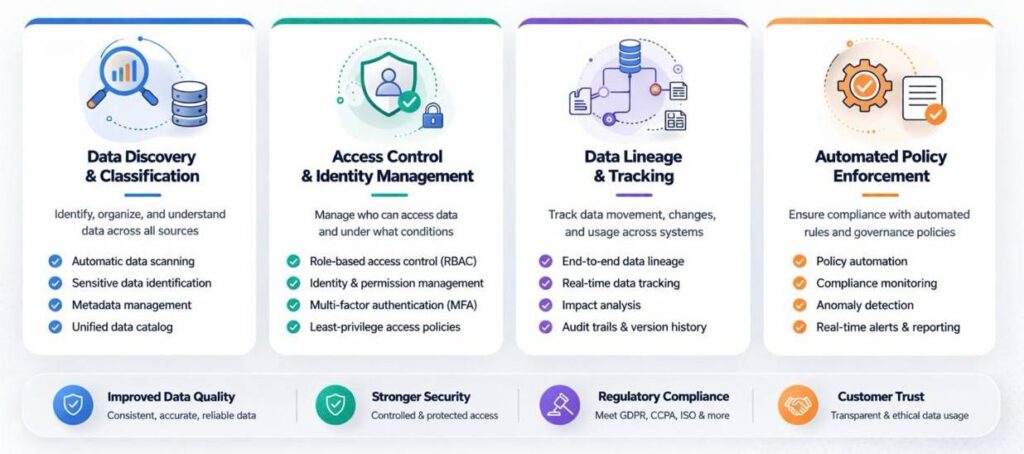
Organizations rely on modern data platforms that provide visibility into how data is stored, accessed, and used. These systems help identify sensitive data, enforce policies, and monitor compliance in real time.
Key capabilities include:
- data discovery and classification
- access control and identity management
- data lineage and tracking
- automated policy enforcement
Automation is critical. As data environments grow, manual processes become inefficient and error-prone. Automated governance ensures consistency and reduces operational risk.
Technology transforms governance from a static framework into a dynamic system that evolves with the organization.
Challenges Organizations Still Face
Despite progress, many organizations struggle to implement effective governance and ethical frameworks.
Data is often fragmented across multiple systems, making it difficult to maintain consistency. Legacy infrastructure and modern cloud platforms must be aligned under a single governance model.
There is also a skills gap. Organizations need professionals who understand both technical data systems and regulatory requirements.
Cultural adoption is another challenge. Governance policies must be embedded into daily workflows, not treated as external requirements.
Finally, organizations must balance innovation with control. Overly restrictive governance can slow down development, while weak governance increases risk.
Data is a precious thing and will last longer than the systems themselves.
Tim Berners-Lee
Conclusion
Data governance and ethics are no longer optional — they are essential for operating in a data-driven world.
Organizations must ensure that data is accurate, secure, and compliant, while also using it responsibly and transparently.
The companies that succeed will be those that build systems where governance and ethics are integrated into every layer of their data strategy.
In 2026, trust is built not only on what organizations do with data, but on how they do it.
Why Ficus Technologies?
Ficus Technologies helps organizations design modern data platforms that combine governance, security, and ethical data practices.
We support companies in building scalable data architectures, implementing governance frameworks, and ensuring compliance across distributed systems.
By integrating data engineering, cloud infrastructure, and AI expertise, we help organizations turn data into a trusted and valuable asset.
Because organizations rely on data for decision-making, and without governance, data becomes unreliable and risky.
Governance focuses on control and compliance, while ethics focuses on responsible and fair data usage.
AI introduces risks such as bias and lack of transparency, making ethical data practices essential.
Managing data across complex, distributed systems while maintaining consistency and compliance.




 Success...!