

Technology debt is not just a technical issue — it is a business risk.
In 2026, companies are moving faster than ever, building products, launching features, and scaling systems. But behind this speed, a hidden cost is growing.
Technology debt. It accumulates quietly, but its impact becomes visible over time — slowing down development, increasing costs, and limiting innovation.
Product teams scaling platforms.
Companies dealing with legacy systems.
Organizations experiencing slow development cycles.
- Technology debt reduces speed and increases long-term costs.
- It often comes from short-term decisions made under pressure.
- The biggest risk is not debt itself — but ignoring it.
- Managing debt requires strategy, not just refactoring.
What Technology Debt Really Means
Technology debt is the result of trade-offs.
When teams prioritize speed over long-term quality, they introduce shortcuts — quick fixes, temporary solutions, or suboptimal architecture decisions. These choices help deliver results faster in the short term, but create complexity over time.
Not all debt is bad. In many cases, it is intentional. Teams take on debt to move quickly, validate ideas, or respond to market demands. The problem begins when debt is not managed.
Over time, systems become harder to maintain, slower to update, and more difficult to scale. Technology debt turns speed into friction.
Where Technology Debt Comes From
Technology debt rarely appears suddenly — it accumulates gradually.
One of the most common causes is rapid growth. As companies scale, systems evolve organically. New features are added, integrations increase, and architecture becomes more complex. Without proper structure, this leads to fragmentation.
Another source is legacy systems. Older technologies may no longer meet current requirements, but replacing them is costly and risky. As a result, companies continue to build on top of outdated foundations.

Lack of documentation also contributes to debt. When systems are not well documented, knowledge becomes fragmented across teams. This makes maintenance slower and increases the risk of errors.
Short-term decision-making is another factor. Under pressure to deliver quickly, teams often prioritize immediate results over long-term sustainability.
The Business Impact of Technology Debt
Technology debt directly affects business performance. It slows down development cycles, making it harder to release new features. It increases operational costs, as more time is spent maintaining systems. It reduces system reliability, increasing the risk of failures.
But the most critical impact is strategic. Companies with high levels of technology debt struggle to innovate. They become reactive instead of proactive, focusing on fixing issues instead of building new capabilities. Technology debt limits growth.
The cost of adding a feature isn’t just the time it takes to build it — it’s the cost of maintaining it forever.
Ward Cunningham
The Numbers Behind Technology Debt
The Numbers Behind Technology Debt:
Technology debt is not just a technical concern — it has measurable impact on performance, cost, and business growth.
Recent data highlights how deeply it affects modern organizations. More than 70–75% of IT leaders report that technology debt slows down innovation and reduces their ability to deliver new features quickly. This means that in most companies, growth is directly constrained by existing systems.
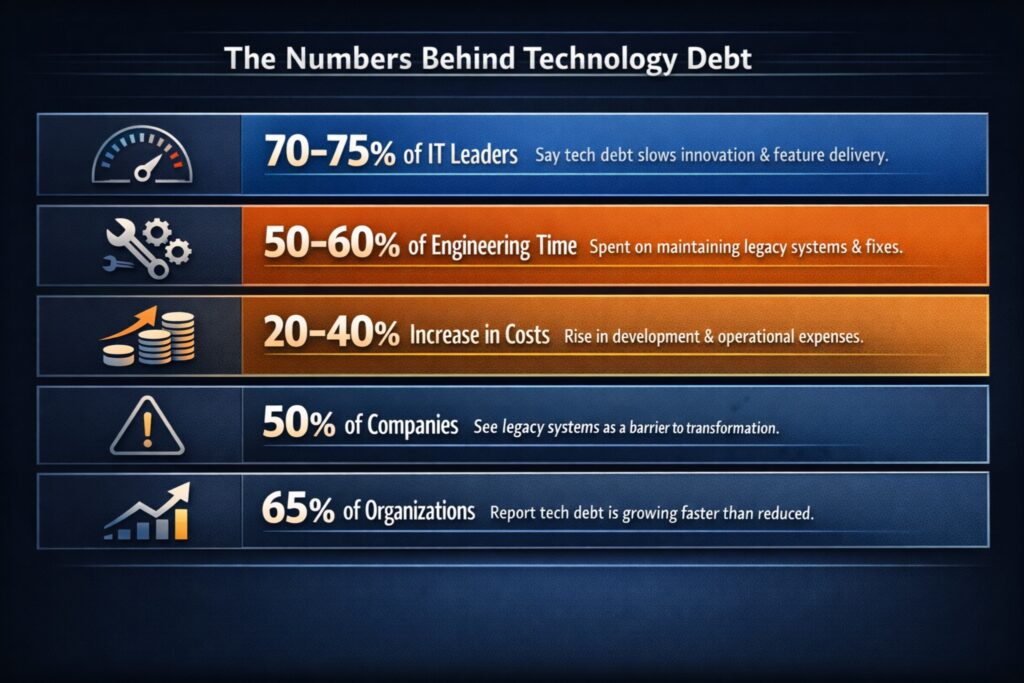
Development efficiency is also heavily impacted.
In many organizations, up to 50–60% of engineering time is spent maintaining legacy code, fixing issues, and managing outdated systems — rather than building new functionality.
Why It Gets Ignored
Despite its impact, technology debt is often overlooked.
One reason is visibility. Debt is not always immediately visible. Systems continue to function, even as complexity increases.
Another reason is prioritization. Business goals often focus on growth, features, and revenue. Debt management does not always show immediate returns, making it harder to justify.
There is also a cultural factor. Teams may accept inefficiencies as normal, especially in fast-growing environments. Over time, this leads to accumulation.
How to Manage Technology Debt
Managing technology debt requires a structured approach.
The first step is visibility. Organizations must identify where debt exists and understand its impact on performance and cost.
Prioritization is critical. Not all debt needs to be addressed immediately. Companies should focus on areas that have the greatest impact on business outcomes.
Refactoring is part of the solution, but not the entire strategy. Architecture improvements, system redesign, and modernization efforts are often required.
Integration and simplification also play a key role. Reducing unnecessary complexity can significantly improve system performance and maintainability.
Most importantly, debt management must be continuous. It is not a one-time effort, but an ongoing process.
The Risk of Ignoring Technology Debt
Ignoring technology debt leads to compounding problems.
Systems become harder to maintain, development slows down, and costs increase over time. Eventually, organizations reach a point where change becomes difficult or risky.
At this stage, even small updates can require significant effort. The longer debt is ignored, the more expensive it becomes to fix.

Reduce tech debt. Increase speed — with Ficus Technologies!
Contact usFrom Debt to Strategy
Leading organizations treat technology debt as part of their strategy. They balance speed with sustainability, ensuring that short-term gains do not compromise long-term performance. They invest in architecture, governance, and continuous improvement. They align technical decisions with business goals.
Technology debt does not disappear — but it can be controlled.
Conclusion
Technology debt is one of the most underestimated challenges in modern systems.
In 2026, the companies that succeed are not those that avoid debt entirely — but those that manage it effectively. The goal is not perfection. It is control.
Why Ficus Technologies?
Ficus Technologies helps organizations identify, manage, and reduce technology debt by building scalable architectures and optimizing systems for long-term performance.
The cost of short-term technical decisions that create long-term complexity.
No — but unmanaged debt becomes a problem.
It slows down development, increases costs, and limits innovation.
Through visibility, prioritization, and continuous improvement.







 Success...!