
Security and developer experience have long been presented as competing priorities. One focuses on reducing risk, enforcing controls, and limiting exposure. The other emphasizes speed, usability, and productivity. As organizations scale digital products and cloud-native systems, teams often find themselves balancing these objectives under increasing pressure.
By 2026, the conversation has become more nuanced. Most engineering leaders no longer view security and developer experience as opposing forces. Instead, they recognize that poor implementation on either side creates operational friction. Security that slows delivery becomes difficult to sustain. Developer workflows that bypass security introduce risk that eventually impacts the business.
The challenge is not choosing between security and developer experience. It is designing systems where both can coexist without creating unnecessary complexity.
Security leaders embedding DevSecOps practices into cloud-native and distributed engineering environments.
Organizations improving developer productivity while strengthening operational security and software delivery.
- Security and developer experience are most effective when treated as complementary parts of platform design rather than competing priorities.
- What works in 2026 is embedding security into workflows, platforms, and automation rather than relying on manual controls and external checkpoints.
- What fails is forcing teams to choose between productivity and protection through processes that increase friction without reducing meaningful risk.
Why the Conflict Exists
The tension between security and developer experience often emerges from how security controls are implemented rather than from the controls themselves.
Historically, security has been introduced as a separate layer of review. Development teams build and deploy systems, while security teams evaluate them afterward. This model creates delays, additional handoffs, and competing priorities.
As organizations accelerate software delivery, these differences become more visible. Security is perceived as a blocker, while developers are seen as introducing unnecessary risk. Both perspectives are often symptoms of disconnected operating models.
The result is a cycle where controls are bypassed to maintain speed, and additional controls are introduced in response, creating even more friction.
Friction Becomes a Security Problem
One of the most important shifts in 2026 is the recognition that excessive friction creates security risks of its own.
When workflows become difficult, developers naturally search for shortcuts. Complex approval chains, cumbersome access procedures, and repetitive manual reviews encourage workarounds that operate outside established controls.
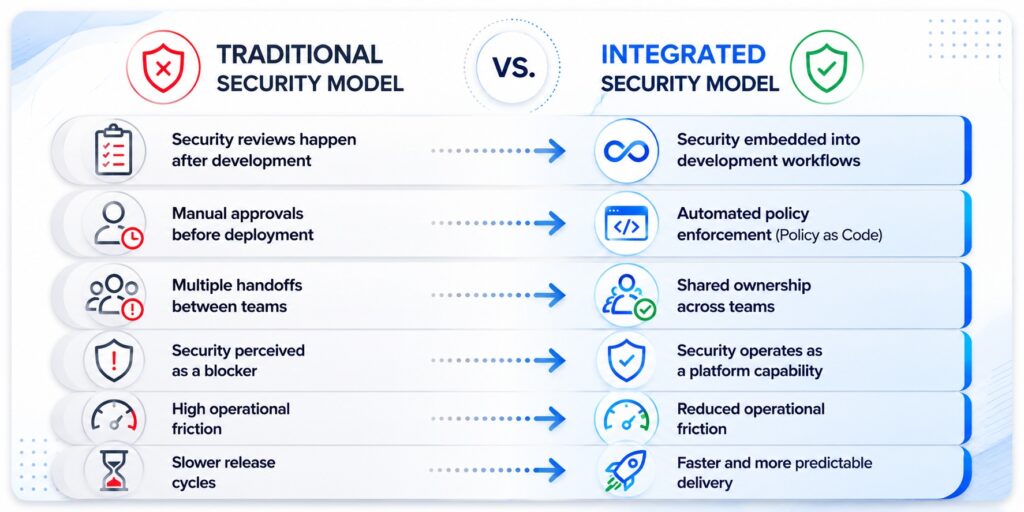
Teams rarely bypass security because they oppose it. More often, they bypass security because existing processes prevent them from completing work efficiently.
This reality changes how organizations evaluate controls. Security measures are no longer judged solely by their effectiveness. They are also evaluated by how consistently they can be followed in daily operations.
Developer Productivity Is Becoming a Strategic Metric
The relationship between developer experience and operational performance is becoming increasingly measurable.
According to Atlassian’s State of Developer Experience research, developers spend only a fraction of their working week writing code, with significant time consumed by meetings, administrative processes, context switching, and operational overhead. As organizations grow, these inefficiencies compound across teams and directly affect delivery timelines.
At the same time, findings from DORA research continue to show that organizations with streamlined workflows and stronger platform capabilities achieve better software delivery performance without sacrificing reliability or governance.
These trends highlight an important reality: security friction is no longer viewed as an engineering inconvenience. It is increasingly treated as a business issue that influences productivity, cost efficiency, and organizational agility.
Security Built Into the Platform
Organizations increasingly move away from security models that rely on individual compliance and toward platform-based enforcement.
Instead of asking developers to remember policies, teams build those policies directly into infrastructure, deployment pipelines, and development environments. Security becomes the default behavior rather than an additional requirement.
This approach reduces cognitive load for developers while improving consistency across environments. Teams spend less time navigating procedural requirements and more time focusing on product development.
When security is embedded into platforms, compliance becomes easier because secure practices are automatically reinforced by system design.
If you think good architecture is expensive, try bad architecture.
Brian Foote, software architect
Developer Experience as a Security Investment
Developer experience is often discussed in terms of productivity, but its impact extends beyond delivery speed.
Clear documentation, standardized environments, reliable tooling, and predictable workflows reduce the likelihood of configuration errors and operational mistakes. Developers make better security decisions when systems are easier to understand and navigate.
Organizations increasingly recognize that improving developer experience can strengthen security outcomes. Simpler systems reduce opportunities for misconfiguration. Consistent environments make abnormal behavior easier to identify. Clear ownership improves accountability when incidents occur.
In this context, developer experience becomes part of risk management rather than a separate concern.
Platform Engineering Is Reshaping Security Operations
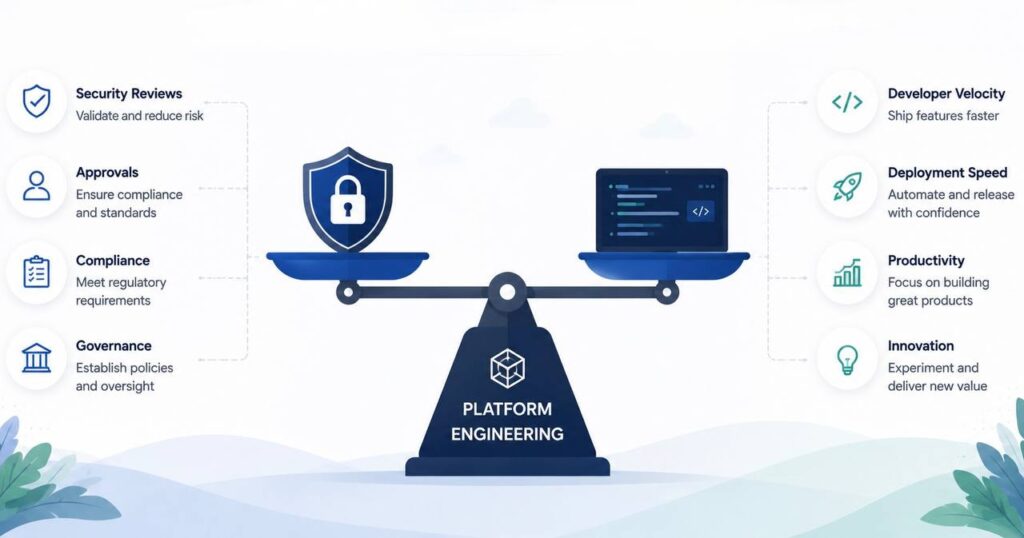
The growing adoption of platform engineering reflects a broader shift in how organizations balance security and developer productivity.
Recent industry surveys show that the vast majority of enterprise organizations now operate platform engineering initiatives or internal developer platforms designed to standardize environments, automate governance, and reduce operational complexity.
This trend is driven by scale. As systems become more distributed, manual enforcement becomes increasingly difficult to maintain. Platform-level controls provide consistency across teams while reducing reliance on repetitive reviews and approvals.
Rather than adding more checkpoints, organizations are redesigning the environments in which decisions are made. Security becomes embedded into the platform itself rather than layered on top of engineering workflows.
Ownership and Shared Responsibility
The traditional model of security as the responsibility of a dedicated team continues to evolve.
Modern systems require shared ownership between platform teams, security specialists, and engineering organizations. Security teams define standards and guardrails, while platform teams implement scalable controls and developers operate within those boundaries.
This distribution of responsibility improves both speed and accountability. Security becomes integrated into delivery processes rather than positioned outside them.
Organizations that achieve this balance spend less time resolving conflicts between teams and more time improving system resilience.
What Loses Relevance in 2026
Several approaches continue to lose effectiveness. Security models built around extensive manual approvals struggle to keep pace with continuous delivery environments. Developer experience initiatives that ignore governance create scalability challenges as organizations grow.
Tool adoption without workflow integration adds complexity without addressing underlying problems. Security policies that depend entirely on documentation and training often fail under operational pressure.
Organizations increasingly reject models that treat security and developer experience as competing priorities.
Conclusion
The trade-off between security and developer experience is often overstated. In practice, both objectives support the same goal: creating systems that remain reliable, scalable, and manageable under real-world conditions.
The organizations that succeed in 2026 are not those that prioritize one over the other. They are the ones that design platforms where secure behavior is easy, consistent, and aligned with how teams actually work.
Security becomes more effective when it reduces friction. Developer experience becomes more valuable when it supports operational discipline. Long-term success comes from treating both as parts of the same system rather than separate concerns.
Ready to build secure platforms without slowing down development? Let’s talk.
Contact usWhy Ficus Technologies?
Ficus Technologies helps organizations design cloud-native platforms where security and developer productivity reinforce each other rather than compete.
As digital systems become more complex, organizations often struggle with fragmented controls, inconsistent workflows, and growing operational overhead. Security is added through separate processes while engineering teams focus on delivery speed, creating friction across the organization.
Ficus focuses on integrating security directly into platform architecture, deployment pipelines, and operational workflows. This approach helps organizations maintain governance and resilience while enabling teams to move efficiently at scale.
By aligning security, platform engineering, and developer experience, businesses create systems that remain both secure and adaptable as they grow.
The conflict usually arises from how security controls are implemented. When controls create excessive friction, they slow delivery and encourage workarounds.
Yes. Clear workflows, standardized environments, and better tooling reduce errors and improve the consistency of secure practices.
Embedding security into platforms and workflows allows teams to maintain strong controls without relying on manual processes.
No. Compliance provides a baseline, but operational resilience depends on how effectively security practices function in day-to-day environments.
Platform engineering helps enforce security standards through infrastructure and automation, reducing friction while improving consistency.







 Success...!