
Growing an engineering team sounds like a straightforward way to increase development capacity. More engineers should mean more features, faster releases, and greater ability to handle complex products. In practice, the relationship between team size and productivity is rarely that simple.
As engineering organizations grow, communication becomes more complex, dependencies increase, decision-making slows down, and developers spend more time coordinating work. Processes that worked perfectly for a team of ten may become a bottleneck for a team of fifty.
The challenge is therefore not simply hiring more engineers. It is creating an engineering organization that can grow without adding complexity faster than capacity.
Successful scaling requires the right combination of team structure, architecture, developer experience, automation, documentation, and technical leadership. When these elements evolve together, larger teams can deliver more without turning every release into a coordination problem.
For businesses experiencing slower delivery despite adding engineers, understanding the structural causes of productivity loss can help determine whether the problem is capacity, architecture, processes, or coordination.
- Team structure becomes critical at scale. Clear ownership allows teams to make decisions without waiting for multiple departments.
- Architecture affects organizational productivity. Highly coupled systems create dependencies between teams and slow parallel development.
- Automation becomes more valuable as teams grow. Testing, CI/CD, infrastructure, and repetitive workflows should scale without proportional manual effort.
Why Engineering Productivity Often Drops as Teams Grow
Small engineering teams benefit from proximity. Developers understand large parts of the product, communication is relatively direct, and important decisions can often be made in a short conversation. Growth changes this dynamic.
New teams are created, responsibilities become more specialized, and engineers depend on systems owned by people they may rarely interact with. A change that previously required one developer can begin involving backend, frontend, platform, security, QA, and infrastructure teams. Communication also grows faster than headcount. Every additional engineer introduces potential coordination with other people, projects, and systems. Without clear boundaries, developers spend increasing amounts of time in meetings, waiting for decisions, resolving dependencies, and understanding work performed elsewhere.
This creates a common scaling paradox: the organization adds engineering capacity while individual engineers become less productive. The problem is usually not that people are working less effectively. The environment around them has become more complicated.
The Coordination Cost of Growth
Coordination is one of the largest hidden costs of engineering scale. When responsibilities are unclear, relatively simple decisions can require several meetings. Teams wait for approvals, developers depend on another team’s backlog, and technical questions move through multiple communication channels before reaching the person who can answer them. Dependencies amplify this problem. If five teams need to coordinate every time a feature crosses system boundaries, increasing the number of engineers inside those teams does little to accelerate delivery.
The goal should not be to eliminate coordination. Complex products require collaboration. The goal is to reduce unnecessary coordination by creating clearer boundaries and giving teams enough ownership to operate independently.
A well-structured engineering organization allows most decisions to happen close to the work. Teams understand what they own, which interfaces they depend on, and when broader coordination is genuinely required.
Adding manpower to a late software project makes it later.
Frederick P. Brooks Jr.
Team Structure Matters More Than Team Size
Scaling engineering effectively usually means creating smaller teams with clear responsibilities rather than continuously expanding existing teams. Teams can be organized around products, customer journeys, business capabilities, platforms, or technical domains. The exact model depends on the organization, but the principle remains similar: teams need meaningful areas of ownership.
A team responsible for a particular domain should ideally have enough capability to develop, test, deploy, monitor, and improve that domain without constantly depending on several other teams. This creates autonomy.
Autonomy does not mean every team chooses completely different technologies or ignores organizational standards. Shared architecture principles, security requirements, engineering standards, and platform capabilities still matter.
The objective is autonomy within clear boundaries, when those boundaries are well designed, organizations can add teams without creating the same increase in cross-team dependencies.
Architecture Is an Organizational Scaling Tool
Engineering productivity and software architecture are closely connected. In highly coupled systems, even small changes can affect multiple components. Developers need to understand dependencies outside their immediate area, releases require coordination, and teams can block each other.
As the organization grows, these dependencies become increasingly expensive. Modular architectures, well-defined APIs, clear service boundaries, and stable contracts allow teams to work more independently. One team can change its internal implementation without forcing several other teams to modify their systems at the same time.
This does not mean every organization needs microservices. Breaking a system into hundreds of services can introduce a different type of complexity involving networking, observability, deployment, data consistency, and operations.
The objective is not maximum distribution. It is appropriate separation of responsibilities. Good architecture reduces the number of organizational conversations required to safely change software.
Where Engineering Capacity Gets Lost
Engineering productivity is difficult to measure with a single metric because software development combines technical work, collaboration, problem-solving, and business outcomes. However, industry research consistently shows that significant engineering capacity can be consumed by work surrounding development rather than development itself.
Developers spend time maintaining legacy systems, fixing technical debt, waiting for builds and deployments, searching for documentation, switching between tools, resolving production issues, and coordinating dependencies.
As organizations grow, even small inefficiencies become expensive because they are repeated across larger numbers of engineers.
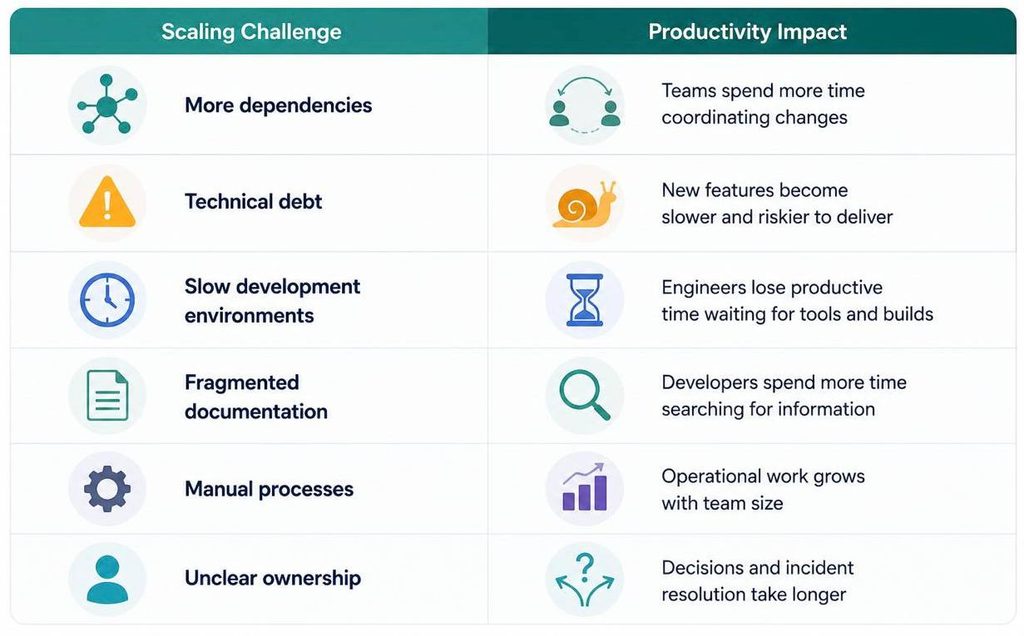
The important insight is that productivity problems at scale are often systemic. Saving ten minutes for one developer may seem insignificant. Saving the same ten minutes repeatedly across hundreds of developers can represent substantial engineering capacity over a year.
This is why mature organizations treat developer productivity as an engineering problem rather than an individual performance problem.
Developer Experience Becomes Infrastructure
As engineering organizations grow, developer experience becomes increasingly important.
A developer should be able to understand a project, configure a local environment, run tests, deploy changes, find documentation, and diagnose failures without requiring extensive assistance from other engineers.
When these workflows are difficult, productivity declines in ways that are easy to underestimate. A complicated onboarding process may consume weeks. Slow CI pipelines create waiting time every day. Unreliable test environments interrupt development. Poor documentation forces engineers to repeatedly ask the same questions.
At small scale, teams often work around these problems informally. At larger scale, informal workarounds stop working.
Developer portals, standardized environments, reusable templates, internal platforms, documentation, observability, and self-service infrastructure can reduce this friction. The goal is simple: make the correct engineering workflow the easiest workflow to follow.
Documentation Becomes a Productivity System
Small teams can rely heavily on shared context. Engineers know why architectural decisions were made, where important systems live, and who understands a particular component. As teams grow, that knowledge becomes distributed.
New employees cannot depend on conversations they were never part of. Remote teams may work in different time zones. Engineers leave the organization, taking undocumented knowledge with them. Documentation becomes part of the engineering system itself.Architecture decisions, service ownership, APIs, development workflows, operational procedures, and important technical standards should be discoverable without requiring developers to identify the right person first.
Good documentation reduces repeated questions, accelerates onboarding, and allows teams to make decisions with greater independence. The objective is not documenting everything. It is documenting the information that would otherwise repeatedly require human coordination.
Scaling organizations eventually need standards. Without them, every team can develop its own CI/CD process, observability stack, infrastructure conventions, libraries, and security practices.
Too much variation increases maintenance and makes it difficult for engineers to move between teams.
But excessive standardization creates a different problem. Central teams can become bottlenecks, experimentation slows down, and developers lose the ability to choose tools appropriate for their problems.
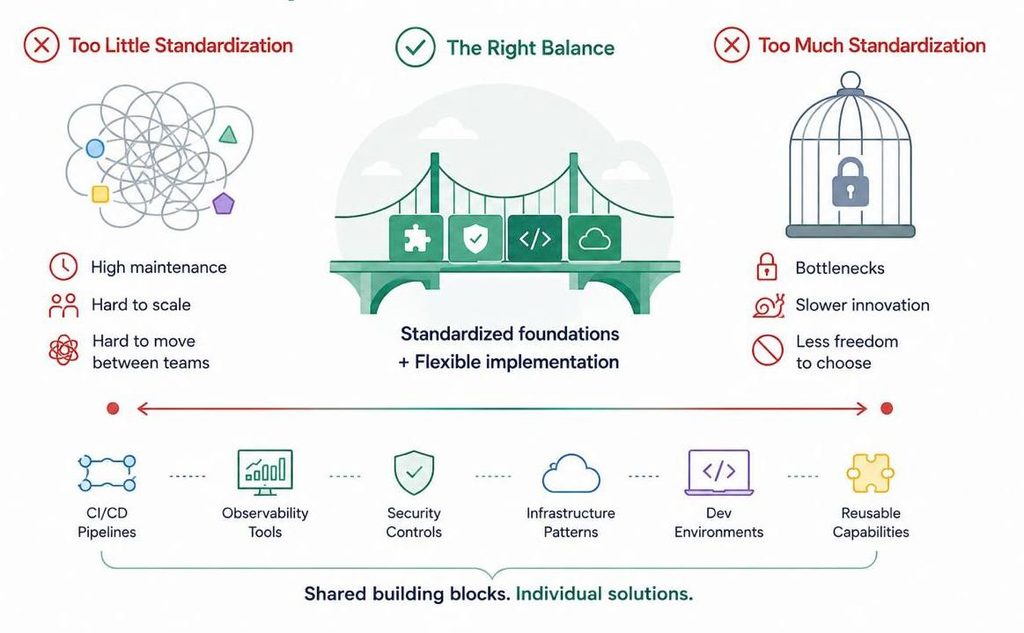
The strongest approach is usually to create standardized foundations with flexible implementation.
Organizations can provide supported deployment pipelines, observability tools, security controls, infrastructure patterns, and development environments while allowing teams freedom where variation creates genuine value.
Internal platforms can make these standards available as reusable capabilities rather than policies developers need to implement manually.
Technical Debt Becomes More Expensive at Scale
Technical debt affects every engineering organization, but its impact increases as teams grow.
A poorly designed component may initially inconvenience three developers. After expansion, twenty developers may depend on it. A manual deployment process that was manageable with one team can become a serious bottleneck when ten teams release independently.
Technical debt therefore has a multiplier effect. The longer foundational problems remain unresolved, the more people and systems begin depending on them. Eventually, changes become difficult because fixing the original issue requires coordinating across large parts of the organization.
Successful engineering organizations create space for continuous maintenance rather than waiting for a major rewrite.
Refactoring, dependency upgrades, test improvements, observability, documentation, and architecture work should be part of normal development.
Scaling on top of unresolved technical debt does not remove the debt. It increases the number of engineers paying interest on it.
Measure Outcomes, Not Engineering Activity
Productivity becomes particularly dangerous when organizations attempt to measure it using simple activity metrics.
Lines of code, number of commits, tickets completed, or hours worked are easy to count, but they provide limited information about engineering effectiveness.
An experienced engineer may solve an important scalability problem with a small change. Another developer may delete thousands of unnecessary lines of code and improve the system significantly. Neither contribution is accurately represented by activity volume.
Engineering productivity should instead be evaluated through a combination of delivery performance, quality, reliability, developer experience, and business outcomes.
Useful signals can include deployment frequency, lead time for changes, recovery time, change failure rate, development cycle time, and developer feedback about friction in everyday workflows.
The objective is not to maximize how much engineering activity occurs. It is to understand how effectively engineering effort becomes reliable business value.
The Challenges of Scaling Engineering Teams
There is no single organizational model that guarantees productivity at scale.
Too much autonomy can create fragmented technology stacks and duplicated solutions. Too much centralization can create approval bottlenecks. Too many services can increase operational complexity, while systems that are too tightly coupled can prevent teams from working independently.
Rapid hiring can create another problem: onboarding capacity. If experienced engineers spend most of their time helping new employees understand systems and processes, short-term productivity may decline even though the organization is investing in future capacity.
Leadership also needs to evolve. Practices based on direct communication with every engineer stop working as organizations grow. Managers need clearer ownership structures, technical leaders need mechanisms for maintaining architectural alignment, and teams need enough context to make decisions independently.
Scaling therefore requires continuous adjustment rather than a one-time organizational redesign.

Build scalable development environments with Ficus Technologies.
Contact usConclusion
Scaling an engineering organization is not primarily a hiring challenge. It is a systems challenge.
As teams grow, communication paths multiply, dependencies become more expensive, technical debt affects more developers, and manual processes consume increasing amounts of engineering time.
Organizations that maintain productivity treat these problems as part of the engineering environment. They create clear team boundaries, design architecture for independent change, invest in developer experience, automate repetitive workflows, maintain documentation, and measure outcomes rather than activity.
The goal is not to eliminate the complexity that comes with growth. It is to prevent that complexity from increasing faster than the organization’s ability to manage it. The most successful engineering teams do not simply add more developers.
They build an environment where every additional developer can contribute effectively.
Why Ficus Technologies?
At Ficus Technologies, we help businesses scale software development without allowing engineering complexity to become a bottleneck. From dedicated development teams and custom software engineering to cloud architecture, DevOps, QA automation, and modernization, we help organizations create technical foundations that support sustainable growth.
Scale your engineering capacity, not your complexity — with Ficus Technologies.
Larger teams introduce more communication, dependencies, processes, and coordination.
Clear team ownership, modular architecture, automation, strong developer experience, documentation, and standardized engineering foundations help teams grow without creating unnecessary friction.
Not automatically. Additional engineers increase capacity only when the organization can integrate them without creating excessive coordination and dependency costs.
Good developer experience reduces time spent on setup, builds, deployments, documentation searches, and repetitive tasks, allowing engineers to focus more of their time on product development.
Organizations should focus on delivery speed, quality, reliability, developer experience, and business outcomes rather than simple activity metrics such as commits or lines of code.







 Success...!