Modern software is rarely built entirely from scratch. Applications depend on open-source libraries, third-party packages, cloud services, APIs, CI/CD platforms, development tools, container images, and external vendors.
This makes development faster, but it also creates a much larger security surface. Attackers no longer need to compromise every company individually. If they can compromise a widely used package, vendor, build system, or developer account, malicious code or stolen credentials can potentially reach many organizations through trusted software relationships.
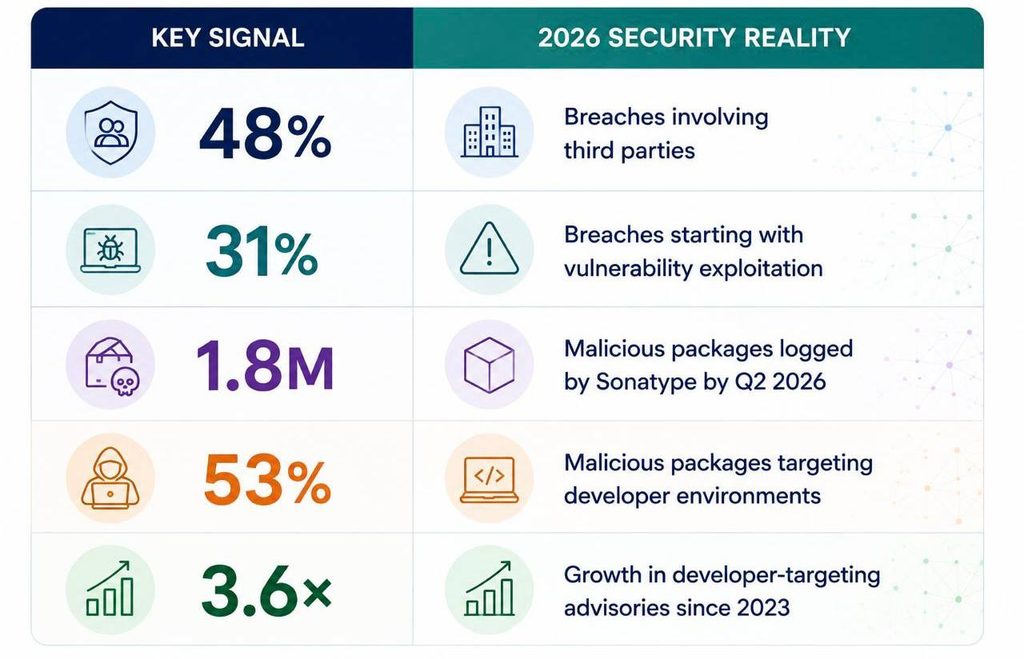
That risk is becoming increasingly visible in 2026. Verizon’s 2026 DBIR reports that third-party involvement has risen to 48% of breaches, while vulnerability exploitation has become the leading initial access vector at 31%.
For businesses, software supply chain security is therefore no longer only an open-source or dependency-management problem. It extends across the entire path from source code to production.
It is also useful for organizations that rely heavily on open-source software, third-party APIs, cloud platforms, external development vendors, automated CI/CD pipelines, or large dependency ecosystems.
- Software supply chain risk extends far beyond open source. Dependencies, build tools, CI/CD systems, vendors, credentials, containers, and update mechanisms can all become attack paths.
- Trusted components are attractive targets. Attackers can compromise something developers already trust instead of attacking the final application directly.
- Malicious packages are growing rapidly. Sonatype identified more than 454,600 new malicious packages during 2025.
What Is a Software Supply Chain Attack?
A software supply chain includes everything involved in creating, building, testing, distributing, and operating software.
That can include source code, open-source libraries, package registries, build tools, repositories, CI/CD platforms, container images, cloud infrastructure, external APIs, development vendors, and deployment systems. A supply chain attack targets one of these components or relationships rather than attacking the final organization directly.
For example, an attacker might publish a malicious package that resembles a legitimate library. A developer installs it, and the package attempts to steal credentials from the development environment. In another scenario, attackers could compromise a vendor or development tool that already has trusted access to customer environments. The danger comes from inherited trust.
Organizations may carefully secure their own application while simultaneously importing thousands of components and interacting with dozens of external systems they did not build themselves. Every dependency effectively extends the application’s security boundary.
Why Software Supply Chains Are Becoming More Attractive
Modern development depends heavily on reuse. Instead of implementing every capability internally, engineering teams combine existing libraries, frameworks, APIs, cloud services, containers, development tools, and SaaS platforms. A single application may therefore depend on hundreds or thousands of external components directly or indirectly. Attackers understand this structure. Compromising one widely used component can potentially provide access to many downstream targets. That makes supply chain attacks economically attractive: rather than attacking organizations one by one, attackers can target infrastructure that sits upstream from multiple organizations. Automation makes the problem even more significant.
Package ecosystems operate at enormous scale, and malicious packages can be created, published, modified, and distributed quickly. Sonatype reports that more than 454,600 new malicious packages were identified during 2025 across ecosystems including npm, PyPI, Maven Central, NuGet, and Hugging Face. Supply chain security is therefore increasingly a question of scale.
Software Supply Chain Risk Is Scaling Fast
Software supply chain attacks are becoming more dangerous because attackers no longer need to target the final application directly. They can compromise the components, tools, vendors, and development environments that organizations already trust.
The scale of this exposure has increased significantly. In the 2026 Verizon DBIR, 48% of breaches involved a third party, compared with 30% in the previous report. That represents a 60% year-over-year increase and shows how strongly external technology relationships now influence enterprise security.
Software vulnerabilities are another major entry point. 31% of breaches now begin with vulnerability exploitation, making software flaws the leading initial access vector in Verizon’s 2026 data. Open-source ecosystems show an equally significant increase in risk. Sonatype identified 454,648 new malicious packages in 2025 alone, bringing its cumulative count above 1.23 million at the beginning of 2026. And the threat has continued growing. By the end of Q2 2026, Sonatype reported 1.8 million malicious packages logged, showing how quickly malicious activity is expanding across software ecosystems.
Open Source Creates Scale — and Shared Risk
Open-source software is fundamental to modern development. It allows teams to avoid rebuilding common functionality, accelerate delivery, use mature frameworks, and benefit from large developer communities. The problem is not open source itself. The challenge is that applications can inherit risks from components they did not create. A direct dependency may introduce dozens of transitive dependencies. Those dependencies may be maintained by different developers, updated at different speeds, and contain their own vulnerabilities.
Security teams therefore need to answer questions that sound simple but can become surprisingly difficult:
Which packages are running in production? Which versions are being used? Which applications depend on them? Where did they come from? Are they still maintained? Are known vulnerabilities exploitable in our environment?
Without reliable dependency visibility, responding to a newly discovered vulnerability becomes much slower.
Malicious Packages Change the Threat Model
Traditional dependency security has focused heavily on vulnerable software. A legitimate package contains a flaw. Researchers discover it. A security advisory is published. Organizations identify affected versions and update them. Malicious packages create a different problem. The software may have been created specifically to compromise developers or systems.
Attackers can use techniques such as typosquatting, dependency confusion, package impersonation, compromised maintainer accounts, or malicious updates to make dangerous components appear legitimate. The target may not even be the final production application. Developer machines and CI/CD systems can contain valuable credentials, including API keys, repository tokens, cloud credentials, package registry credentials, and deployment secrets.
Sonatype found that 53% of malicious packages analyzed in 2025 were designed to compromise developer environments during installation. That makes the development environment itself part of the security perimeter.
CI/CD Pipelines Are High-Value Targets
CI/CD pipelines connect development directly with production. They can access source code, execute scripts, create software artifacts, interact with cloud infrastructure, retrieve secrets, sign releases, and deploy applications. That combination of permissions makes them extremely valuable to attackers.
If an attacker compromises a pipeline, they may not need to attack production infrastructure separately. The trusted deployment process can potentially deliver the malicious change for them.
This is why CI/CD security needs stronger controls around authentication, secrets, permissions, build isolation, third-party actions, and artifact integrity. Service accounts should follow least-privilege principles. Secrets should not be permanently embedded in code or configuration. Build environments should be reproducible and monitored. Most importantly, organizations need to know exactly what entered the build and what artifact came out of it.
Security is always excessive until it’s not enough.
Robbie Sinclair
The Dependency Problem Is Bigger Than Direct Dependencies
Developers usually know which libraries they intentionally add to an application. They may have much less visibility into everything those libraries depend on.
This creates the problem of transitive dependencies. A development team may install one package that depends on ten additional packages, which themselves depend on many others. Eventually, a relatively small application can contain a surprisingly large dependency tree. A vulnerability or malicious component several levels deep can still affect the final product.
This means security cannot stop at checking the dependencies listed directly in a project configuration file.
Organizations need dependency graphs that show how components are connected and where vulnerable or suspicious software enters the application. Without this visibility, teams may know that a dangerous package exists somewhere in the ecosystem without knowing whether their products actually contain it.
SBOMs Make Software Composition Visible
A Software Bill of Materials, or SBOM, provides an inventory of components included in a software product. It can identify libraries, packages, versions, and relationships between components. This becomes extremely valuable when a new vulnerability is discovered. Instead of manually investigating dozens or hundreds of applications, security teams can query their software inventory and identify affected systems much faster. But generating an SBOM is only the beginning.
If the inventory becomes outdated immediately after deployment, its operational value is limited. Organizations need processes that keep component information connected with current builds and releases.
SBOMs are therefore most useful when integrated into development and security workflows rather than produced only for compliance. The goal is not simply to document software composition. It is to make that composition searchable and actionable when risk appears.
Securing the Build, Not Just the Code
Secure source code does not automatically result in secure software. Between development and production, code passes through a complex chain of systems: dependencies, package managers, build servers, compilers, CI/CD pipelines, container registries, artifact repositories, signing services, and deployment infrastructure. Each stage introduces another point where software can be modified, replaced, or compromised.
This is why software supply chain security must protect the entire build process — not only the source code.
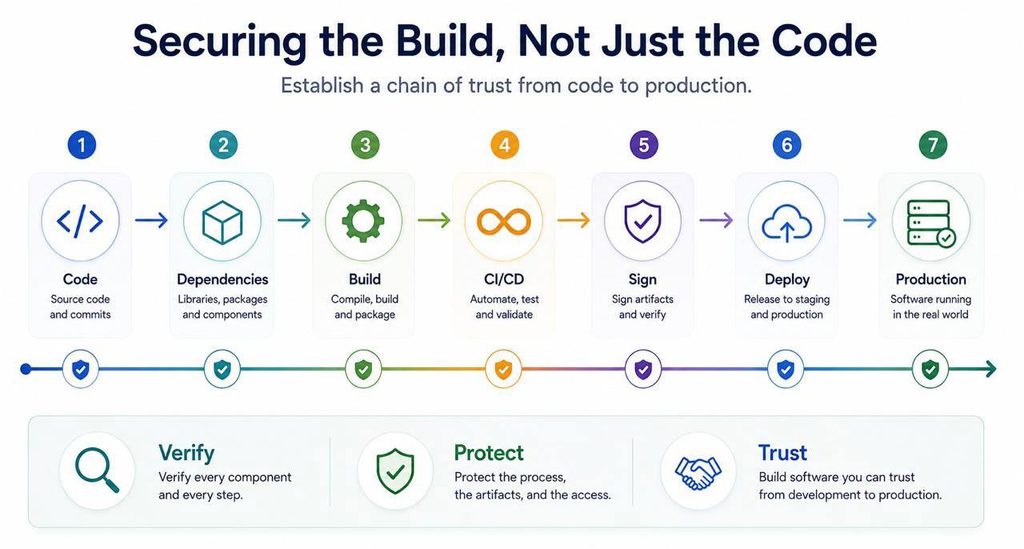
A development team may follow secure coding practices and perform regular code reviews, yet an attacker who gains access to a build environment could potentially inject malicious code after those reviews have already taken place. A compromised dependency could introduce unwanted functionality during installation. Stolen CI/CD credentials could allow unauthorized changes to deployment workflows. A manipulated container image could reach production even though the original application code remains untouched.
In these situations, traditional source-code security may not detect the problem because the attack happens somewhere else in the delivery chain.
AI Is Changing the Software Supply Chain
AI coding tools are adding another layer to software supply chain management. Developers can generate code, discover libraries, create configuration, and receive dependency recommendations much faster than before. This improves productivity, but speed can also accelerate unsafe decisions.
A developer may accept a generated dependency without examining its origin, maintenance history, or security profile. AI-generated code may introduce unnecessary libraries or recommend components that should not be trusted.
The broader issue is that AI makes software creation faster while security teams still need to understand everything entering the product. As development becomes increasingly automated, verification needs to become more automated as well.
The future of software supply chain security will therefore depend heavily on automated dependency analysis, provenance verification, policy enforcement, malicious-package detection, and continuous monitoring.
Effective software supply chain security requires controls throughout the development lifecycle rather than one security scanner at the end. Organizations should maintain accurate inventories of dependencies and software components, continuously scan packages for vulnerabilities and malicious behavior, restrict where dependencies can be downloaded from, and establish policies for introducing new components. Developer identities and CI/CD credentials require particularly strong protection because they can provide access to multiple stages of software delivery. Build systems should use least privilege, isolated environments, protected secrets, and trusted artifacts. Organizations should also establish processes for rapidly answering three questions when a new threat appears:
Are we affected? Where is it running? How quickly can we remove or replace it? The faster these questions can be answered, the smaller the window of exposure.

Build software with us that you can trust every step of the way.
Contact usConclusion
Software supply chain attacks are becoming a growing business risk because modern organizations depend on enormous ecosystems of code, tools, vendors, and infrastructure they do not completely control.
Attackers are taking advantage of those relationships. They can target open-source packages, developer credentials, CI/CD environments, build systems, vendors, and trusted integrations — potentially reaching downstream organizations through systems that already have permission to operate. The solution is not to stop using open source or third-party technology. Modern software development depends on both. The objective is to make trust measurable. Organizations need visibility into dependencies, stronger developer and CI/CD security, software inventories, automated scanning, provenance, artifact verification, vendor controls, and continuous monitoring. In 2026, securing an application means more than protecting the code your company writes. It means protecting everything that helps turn that code into software.
Why Ficus Technologies?
At Ficus Technologies, we help businesses build secure software environments across the entire development lifecycle. From custom software development and DevSecOps to cloud infrastructure, CI/CD automation, application security, and modernization, we help organizations reduce risk without slowing down delivery.
Build software you can trust from source to production — with Ficus Technologies.
It is an attack that compromises a dependency, vendor, development tool, build system, or another trusted component used to create or deliver software.
Modern applications rely on large ecosystems of external packages, cloud services, APIs, and development tools, creating more potential attack paths.
A Software Bill of Materials is an inventory of the components and dependencies included in a software product.
Organizations can use dependency scanning, trusted registries, SBOMs, automated policies, package verification, and continuous monitoring.
CI/CD systems often have access to source code, credentials, build processes, cloud infrastructure, and production deployments, making them valuable targets.
Yes. AI can accelerate development and dependency selection, making automated verification and security controls increasingly important.




 Success...!