
Cloud computing changed the way companies build and scale digital products. Infrastructure can be provisioned in minutes, teams can experiment without purchasing hardware, and computing resources can expand automatically as demand grows. But this flexibility has created a new financial challenge: cloud spending is much easier to start than it is to control.
A company may begin with a predictable cloud bill and gradually accumulate hundreds of services, environments, databases, storage resources, containers, and third-party tools. Different teams make infrastructure decisions independently, usage changes constantly, and costs can increase without a clear connection to business value.
Traditional budgeting was not designed for infrastructure that changes every hour. This is where FinOps becomes important.
FinOps brings engineering, finance, and business teams together to understand cloud spending, improve accountability, and make better decisions about the relationship between cost, performance, and value. The objective is not simply to reduce the cloud bill. It is to make cloud economics visible enough that organizations can control spending while continuing to innovate.
It is also useful for companies experiencing unpredictable cloud bills, limited cost visibility, rapid infrastructure growth, or difficulty understanding which teams, products, and customers are responsible for cloud consumption.
- FinOps is not simply cloud cost cutting. It connects cloud spending with business value and technical decisions.
- Visibility comes before optimization. Companies need to understand where cloud costs originate before they can control them effectively.
- Engineering teams influence cloud economics every day. Architecture, resource configuration, storage, scaling, and deployment decisions all affect spending.
Why Cloud Costs Become Difficult to Control
Cloud spending rarely becomes unmanageable because of one major decision. More often, costs grow through hundreds of small infrastructure decisions made over time.
A development team creates a temporary environment and forgets to remove it. A database is provisioned for expected future demand but remains underutilized. Storage accumulates old snapshots and logs. Kubernetes clusters run with excess capacity. Data transfer increases as architecture becomes more distributed. Teams choose larger compute instances because performance is easier to guarantee than utilization.
Individually, these decisions may have limited impact. Across a large cloud environment, they accumulate.
The problem becomes even more difficult because cloud resources are dynamic. Infrastructure scales automatically, workloads move between services, usage changes throughout the day, and pricing models vary between providers and regions. Traditional financial management typically asks, “How much did we spend?”
FinOps adds more useful questions: What created that cost? Who owns it? Was it expected? What business value did it support? And can we achieve the same outcome more efficiently?
What FinOps Actually Means in Practice
FinOps is an operating model for managing the financial value of cloud technology. It creates shared responsibility between engineering, finance, procurement, product, and business teams rather than treating cloud spending as the responsibility of a single department. Finance provides budgeting, forecasting, and financial discipline. Engineering understands how architecture and infrastructure decisions affect consumption. Product and business teams provide context about which workloads generate customer or business value. Together, these perspectives allow organizations to make more informed trade-offs. For example, reducing infrastructure cost by 20% may appear successful from a purely financial perspective. But if the change increases application latency, reduces reliability, or prevents a product from handling peak demand, the organization may have optimized the wrong metric. FinOps therefore focuses on unit economics and value, not simply the lowest possible infrastructure bill. The goal is to spend intentionally.
You can’t optimize what you can’t see.
FinOps principle
Visibility: The First Step in Cloud Cost Control
Companies cannot optimize cloud spending they cannot explain. The first practical step is creating visibility into where costs originate. Organizations need to understand spending by cloud provider, account, subscription, service, region, environment, product, team, and ideally business capability.
Tagging and labeling play an important role here. Resources can be associated with owners, applications, environments, projects, or cost centers so that spending can be allocated rather than appearing as one large infrastructure bill.
Instead of knowing that cloud infrastructure costs $500,000 per month, a company can understand that a specific product consumes a certain percentage, production represents another portion, development environments account for a measurable amount, and a particular service has suddenly increased in cost. Visibility turns cloud spending from an accounting number into operational information. And once teams can see where money is going, they can begin asking whether that spending is justified.
Where Cloud Budgets Lose Efficiency
Cloud spending continues to grow as businesses move more workloads, data, AI systems, and digital products into cloud environments. At the same time, organizations frequently report difficulty controlling waste, forecasting consumption, and allocating costs accurately. The scale of the problem becomes particularly visible when relatively small inefficiencies are multiplied across hundreds or thousands of resources.
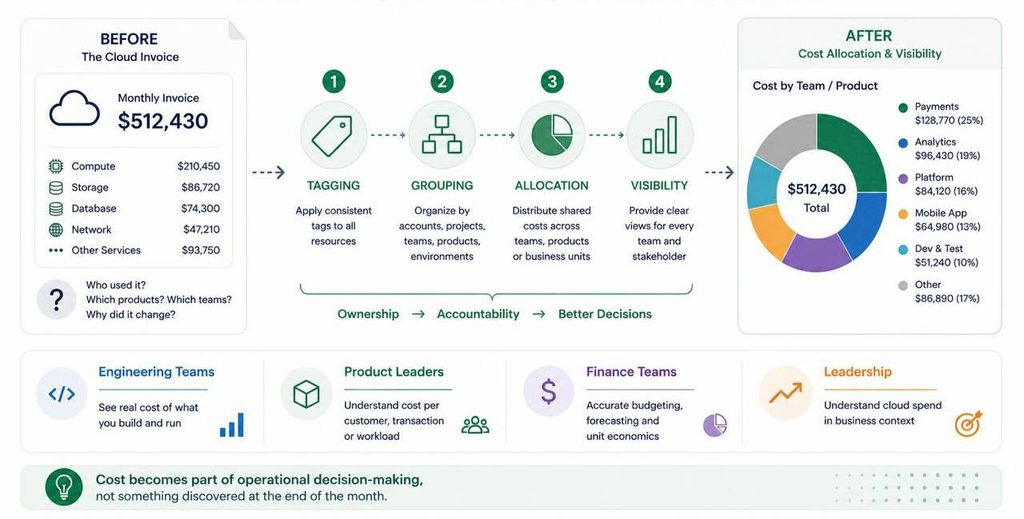
The important point is that cloud waste is rarely concentrated in one obvious place. It is distributed across compute, storage, databases, networking, Kubernetes, SaaS services, observability, backups, and increasingly AI infrastructure.
That is why one-time cost reduction projects rarely solve the problem permanently. The environment continues changing after the optimization project ends.
From Cloud Bills to Cost Allocation
A monthly cloud invoice tells a company how much it spent. It does not necessarily explain why.
FinOps introduces allocation by connecting infrastructure consumption to the teams, products, environments, or business units responsible for it. This can be achieved through tagging standards, cloud accounts, subscriptions, projects, namespaces, cost centers, and other ownership structures.Once allocation is established, companies can introduce showback or chargeback models.
Showback gives teams visibility into their infrastructure spending without directly transferring the cost to their budgets. Chargeback goes further by assigning those costs to the responsible department or product.
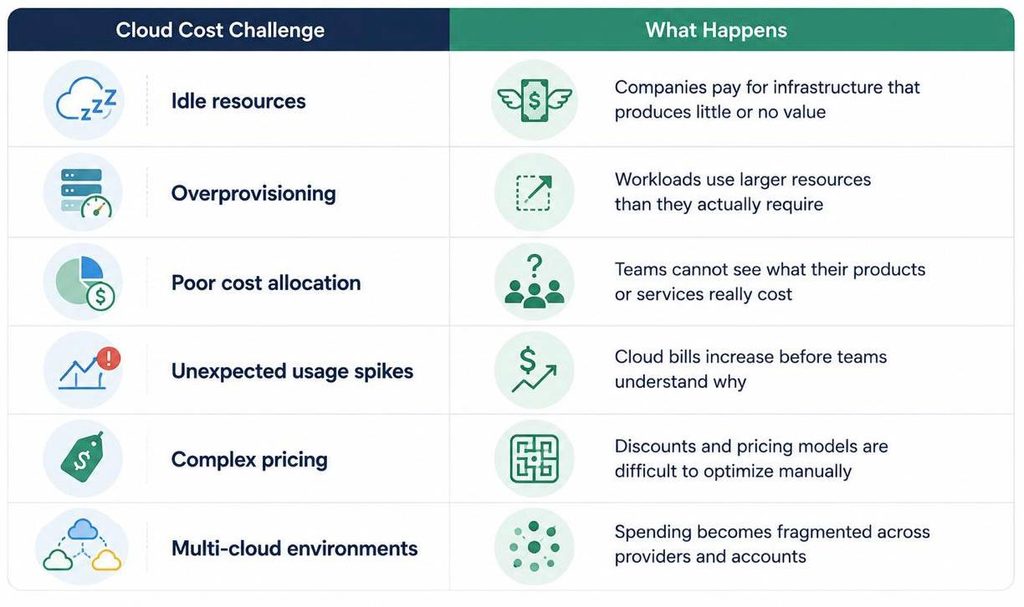
Both approaches create awareness. An engineering team that sees its cloud consumption every month can identify patterns that would otherwise remain hidden. A product leader can understand whether infrastructure costs are growing faster than revenue. Finance can forecast spending based on actual ownership rather than a single aggregated cloud bill.
Cost becomes part of operational decision-making rather than something discovered at the end of the month.
Rightsizing: Paying for What Workloads Actually Need
Overprovisioning is one of the most common sources of unnecessary cloud spending. Teams often choose larger compute instances, databases, or Kubernetes capacity to avoid performance problems. This provides safety but can leave significant resources unused.
Rightsizing aligns infrastructure with actual workload requirements. Instead of choosing resources based primarily on assumptions, teams can analyze CPU, memory, storage, network usage, and demand patterns to determine what workloads actually consume.
Some workloads may need smaller instances. Others may benefit from autoscaling. Development environments can be stopped outside working hours. Databases may require different service tiers. Containers can use more accurate resource requests and limits. Rightsizing is not simply about making infrastructure smaller.
The objective is to find the lowest-cost configuration that still meets performance and reliability requirements. Because workloads change, rightsizing also needs to be repeated continuously rather than performed once.
Commitment Discounts and Pricing Strategy
Cloud providers offer significant discounts when organizations commit to predictable levels of usage.
Reserved instances, savings plans, committed-use discounts, spot capacity, and other pricing models can reduce costs compared with standard on-demand pricing. But discounts introduce another optimization problem.
Commit too little and the company continues paying higher on-demand rates. Commit too much and it pays for capacity it no longer needs. Effective FinOps therefore combines historical usage, workload forecasts, growth expectations, and architecture plans before making long-term commitments. Stable baseline workloads are usually stronger candidates for commitments, while unpredictable or experimental workloads may require greater flexibility. Pricing optimization becomes particularly important at scale because even a relatively small percentage improvement can represent substantial savings across a large infrastructure budget.
Automation Is Where FinOps Starts to Scale
Manual cloud cost reviews can work when infrastructure is small. They become increasingly ineffective as organizations grow. Modern environments may contain thousands of resources that appear, scale, and disappear automatically. No finance or cloud team can manually review every infrastructure decision.
Automation allows organizations to apply cost controls continuously. Policies can identify unused resources, enforce tagging standards, stop non-production environments outside working hours, flag oversized infrastructure, monitor budgets, detect anomalies, and notify resource owners when spending exceeds expected thresholds. Some actions can be automated completely. Others should generate recommendations that engineers review before changes are applied.The goal is not to automate every financial decision. It is to automate the repetitive detection and enforcement work so that teams can focus on higher-value optimization decisions.
From Cloud Cost to Unit Economics
Total cloud spending alone provides limited information about whether infrastructure is efficient. A company may increase its cloud bill by 40% while increasing customers or transactions by 100%. In that case, infrastructure economics may actually be improving. This is why mature FinOps programs increasingly focus on unit economics.
Instead of asking only how much cloud costs, organizations can measure infrastructure cost per customer, transaction, API request, order, workload, or another relevant business unit. These metrics connect technical consumption with business growth.
If cloud spending rises while cost per transaction falls, scaling may be efficient. If customer growth remains flat while infrastructure cost rises quickly, the organization has a different problem. Unit economics allows cloud optimization to move beyond “spend less” toward a more useful objective: generate more business value from every unit of cloud spending.
FinOps is easier to describe than to implement.Incomplete tagging can make allocation unreliable. Shared infrastructure may be difficult to divide between products. Teams may disagree about who owns certain costs. Discounts and commitments complicate financial reporting. Multi-cloud environments introduce different billing models and terminology. Organizational behavior can be an even larger challenge.
If teams believe FinOps exists only to reduce their budgets, they may resist it. If finance focuses only on monthly spending, engineering teams may prioritize short-term savings over reliability or scalability. Successful FinOps requires shared objectives. Finance needs technical context. Engineering needs financial visibility. Product leaders need to understand how infrastructure spending relates to customer and business value. The objective is not to make every team spend less. It is to help every team spend intentionally.

Build efficient, scalable cloud infrastructure with Ficus Technologies.
Contact usConclusion
Cloud flexibility creates enormous business value, but it also makes traditional cost management increasingly difficult.
FinOps provides a practical way to bring visibility, accountability, engineering decisions, and financial discipline together. Organizations can understand where spending originates, assign ownership, optimize infrastructure, detect anomalies, use pricing models more effectively, and connect cloud consumption with business outcomes.
The goal is not simply to minimize cloud spending. The cheapest infrastructure is not necessarily the best infrastructure.
The objective is to understand what the organization is paying for, why it is paying for it, and whether that spending creates sufficient value. Companies that achieve this move from reacting to cloud bills toward actively managing cloud economics. Control does not mean using less cloud. It means getting more value from what you use.
Why Ficus Technologies?
At Ficus Technologies, we help businesses build and optimize cloud environments with scalability, performance, and cost efficiency in mind. From cloud architecture and migration to DevOps, infrastructure automation, modernization, and optimization, we help organizations create infrastructure that supports growth without unnecessary complexity or spending.
Build cloud infrastructure that scales with your business — not your costs — with Ficus Technologies.
FinOps is an operating model that brings finance, engineering, and business teams together to manage cloud spending and maximize the value generated from cloud investments.
No. FinOps focuses on optimizing the relationship between cost, performance, reliability, and business value rather than simply minimizing spending.
Common causes include idle resources, overprovisioning, unused storage, inefficient architectures, poor resource ownership, and inappropriate pricing models.
FinOps gives engineers greater visibility into how technical decisions affect cloud spending and helps teams optimize infrastructure alongside performance and reliability.
Cloud environments change too quickly for manual cost management alone. Automation helps detect anomalies, identify waste, enforce policies, and continuously monitor spending.






 Success...!