
For years, enterprise data strategies were built around one central goal: collect as much information as possible and create infrastructure capable of storing it. As businesses became more digital, data started arriving from websites, mobile applications, CRM platforms, payment systems, IoT devices, customer support tools, internal software, analytics platforms, and dozens of SaaS services.
Data lakes became an effective answer to this growth. They allowed organizations to store enormous volumes of structured, semi-structured, and unstructured information without defining every future use case in advance. Companies gained scalable storage, greater access to historical data, and more flexibility for analytics, machine learning, and experimentation. But as these environments expanded, another problem became increasingly difficult to ignore. Having more data did not automatically mean having more useful data. Analysts could spend hours trying to determine which dataset was correct. Different departments could calculate the same business metric differently. Engineers maintained pipelines with unclear ownership. Teams recreated datasets because they did not know that similar information already existed elsewhere. Business users gained access to hundreds of tables but still needed help understanding which ones were reliable enough to support important decisions. This is where the shift toward data products begins. The change is not simply about replacing data lakes with another technology.
- Data lakes solved storage, but not usability and trust.
- Data products add ownership, quality, documentation, and clear access.
- The focus is shifting from collecting data to making it reusable.
Why Data Lakes Became the Foundation of Modern Data Platforms
Data lakes became popular because traditional data architectures were struggling to keep pace with the volume and variety of information generated by modern businesses. Traditional warehouses worked extremely well for structured reporting environments, but they generally required teams to understand how data would be modeled and used before loading it into the platform. That approach became increasingly difficult as companies began generating application events, server logs, behavioral data, documents, images, IoT information, operational records, and many other data types.
The data lake changed the sequence. Organizations could store information first and decide later how it should be processed, modeled, or analyzed. This gave data scientists access to raw information, allowed companies to maintain longer histories, and made it easier to introduce new sources without redesigning the entire analytical environment. Cloud platforms made the model even more attractive. Storage could expand as demand increased, while compute resources could be scaled separately depending on the workload. Organizations no longer needed to predict years of future capacity before building their data infrastructure.
These advantages remain relevant. Data lakes are not becoming obsolete because they failed technically. The problem emerged at another level.
As companies became better at collecting information, they discovered that storage capacity was no longer the main limitation. The harder challenge became understanding which data mattered, whether it could be trusted, who was responsible for it, and how easily another team could use it.
Where the Data Lake Model Started to Struggle
The limitations of large data environments rarely appear overnight. They develop gradually as new sources, pipelines, transformations, and teams are added.
Imagine a business where customer information exists in the CRM, billing system, mobile application, support platform, marketing tools, and analytics environment. Marketing creates its own customer dataset for segmentation. Finance creates another for revenue reporting. Product analytics develops a third for engagement analysis, while a machine learning team prepares another version for predictive models. All of these datasets may be technically correct for their original purpose. The difficulty appears when people start asking which one represents the official customer view. Different teams may use different definitions of an active customer. Some may exclude trial accounts while others include them. One dataset may update every hour while another refreshes once per day. A field may change upstream without anyone realizing that multiple dashboards and models depend on it. Eventually, employees begin spending more time validating information before they can actually use it. Analysts compare conflicting metrics. Engineers investigate broken pipelines. Business teams export information into spreadsheets for additional checking. Data scientists create their own copies because existing datasets are difficult to understand.
At this point, the organization does not have a storage problem.It has a trust and usability problem. This is how a data lake can gradually become a data swamp: information is technically available, but its meaning, relevance, ownership, and reliability become increasingly difficult to determine.
What Changed: From Storing Data to Serving Consumers
The data product model starts with a different question. Instead of asking only where should we store this data?, organizations begin asking who needs this information, what are they trying to accomplish, and what would make the data reliable enough for them to use repeatedly? This changes how success is measured.
A traditional pipeline may be considered successful when information reaches the expected database or table. From a product perspective, that is only the beginning. Consumers still need to understand what the information means, whether it is current, what quality they can expect, how they can access it, and who is responsible when something changes. Consider customer information again. Instead of allowing every department to independently combine CRM, billing, support, and application data, an organization might create a trusted Customer Data Product. The product provides a consistent customer definition, clear ownership, documented fields, monitored quality, controlled access, and predictable updates. Marketing can use it for segmentation. Finance can use it for analysis. AI teams can use approved attributes for models. Product teams can connect it to internal applications. The same information becomes reusable because the complexity required to understand and maintain it is handled by the product rather than every consumer separately. That is the fundamental difference.A dataset simply exists.
What Actually Makes Data a Product
Calling a dataset a product does not make it one. The difference comes from the responsibilities, standards, and user experience built around the information.
The first requirement is clear ownership. Important data needs an accountable team responsible for its meaning, reliability, documentation, and ongoing evolution. When a quality issue appears or a business definition changes, consumers should know who can investigate the problem and make decisions. Without ownership, even technically strong data platforms become difficult to manage because responsibility is spread across too many teams.
Quality also needs to become explicit rather than assumed. Consumers should understand how often the data is updated, which fields are required, what level of completeness is expected, and what conditions indicate that the product is healthy. Instead of discovering quality problems manually during reporting or analysis, monitoring should identify issues as part of normal operation.
Documentation adds the context that raw tables rarely provide. A field name that seems obvious to the engineer who created it may be interpreted differently by finance, marketing, product, or AI teams. A mature data product should explain key definitions, source systems, transformations, limitations, update frequency, and the use cases it is designed to support.
Discoverability is equally important. Organizations cannot build meaningful self-service if employees need to know the exact database, schema, or engineer responsible for a dataset before they can find it. Trusted data products should be searchable through catalogs, internal marketplaces, or other discovery tools that help users understand what exists and whether it fits their needs.
Access also needs to be predictable. Consumers may use a data product through a table, API, event stream, file, or another interface, but that interface should be stable enough for other teams and systems to depend on it. Changes should be managed carefully so downstream consumers are not unexpectedly disrupted.
Data Lakes and Data Products Solve Different Problems
Data lakes and data products are sometimes presented as competing ideas, but that comparison is misleading. They address different layers of the data environment and solve different problems. A data lake is primarily designed to help an organization store, retain, and process large volumes of structured, semi-structured, and unstructured information. It provides the technical foundation for collecting data from multiple sources and making it available for analytics, machine learning, reporting, and other future use cases. A data product focuses on what happens after that data has been collected. Its purpose is to make important information easier for people and systems to discover, understand, trust, and reuse. That means adding clear ownership, documentation, quality expectations, lineage, access rules, and a predictable way for consumers to work with the data.
This distinction becomes especially important in mature data environments. Many organizations already have technically capable lakes, warehouses, or lakehouses. Their biggest challenge is no longer storing information. It is determining which data should be trusted, who is responsible for it, whether different departments interpret it consistently, and whether it can be safely reused across analytics, applications, and AI systems.
For example, a company may already store years of customer information in a data lake, but marketing, finance, product, and AI teams can still work with different versions of that information. The infrastructure has solved the storage problem, but it has not necessarily created a single trusted way to consume customer data. A customer data product can provide that additional layer by defining the sources, business rules, update frequency, ownership, quality expectations, and supported access methods.
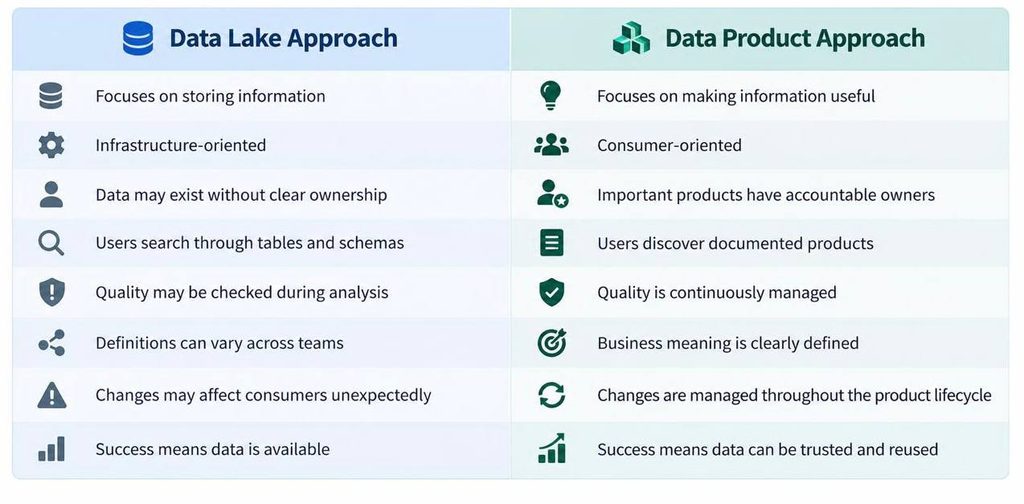
Adopting data products therefore does not usually mean replacing the existing data platform. In many cases, the same lake, warehouse, or lakehouse continues to provide storage and processing while product-oriented practices are introduced on top of it. This is often more practical than rebuilding an entire architecture simply to follow a new data model.
The larger opportunity is to improve how existing information is owned, documented, governed, monitored, and delivered. Instead of measuring success only by whether data is available, organizations can begin measuring whether users can find the right information, understand what it means, trust its quality, and reuse it without repeatedly asking data engineers for help.
When More Data Stops Creating More Value
For many organizations, the biggest cost of poor data management is not storage. It is the amount of human effort required to make information usable.
An analyst spends several hours determining which customer table should be used for a report. A data engineer repairs a pipeline after an upstream field changes unexpectedly. Finance manually checks monthly figures because different systems produce different totals. A machine learning engineer recreates a dataset because an existing one lacks documentation. Another team develops nearly identical transformations because nobody knows the previous version exists. None of these problems appears particularly dramatic on its own. The cost emerges when they are repeated across dozens of teams and hundreds or thousands of datasets.
As the environment grows, more engineering capacity is spent maintaining relationships between systems instead of creating new data capabilities. Analysts spend more time validating information rather than interpreting it. Business users lose confidence in dashboards, which encourages them to build additional local spreadsheets and duplicated datasets. The organization can therefore continue increasing its data infrastructure investment without receiving a proportional increase in business value. Data products try to reverse that pattern through reuse. A trusted customer product can support multiple dashboards, models, applications, and departments. The quality checks, transformations, documentation, and business definitions do not need to be recreated for every consumer. The important metric gradually changes from how much data the organization stores to how much trusted data the organization can reuse without repeated investigation and reconstruction.
Ownership Becomes Part of the Architecture
Clear ownership is one of the biggest differences between traditional data environments and product-oriented models.
In many organizations, responsibility becomes fragmented as information moves through the architecture. An application team generates the original data. Data engineers transport it. Analytics engineers transform it. BI teams build reports. Machine learning teams use it in models. Business departments ultimately make decisions based on it. When something becomes incorrect, determining who should solve the problem can take almost as long as solving it.
Data products introduce a clearer accountability model. An owning team becomes responsible for the product’s meaning, reliability, documentation, and consumers. This does not mean the team operates every layer of infrastructure itself. Central platform teams may continue managing storage, orchestration, observability, security, and access control. The difference is that responsibility for the business meaning of data is placed closer to the people who understand it. This creates a more scalable division of responsibilities. Platform teams provide reusable technical capabilities, while domain teams maintain the data products built on top of them. Ownership therefore stops being an administrative detail and becomes part of the system design.
Self-Service Data Becomes More Realistic
Self-service analytics has been an enterprise goal for years, but simply giving users access to more information rarely creates real independence. In many organizations, broader access only exposes employees to a larger and more confusing data environment.
An analyst may technically have access to hundreds of tables and dashboards but still be unable to answer basic questions: Which dataset contains the approved revenue definition? Which customer table is current? Who owns this metric? Can this information be used for an executive report? Is the dataset complete enough for an AI model? When these questions remain unanswered, employees continue depending on data engineers even though the organization calls the environment self-service. Data products change this model because context is delivered together with the information. Instead of exposing users only to technical assets, the organization provides trusted products with clear ownership, definitions, quality indicators, documentation, and access rules.
An employee searching for customer retention data should be able to find a relevant product, understand what it contains, see who owns it, check how frequently it updates, review its quality status, and request the appropriate access. They should not need to know which internal database, schema, or pipeline contains the underlying tables. This creates a much better consumer experience. Users spend less time asking technical teams where data lives and more time actually working with it. Analysts can move faster because they are not repeatedly validating the same definitions. Business teams can make decisions with greater confidence because approved data products are easier to identify. AI teams can discover which datasets are suitable for model development without reconstructing lineage and ownership from scratch. The impact on central data teams is equally important. In traditional environments, engineers often spend significant time answering repetitive questions, creating one-off extracts, explaining schemas, fixing access issues, and helping different departments interpret the same data. As the organization grows, these requests scale faster than the team can handle them.
AI Raises the Standard for Data Quality
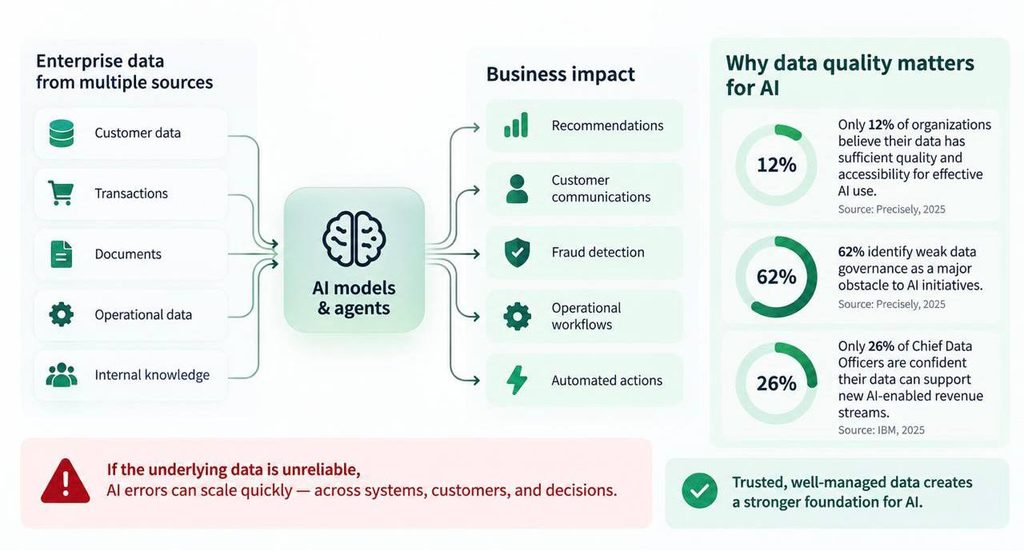
AI is making reliable enterprise data significantly more important because models can consume, combine, and act on information at a scale that traditional analytics rarely could. In conventional analytics, a human usually remains between the data and the final decision. An analyst may notice that a number looks unusual, compare it with another report, question the definition behind a metric, or decide that a dataset is not reliable enough to present. This human review creates an additional layer of protection.
The gap between AI ambition and data readiness is already visible. Precisely’s research found that only 12% of organizations believed their data had sufficient quality and accessibility for effective AI use, while 62% identified weak data governance as a major obstacle to AI initiatives. More recent 2026 research shows that 43% of organizations still identify data readiness as one of the biggest barriers to achieving their AI goals.
IBM found a similar confidence gap among data leaders. Although organizations are investing heavily in AI infrastructure, only 26% of surveyed Chief Data Officers said they were confident their existing data could support new AI-enabled revenue streams. Problems with accessibility, completeness, integrity, accuracy, and consistency continue to limit how effectively enterprise information can be used.
The financial impact extends beyond AI projects themselves. IBM reported in 2026 that more than one quarter of organizations estimate they lose over $5 million annually because of poor data quality, while 7% report losses of $25 million or more. As more business processes become automated, the cost of unreliable information can increase because the same problem can affect analytics, operational systems, and AI simultaneously.
For AI teams, access to large amounts of data is therefore not enough. They need to know where the information originated, who owns it, how current it is, which transformations were applied, whether its use is permitted, and how its quality changes over time.
This is where data products become especially valuable. Ownership provides accountability when something goes wrong. Lineage makes it possible to trace information back to its source. Documentation explains business meaning and limitations. Governance controls which people and systems can use the data, while continuous quality monitoring can identify changes before they affect downstream models.
The analytical implication is important: AI does not simply create another use case for enterprise data – it multiplies the consequences of existing data problems. A quality issue that once affected one dashboard can now influence automated recommendations, customer interactions, predictive models, and agentic workflows at the same time.
Challenges of Moving to Data Products
One of the biggest risks is treating data products as a terminology change rather than an operating model change.
An organization can rename hundreds of datasets as products without assigning meaningful ownership, defining consumers, monitoring quality, or improving documentation. In that case, the architecture becomes more complicated while the user experience remains unchanged. Another challenge is determining which information actually deserves product treatment. Not every temporary transformation, internal table, or experimental dataset needs a dedicated owner and lifecycle.
Creating too many products makes catalogs harder to navigate and increases the amount of governance required to maintain them. Organizations also need to manage the relationship between central and domain teams carefully. Domain teams often understand business meaning better, while platform teams understand infrastructure, governance, and engineering practices. Successful data products require both perspectives. There is also an organizational challenge. Teams that historically viewed data as somebody else’s responsibility may need to accept greater accountability for quality and definitions. Technology alone cannot solve that problem. The data product model works when architecture, ownership, platform capabilities, and organizational responsibility evolve together.
From Data Infrastructure to Business Capability
The most important change is ultimately not technological. During the early data lake era, organizations were primarily concerned with infrastructure questions: how to ingest more information, store it efficiently, process larger volumes, and retain historical datasets. Those questions remain relevant, but they are no longer enough. Organizations increasingly need to know whether employees can find the right information, whether teams agree on its meaning, whether it can be trusted, whether changes can be introduced safely, and whether analytics and AI systems can reuse it without rebuilding the same logic. These are questions about usability and responsibility rather than storage capacity. That is what the shift toward data products represents. Data infrastructure becomes valuable not because it contains enormous quantities of information, but because it allows trusted information to move efficiently into decisions, applications, analytics, and AI.
Conclusion
Data lakes transformed the way organizations collect and store information. They provided the scalability required for increasingly digital businesses and remain an important foundation for modern data architectures.But the success of large-scale storage exposed another challenge. When information becomes abundant, the scarce resources become trust, context, ownership, and usability. Data products address this problem by giving important information clear consumers, accountable ownership, documented meaning, monitored quality, controlled access, and a managed lifecycle. The transition does not require companies to abandon data lakes. Instead, it changes what sits above them and how the organization thinks about the information they contain. The goal is no longer simply to collect more data.
It is to make the data that matters reliable enough to be reused across analytics, applications, business decisions, and AI without requiring every consumer to investigate it from the beginning. That is the real shift from data lakes to data products.
Why Ficus Technologies?
At Ficus Technologies, we help businesses modernize complex data environments and build scalable systems designed for analytics, automation, and AI. Our focus is not only on moving or storing data, but on creating an architecture where information can be reliably integrated, governed, accessed, and reused across different products and teams.
We work across cloud architecture, data integration, custom software development, analytics platforms, automation, and AI-ready infrastructure. This allows businesses to connect fragmented systems, reduce duplicated data flows, improve visibility, and create a stronger foundation for reporting, operational workflows, and intelligent applications.
A data product is a reusable data asset with clear ownership, documentation, quality expectations, and a defined way for consumers to access it.
No. Data lakes can remain the underlying storage and processing infrastructure while data products make important information easier to discover and use.
A dataset contains information. A data product also includes ownership, documentation, quality management, defined consumers, and lifecycle responsibility.
AI systems require reliable and traceable information. Data products make ownership, quality, context, and appropriate access easier to manage.
No. Data products are most valuable for information with clear consumers, repeated business value, or important downstream dependencies.
A data platform provides shared infrastructure for storage, integration, quality, security, lineage, and discovery so teams can create and maintain products consistently.







 Success...!