
AI adoption continues to grow — but the dynamics are changing.
In 2026, more organizations than ever are investing in AI. At the same time, many are slowing down, re-evaluating their strategies, and becoming more selective in where and how they apply it.
This is not a decline in interest. It is a shift in mindset. The focus is moving away from hype and expectations toward real performance and measurable outcomes.
AI fatigue is emerging not as a setback, but as a natural stage of maturity in the technology lifecycle.
Product teams working with AI-driven features.
Business leaders evaluating AI investments.
Organizations struggling to scale AI projects.
- AI adoption is not slowing — expectations are changing.
- Companies are moving from experimentation to measurable value.
- Many AI initiatives fail due to integration and data challenges.
- AI fatigue reflects a maturity shift, not a loss of interest.
What Is AI Fatigue
AI fatigue does not mean companies are abandoning AI. It describes a growing gap between expectations and results.
Over the past few years, AI has been positioned as a transformative technology capable of solving complex business problems. This created high expectations across industries. However, many organizations are now facing a different reality.
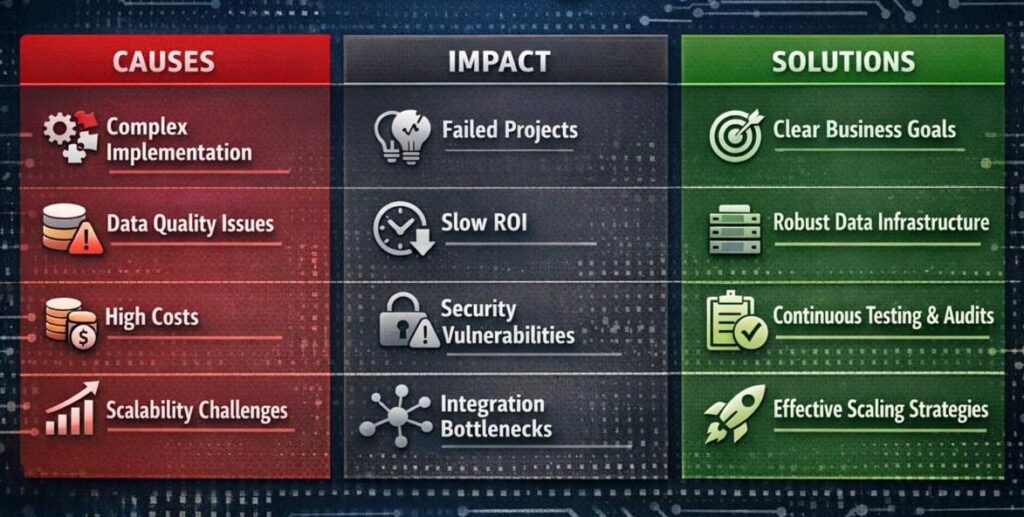
AI projects often take longer than expected, cost more than planned, and fail to deliver immediate ROI. As a result, companies are becoming more selective in how they invest and where they apply AI. Fatigue comes from overexposure to promises — and underdelivery in execution.
Why Companies Are Slowing Down
The shift is driven by several structural challenges. One of the main issues is the complexity of implementation. AI is not a plug-and-play solution. It requires data infrastructure, integration with existing systems, and continuous model improvement. Many organizations underestimate this complexity at the planning stage.
Data readiness is another major barrier. AI systems depend on high-quality, structured, and accessible data. In many companies, data is fragmented across systems, inconsistent, or not available in real time. This limits the effectiveness of AI initiatives.
There is also a growing concern around cost. AI development, infrastructure, and ongoing maintenance can be expensive. Without clear business outcomes, organizations struggle to justify continued investment.
Trust is becoming a critical factor. AI systems can produce unpredictable or non-transparent results. This creates challenges in adoption, especially in industries where accuracy and accountability are essential.
Finally, there is a scaling problem. Many companies successfully build AI prototypes but fail to integrate them into production systems. This creates a gap between experimentation and real impact.
The Numbers Behind AI Fatigue
The shift toward more cautious AI adoption is not just a perception — it is backed by strong and consistent market signals.
AI investment remains high, with over 80–85% of organizations continuing to include AI in their strategic roadmap. However, the way this investment is distributed is changing. Instead of scaling multiple initiatives, companies are concentrating resources on a limited number of use cases that can deliver measurable business impact.
At the same time, execution remains the biggest bottleneck. Nearly 45–50% of AI projects fail to move beyond pilot stages, never reaching full production. This reflects a structural gap between experimentation and operational deployment.
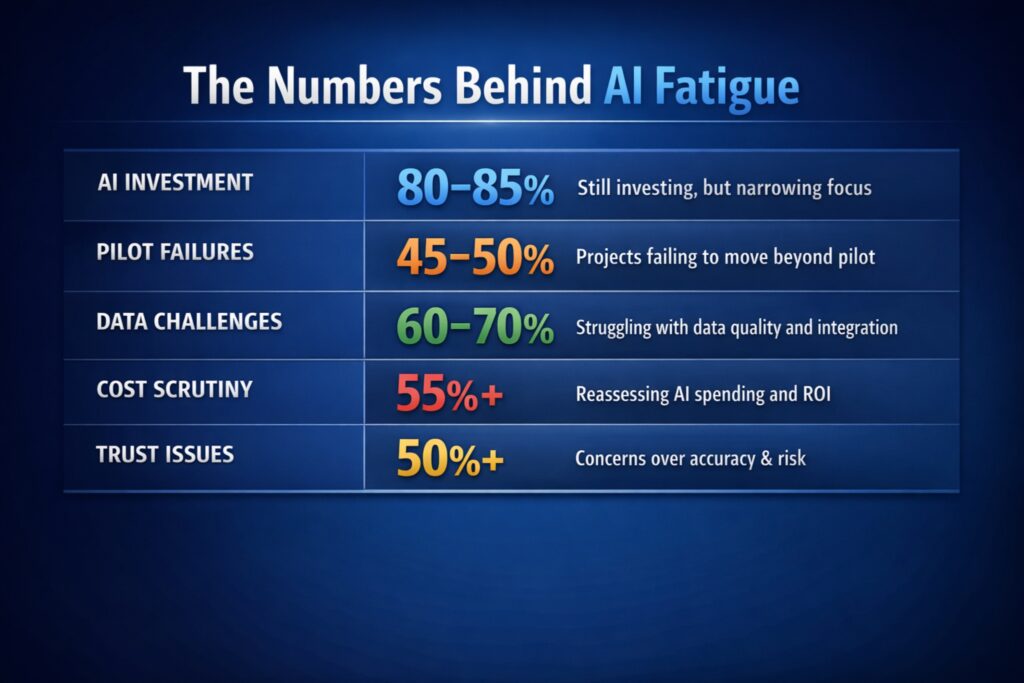
Data remains one of the most critical constraints. Around 60–70% of organizations report challenges with data quality, availability, or integration, directly limiting the performance and scalability of AI systems. In many cases, the issue is not the model — it is the data foundation behind it. Cost pressure is increasing across the board.
From Hype to Practical Value
AI fatigue marks a turning point in how organizations approach technology. Companies are moving away from broad, unfocused experimentation and shifting toward targeted implementation. The question is no longer what AI is capable of, but where it can deliver real, measurable impact. This shift is redefining priorities.
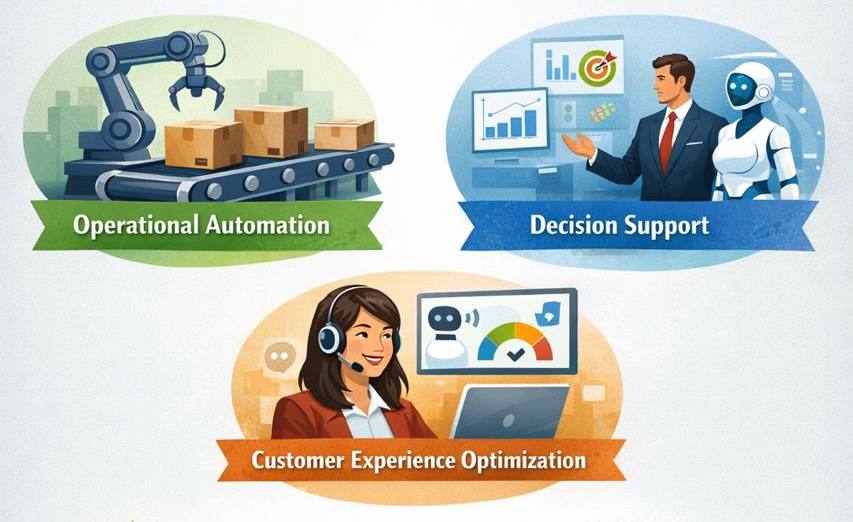
Instead of building isolated AI initiatives, organizations are embedding AI into core business functions — automating operations, supporting decision-making, and enhancing customer experience in ways that directly affect performance.
The focus is no longer on innovation for its own sake. It is on efficiency, scalability, and tangible results. AI is evolving from a standalone initiative into an integrated capability that shapes how businesses operate on a daily basis.
What Successful Companies Do Differently
Organizations that overcome AI fatigue approach it differently. They start with business outcomes, not technology.
Instead of building AI for its own sake, they define clear goals such as cost reduction, revenue growth, or process optimization.
They invest in data infrastructure. Reliable data pipelines, governance, and accessibility are essential for scaling AI.
They focus on integration. AI must be embedded into workflows and systems, not isolated as a separate feature.
They plan for iteration. AI systems require continuous improvement, monitoring, and adaptation.
Most importantly, they measure impact. Success is defined by business results — not by the complexity of models.
Turn AI from hype into real impact — with Ficus Technologies.
Contact usThe Risk of Ignoring AI Fatigue
Ignoring the shift toward AI fatigue can have serious strategic consequences. Organizations that continue investing in AI without a clear direction often fall into the trap of building disconnected solutions — isolated pilots, experimental features, and fragmented systems that never scale. These initiatives consume time, budget, and internal resources, but fail to deliver meaningful business impact.
Over time, this creates internal friction. Teams lose confidence in AI initiatives, stakeholders become more skeptical, and future investments face increased scrutiny. What started as innovation can quickly turn into organizational resistance.
At the same time, there is an opposite risk. Some companies respond to AI fatigue by slowing down too aggressively — cutting budgets, pausing initiatives, or deprioritizing AI altogether. This reaction can be just as dangerous.
Conclusion
AI fatigue is not a sign of failure. It is a sign of maturity.
In 2026, the most successful organizations are not those investing the most in AI — but those using it most effectively. The focus is shifting from potential to performance.
Why Ficus Technologies?
Ficus Technologies helps businesses move beyond AI experimentation and build solutions that are integrated, scalable, and aligned with real business outcomes.
A shift from hype-driven adoption to more cautious, value-focused AI investment.
Due to complexity, cost, data challenges, and scaling issues.
Yes, but adoption is becoming more strategic and selective.
Turning AI from pilot projects into real business impact.




 Success...!