
Modern digital systems are becoming too complex for rigid architectures.
In 2026, businesses are no longer building monolithic platforms that try to do everything at once. Instead, they are moving toward composable architecture — a modular approach that allows systems to be assembled, adapted, and scaled over time. The shift is not just technical. It is strategic.
Product teams building scalable platforms.
Companies transitioning from monoliths to modular systems.
Organizations adopting cloud-native and API-driven approaches.
- Composable architecture enables flexibility and faster adaptation.
- Systems are built from modular, interchangeable components.
- Integration and orchestration become critical capabilities.
- The main challenge is managing complexity, not building components.
What Composable Architecture Really Means
Composable architecture is based on a simple principle: systems should be built from independent, reusable components that can be combined and recombined as needed.
Instead of a single, tightly coupled system, organizations create a set of services, APIs, and modules that work together. This allows businesses to evolve their systems without rebuilding everything from scratch. The key advantage is adaptability.
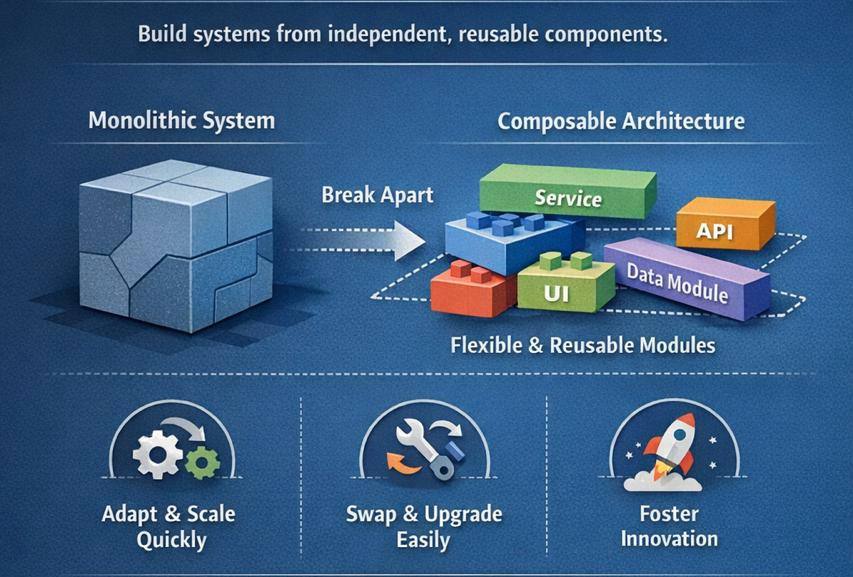
As business requirements change, components can be replaced, updated, or scaled independently. This reduces risk, accelerates development, and supports continuous innovation.
Composable architecture turns systems into platforms — not products.
Why Companies Are Moving Away from Monoliths
Traditional monolithic architectures were designed for stability, not flexibility. They work well in controlled environments, but struggle to adapt to rapid changes. Even small updates can require large deployments, increasing risk and slowing down development cycles.
In contrast, composable systems allow for incremental change. Teams can deploy updates independently, experiment with new features, and scale specific parts of the system without affecting the entire platform. This is especially important in environments where speed and adaptability are critical.
The shift is driven by real business needs. Companies need to respond faster to market changes, integrate new technologies, and support distributed teams and systems. Monoliths cannot keep up with this level of complexity.
Core Principles of Composable Systems
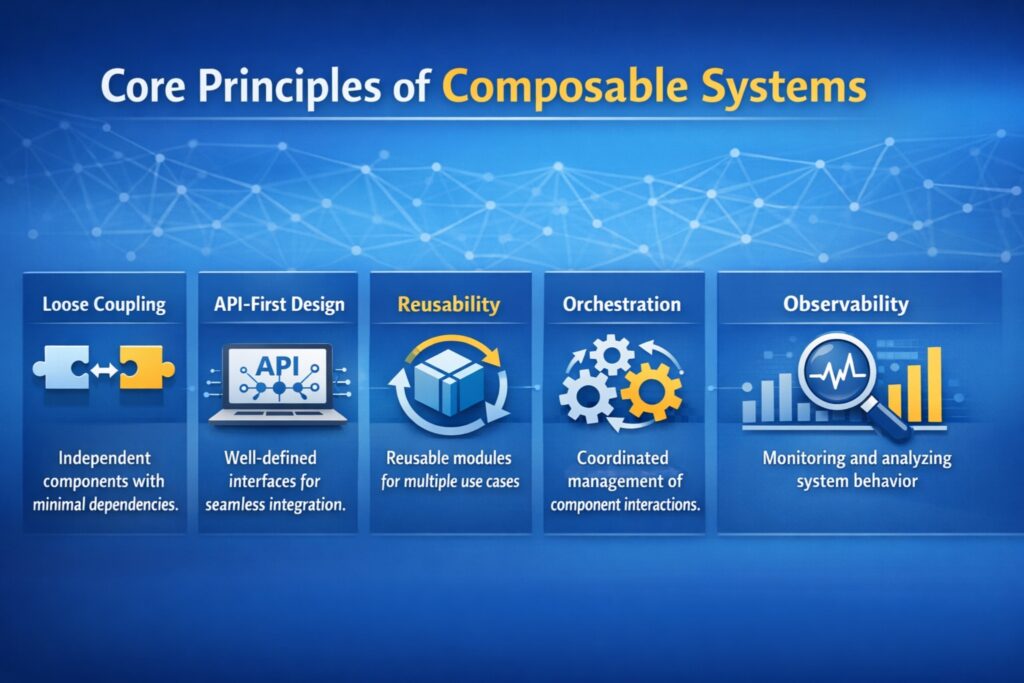
Composable architecture is not just about breaking systems into parts — it is about how those parts interact.
Loose coupling is essential. Components should operate independently, minimizing dependencies and allowing for easier updates and replacements.
API-first design is another key principle. All components communicate through well-defined interfaces, ensuring consistency and interoperability.
Reusability plays a central role. Modules should be designed to be reused across different parts of the system, reducing duplication and increasing efficiency.
Orchestration becomes critical. As systems become more modular, managing interactions between components requires strong coordination mechanisms.
Finally, observability is essential. Organizations must be able to monitor system behavior across multiple components to ensure reliability and performance.
The Business Value of Composable Architecture
Composable architecture directly impacts how businesses operate. It increases speed by enabling faster development and deployment cycles. It reduces risk by isolating changes to specific components. It improves scalability by allowing systems to grow incrementally.
But the most important impact is strategic. Companies can adapt their systems to new requirements without major redesigns. This enables continuous innovation and long-term flexibility. Composable systems align technology with business agility.
Build systems that adapt — with Ficus Technologies.
Contact usThe Challenges of Going Composable
Despite its advantages, composable architecture introduces new challenges.
The biggest one is complexity. Managing multiple components, services, and integrations requires strong architectural discipline. Without it, systems can become fragmented and difficult to maintain.
Integration is another major challenge. Ensuring that all components work together seamlessly requires well-designed APIs and reliable communication mechanisms.
There is also a need for cultural change. Teams must adopt new ways of working, including DevOps practices, automation, and cross-functional collaboration.
Governance becomes more important. Organizations must define standards, manage dependencies, and ensure consistency across components.
Without proper governance, flexibility can turn into chaos.
Composable vs Traditional Architecture
The difference between composable and traditional systems is not just structural — it is operational. Traditional systems prioritize control and stability. Composable systems prioritize flexibility and adaptability.
In a composable model, change is expected. Systems are designed to evolve continuously, rather than remain static. This aligns with the reality of modern business environments, where change is constant.
The Future of Composable Systems
Composable architecture is becoming a foundation for modern digital ecosystems. It supports multi-cloud environments, integrates with AI systems, and enables real-time data processing.
As organizations continue to adopt distributed systems, composability will become a standard approach rather than a competitive advantage. The focus will shift from building systems to orchestrating them.
In a world of constant change, the ability to adapt is the ultimate competitive advantage.
Jeff Bezos
Conclusion
Composable architecture represents a fundamental shift in how digital systems are designed and managed.
In 2026, the goal is no longer to build complete systems — it is to build systems that can evolve.
Organizations that adopt composable approaches can move faster, adapt better, and scale more effectively.
Why Ficus Technologies
Ficus Technologies helps businesses move beyond rigid systems and build composable architectures that are truly scalable, flexible, and aligned with real business needs.
We focus not only on technology, but on how systems support growth, adaptability, and long-term strategy. Our approach combines architecture design, integration, and platform thinking to ensure that every component works as part of a cohesive ecosystem.
From breaking down monolithic systems to designing modular, API-driven environments, we help organizations transition to architectures that can evolve over time — without constant reengineering.
A modular approach to building systems from independent components.
It enables flexibility, scalability, and faster adaptation.
Complexity, integration, and governance.
It is most beneficial for organizations with growing, complex systems.







 Success...!