Technology is no longer evolving in isolated trends. In 2026, innovation is happening at the intersection of AI, data, infrastructure, and security.
For CIOs, the challenge is not discovering new technologies — it is identifying which ones can deliver real business value and scale within existing environments.
The focus is shifting from experimentation to execution.
Enterprise architects building scalable and distributed systems.
Innovation teams evaluating emerging technologies.
Organizations prioritizing digital transformation and modernization.
- Not all emerging technologies deliver immediate value — prioritization is critical.
- AI, real-time data, and distributed infrastructure are becoming foundational capabilities.
- The biggest challenge is not adoption, but integrating technologies into real systems.
- Organizations that focus on execution and scalability gain the strongest competitive advantage.
The 2026 Technology Context
The current technology landscape is defined by convergence.
AI, cloud, edge computing, and data platforms are no longer separate domains. They operate as interconnected systems that drive automation, real-time processing, and intelligent decision-making.
At the same time, organizations are becoming more distributed. Applications run across multiple environments, data is processed closer to users, and systems must operate in real time.
This shift increases both opportunity and complexity. CIOs must evaluate technologies not as isolated tools, but as part of a broader ecosystem.
AI as Core Capability
AI is no longer an experimental layer or a separate initiative within organizations. It is becoming a foundational capability that shapes how systems operate, how decisions are made, and how products deliver value.
Leading organizations are moving beyond isolated use cases and embedding AI directly into core workflows. This includes automating operational processes, enhancing decision-making with predictive models, and enabling systems to continuously adapt based on real-time data.
The key shift is from using AI as a tool to treating it as infrastructure.
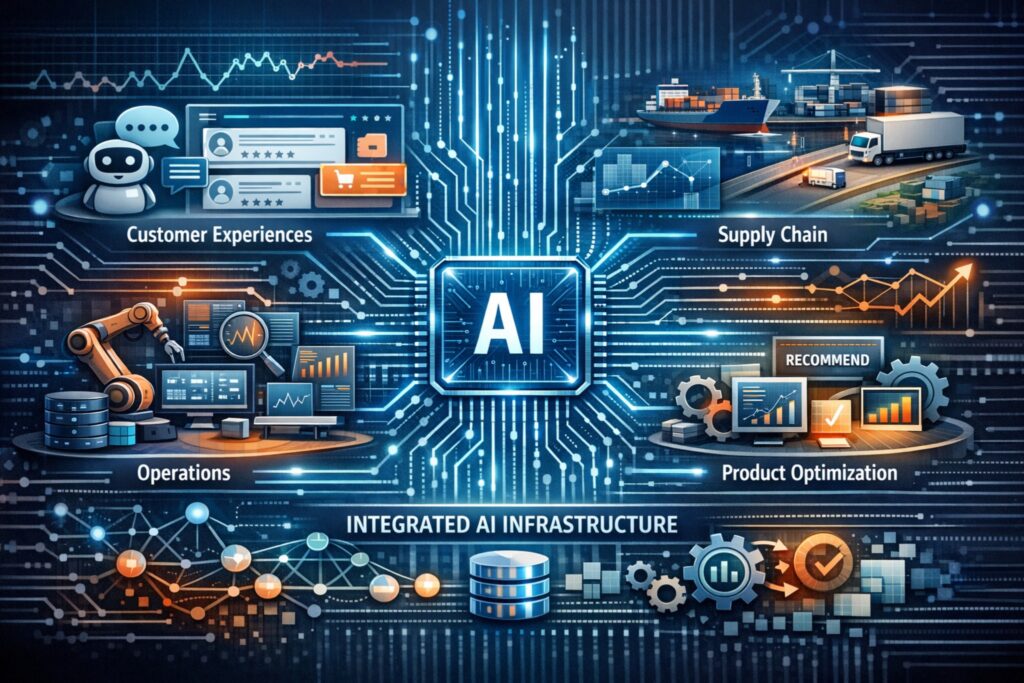
AI is now integrated into customer interactions, supply chains, internal operations, and product functionality. Recommendation engines, anomaly detection, forecasting systems, and intelligent automation are becoming standard components rather than advanced features.
However, the real value of AI does not come from models alone. It comes from how well those models are integrated into business processes, supported by reliable data pipelines, and continuously improved through feedback loops. Organizations that treat AI as a disconnected capability often fail to scale it.
In contrast, companies that build AI into their architecture create systems that learn, optimize, and evolve over time.
Real-Time Data Platforms
Batch processing is no longer sufficient for modern business environments.
Organizations are moving toward real-time data platforms that allow them to process, analyze, and act on data as it is generated. This shift is driven by the need for faster decision-making, more responsive systems, and improved customer experiences.
In practice, this means moving away from static reports toward continuous data flows. Real-time platforms enable organizations to monitor user behavior, detect anomalies, adjust operations, and optimize processes instantly. Instead of waiting hours or days for insights, teams can respond within seconds.
This capability is becoming critical across industries. In finance, real-time analytics supports fraud detection and risk management. In e-commerce, it enables dynamic pricing and personalized recommendations. In operations, it allows systems to react to disruptions as they occur.
However, building real-time systems requires more than just tools. Organizations must invest in streaming data pipelines, scalable processing infrastructure, and architectures that can handle high volumes of data without delays. Data consistency, latency, and reliability become key design considerations.
Market Signals and Adoption Trends
Technology adoption is accelerating across industries, but the way organizations adopt and scale new capabilities is changing.
AI is now a core investment area rather than an experimental initiative. More than 80% of organizations include AI in their strategic roadmap, and for many, it is already embedded into key business processes such as operations, customer experience, and decision-making.
At the same time, infrastructure is becoming increasingly distributed. Over 70% of enterprise data is now processed outside traditional centralized data centers, reflecting the shift toward hybrid and edge environments. Organizations are no longer relying on a single location for data processing — instead, they are building systems that operate across multiple environments simultaneously. Speed is becoming a critical differentiator.
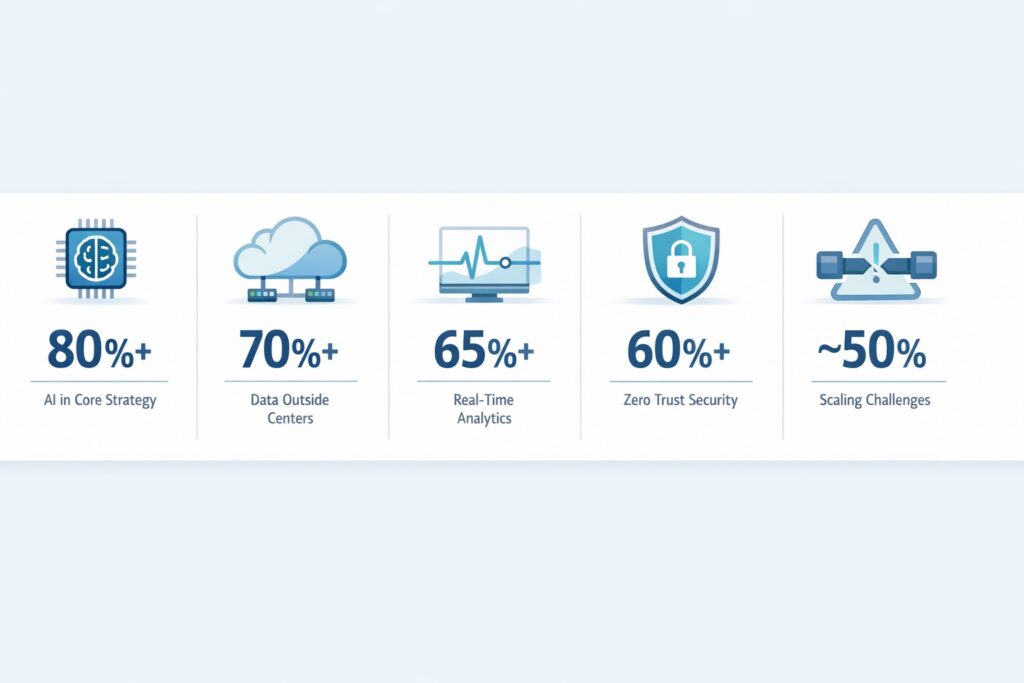
Around 65% of organizations prioritize real-time data capabilities, enabling them to react instantly to changes in user behavior, operational performance, and market conditions. This shift is transforming how decisions are made — from periodic analysis to continuous, data-driven execution.
Security strategies are evolving in parallel with this complexity. More than 60% of companies are implementing Zero Trust principles, moving away from perimeter-based security toward identity-based access and continuous verification. This reflects the need to secure distributed systems where traditional boundaries no longer apply.
However, despite strong adoption, a significant gap remains between experimentation and execution. Nearly 50% of organizations struggle to scale emerging technologies beyond pilot projects. Many initiatives remain isolated because they are not integrated into existing systems, lack data readiness, or do not align with business processes.
Security as a Built-In Layer
Security is no longer a standalone function that can be added after systems are designed and deployed. In modern digital environments, this approach simply does not work.
Infrastructure is distributed, applications run across multiple environments, and users access systems from anywhere. Traditional network boundaries have disappeared, making perimeter-based security models ineffective.
As a result, security is now embedded directly into every layer of the architecture. This includes identity and access management, infrastructure configuration, application logic, and data handling. Security is not a separate control — it is part of how systems are built and how they operate.
The core shift is from perimeter-based security to identity-based security. Zero Trust has become the baseline model. Every user, device, and service must continuously verify identity before accessing resources. Access decisions are no longer based on network location, but on identity, context, behavior, and risk signals.
This fundamentally changes how systems are protected. Instead of assuming that internal environments are safe, organizations treat every interaction as potentially untrusted. This reduces the risk of unauthorized access and limits lateral movement within systems if a breach occurs.
Turn emerging technologies into scalable, business-driven solutions.
Contact usConclusion
Emerging technologies are reshaping how organizations operate, but not all of them will deliver value.
CIOs must focus on technologies that integrate, scale, and support real business outcomes.
In 2026, competitive advantage will not come from adopting the latest tools, but from building systems that work together effectively.
Why Ficus Technologies?
At Ficus Technologies, we help organizations evaluate and implement emerging technologies by aligning innovation with architecture, data, and business strategy.
AI, distributed infrastructure, real-time data platforms, and security architectures.
Because of integration challenges and lack of execution.
Execution.
Based on business impact, scalability, and integration.




 Success...!