
Data is everywhere — but trust in data is not.
In 2026, organizations generate more data than ever. Yet many still struggle with broken pipelines, inconsistent data, and unreliable analytics.
The problem is not data volume. It is lack of structure and accountability. This is where data contracts come in.
Data engineers and platform teams.
Companies building data-driven products.
Organizations struggling with data reliability.
- Data contracts define how data should be structured and used.
- They reduce errors, improve reliability, and enable scalability.
- They introduce accountability between data producers and consumers.
- They are becoming essential in modern data architectures.
What Data Contracts Really Mean
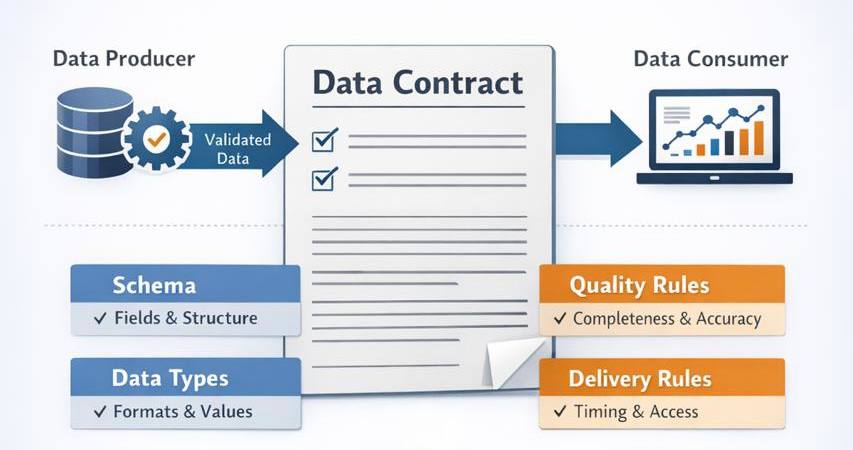
A data contract is a formal agreement that defines how data is structured, validated, and exchanged between systems.
It sets clear rules for how data should behave across the entire pipeline.
This includes:
- Data schema — what fields exist and how they are organized
- Data types — what values are expected and in what format
- Data quality requirements — completeness, consistency, and accuracy
- Delivery rules — how, when, and in what form data is delivered
In modern architectures, data flows continuously between multiple services, platforms, and teams. These systems evolve independently, which creates a high risk of inconsistency.
Even minor changes — such as modifying a field, changing a format, or altering data structure — can break downstream processes. Without clear agreements, these issues are often discovered too late.
Data contracts address this problem at the source. They define expectations before data is produced and ensure that any changes are controlled and validated. If data does not meet the defined contract, it is flagged immediately — before it impacts other systems.
This introduces stability into otherwise dynamic environments. It also creates a clear responsibility model.
Data producers are accountable for maintaining the structure and quality of data. Data consumers can rely on consistent inputs without additional validation layers. As a result, data flows become more predictable.
Why Modern Data Systems Need Them
Modern data architectures are distributed. Data flows across multiple systems, teams, and platforms — often in real time. Without clear agreements, even small changes can break pipelines.
A change in schema. A missing field. A different data format.
These issues propagate quickly. Data contracts prevent this. They ensure that changes are controlled, validated, and communicated. In complex systems, this is not optional — it is necessary.
The Problem Without Data Contracts
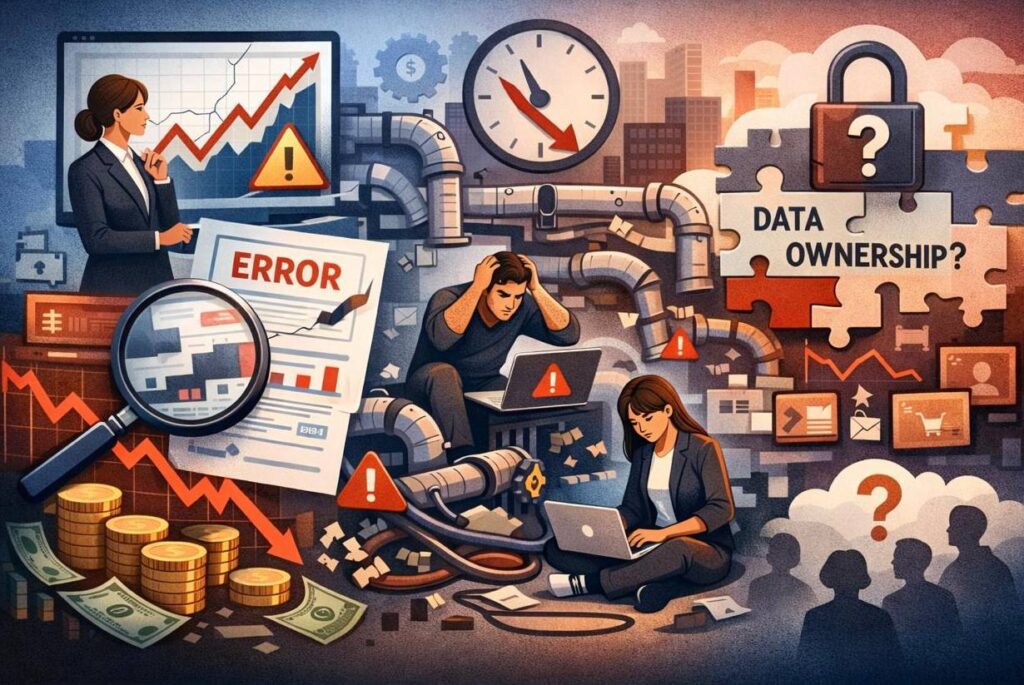
Without data contracts, organizations face recurring issues. Pipelines break unexpectedly. Data becomes inconsistent across systems. Teams spend time debugging instead of building.
There is also a lack of ownership. When data issues occur, it is often unclear who is responsible. This creates delays, inefficiencies, and frustration across teams. Over time, trust in data decreases. And without trust, data-driven decisions become unreliable.
The Business Impact of Data Contracts
Data contracts directly improve system reliability.
They reduce pipeline failures by enforcing structure and validation.
They improve data quality by defining clear expectations.
They accelerate development by reducing debugging and rework.
But the most important impact is trust.
Organizations can rely on data for decision-making, analytics, and AI systems.
Data contracts turn data from a risk into an asset.
The Numbers Behind Data Reliability
The growing importance of data contracts is reflected in how organizations struggle with data reliability today. More than 60% of organizations report recurring data quality issues, which directly impact analytics, reporting, and decision-making. In many cases, business decisions are made on incomplete or inconsistent data. At the same time, over 70% of data engineers spend a significant portion of their time maintaining and fixing pipelines, rather than building new data capabilities. Instead of driving innovation, teams are forced into reactive work. The cost of unreliable data is substantial.
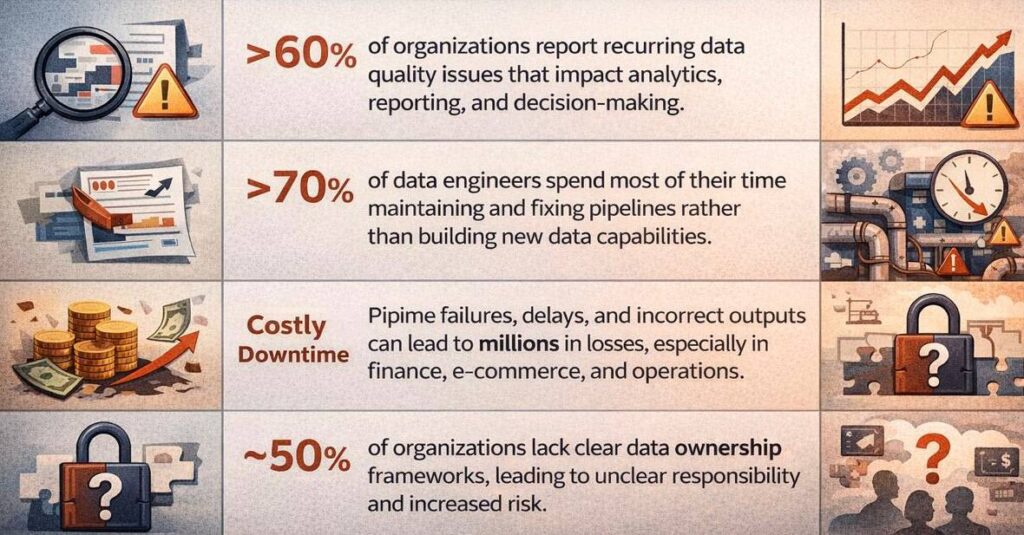
Data downtime — whether caused by pipeline failures, delays, or incorrect outputs — can lead to millions in losses, especially in data-driven environments such as finance, e-commerce, and operations. Another critical issue is ownership. Nearly 50% of organizations lack clearly defined data ownership and governance frameworks. When something breaks, responsibility is unclear, which slows down resolution and increases risk. There is also a hidden impact.
How Data Contracts Work in Practice
Data contracts introduce structure into data systems. Producers define how data is created and structured. Consumers define how data is used and what they expect.
Contracts are validated automatically. If data does not meet the contract, issues are detected early — before they affect downstream systems.
Versioning is also important. Changes to data must be managed carefully to avoid breaking dependencies. This creates a controlled environment where data can evolve safely.
Challenges of Implementing Data Contracts
Data contracts introduce new requirements. One challenge is adoption. Teams must agree on standards and processes, which requires coordination.
There is also a tooling aspect. Organizations need systems to define, validate, and monitor contracts.
Cultural change is another factor. Teams must take ownership of data quality — not just data delivery. Without alignment, contracts may exist but not be enforced.
From Data Pipelines to Data Products
Data contracts are not just a technical improvement — they drive a fundamental shift in how organizations approach data. Traditionally, data has been treated as a byproduct. Systems generate data as part of their operation, and other teams consume it when needed. This approach works at a small scale, but breaks down in complex environments where data flows across multiple systems and teams.
The result is inconsistency, lack of ownership, and unreliable pipelines. The concept of data products changes this completely.
Instead of passively generating data, organizations begin to design it intentionally — with clear structure, purpose, and responsibility. Data becomes something that is owned, maintained, and continuously improved.
Conclusion
Data contracts are becoming a missing layer in modern data architectures.
In 2026, organizations that rely on data without structure face increasing risk. The companies that succeed are those that treat data as a system —
not just a resource.
Why Ficus Technologies?
Ficus Technologies helps businesses design reliable data architectures with clear contracts, governance, and scalable data pipelines.
An agreement defining how data is structured and delivered.
It ensures reliability and prevents pipeline failures.
Data engineers, platform teams, and organizations with complex data systems.
Inconsistent data, broken pipelines, and lack of accountability.




 Success...!