

For years, microservices were presented as the inevitable future of software architecture. Organizations across industries invested heavily in decomposing monolithic applications into independently deployable services, expecting greater scalability, faster development, and increased agility.
While these expectations were often justified, the reality proved more complex. As distributed architectures matured, many engineering teams discovered that breaking systems into hundreds of services introduced operational challenges that were just as significant as the limitations of the monoliths they replaced.
By 2026, the conversation has shifted. Organizations are no longer asking whether monoliths or microservices are better. Instead, they are asking which architectural model best supports their business, engineering capabilities, and long-term growth.
Architecture is becoming less about following trends and more about making deliberate design decisions based on complexity, scale, and operational maturity.
Engineering teams modernizing legacy systems and building cloud-native applications.
Organizations evaluating distributed architectures to improve scalability, resilience, and long-term business growth.
- Microservices remain a powerful architectural approach, but they are no longer viewed as the default solution for every application.
- What works in 2026 is selecting an architecture that reflects product complexity, organizational maturity, and operational requirements.
- What fails is adopting distributed systems before teams, processes, and platforms are ready to support them.
Why Monoliths Fell Out of Favor
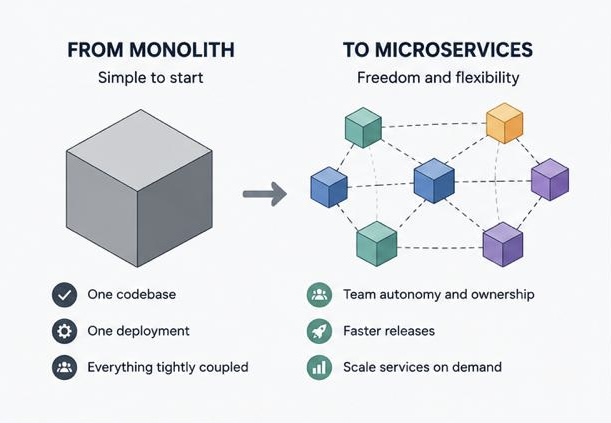
Traditional monolithic applications offered simplicity: one codebase, one deployment process, and one place where business logic lived. For early-stage products and smaller teams, this model often worked well because it reduced operational overhead and allowed developers to move quickly without managing distributed infrastructure.
The problems usually appeared later, when the product grew, teams expanded, and changes became harder to coordinate. Large monoliths made deployments riskier, slowed development across teams, and forced organizations to scale entire applications even when only one part of the system needed more capacity.
This created pressure to move toward architectures that could support independent delivery, clearer ownership, and more flexible scaling. Microservices emerged as a response to real limitations, not simply as an architectural trend.
Microservices Solved Real Problems — and Created New Ones
Microservices helped organizations break large systems into smaller, independently deployable services. Teams could own specific domains, release changes without coordinating across the entire application, and scale services based on actual demand. For large platforms with complex business logic and high traffic, these advantages remain important.
However, distributed systems introduced a different type of complexity. Instead of managing one application, organizations had to manage service communication, API contracts, network latency, observability, security boundaries, deployment pipelines, and data consistency across many moving parts.
In many cases, engineering effort shifted away from building product features toward maintaining the platform itself. The architecture became more flexible, but the operating model became more demanding.
Complexity Has Become the New Bottleneck
Today’s software challenges are often less about writing code and more about managing interactions between systems. Cloud-native adoption has made distributed architectures more common, but it has also increased the need for strong platform practices, observability, automation, and governance.
Industry research from CNCF continues to show broad adoption of Kubernetes and cloud-native technologies, while organizations also report persistent challenges around complexity, security, monitoring, and operational consistency. Google Cloud’s DORA research reaches a similar conclusion: high-performing engineering organizations succeed not because they choose a particular architecture by default, but because they combine technical design with strong delivery and operational practices.
These findings suggest an important shift. Distributed architecture alone does not improve software delivery. Operational maturity does.
The Return of the Modular Monolith
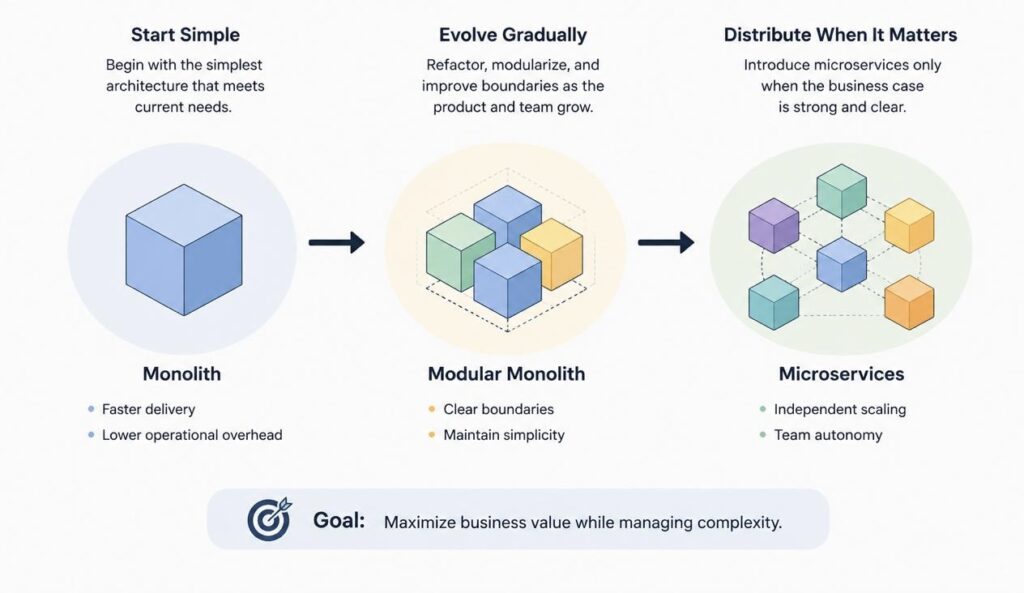
Rather than abandoning microservices entirely, many organizations are moving toward a more balanced architectural model. The modular monolith combines the operational simplicity of a single deployable application with clearer internal boundaries between business domains.
In this model, teams organize the system into well-defined modules before deciding whether those modules should become separate services. This allows companies to maintain simpler deployment, reduce infrastructure overhead, and avoid unnecessary distributed complexity while still improving maintainability.
For many products, especially those that are still evolving, a modular monolith can provide a stronger foundation than premature microservices. It gives teams room to understand the business domain before committing to service boundaries that may later become expensive to change.
Architecture Should Follow the Business
One of the clearest lessons from the last decade is that architecture should reflect business complexity rather than technology preference. Organizations serving millions of users across multiple regions may need distributed services because their scale, reliability requirements, and team structure justify the added complexity.
Smaller products, internal platforms, and early-stage systems often benefit from simpler architectures that reduce coordination overhead and allow teams to deliver value faster. In these cases, the cost of managing distributed systems can outweigh the benefits.
The objective is not to maximize architectural sophistication but to maximize business effectiveness. Architecture should make the organization faster, clearer, and more resilient. If it does not, the design is solving the wrong problem.
Architecture is about the important stuff. Whatever that is.
Ralph Johnson, co-author of Design Patterns
High-Performing Teams Optimize for Simplicity
Successful engineering teams increasingly treat architecture as something that evolves with the product. They do not start with the most complex model available. They begin with the simplest structure that supports current requirements and introduce distribution only when the business case is clear.
This approach aligns with the broader direction of modern software engineering. Thoughtworks and other engineering organizations continue to emphasize evolutionary architecture, where systems change gradually as teams learn more about business needs, performance constraints, and operational demands.
The strongest teams are not those that use microservices everywhere. They are the ones that know when not to.
Choosing Architecture Over Architecture Trends
The debate between monoliths and microservices often creates the impression that one model must replace the other. In reality, mature engineering organizations increasingly reject this binary thinking.
The right architecture depends on practical questions. How quickly can teams deliver changes? How difficult is the system to operate? How expensive is maintenance becoming? Does the architecture support future growth without introducing unnecessary complexity?
These questions produce better decisions than simply following industry trends. The strongest platforms are rarely the most complicated ones. They are the ones that remain understandable, adaptable, and aligned with business needs.

Looking for the right architecture for your next platform?
Contact usConclusion
The evolution from monoliths to microservices reflects the broader maturity of software engineering. Microservices solved important problems for large-scale platforms, but they also demonstrated that architectural complexity carries real operational costs.
In 2026, organizations increasingly recognize that successful architecture is not defined by the number of services, containers, or deployment pipelines. It is defined by how effectively software supports business outcomes.
Whether that means a modular monolith, microservices, or a hybrid model depends on the product, the organization, and the challenges being solved. The future belongs not to one architectural style, but to architectures designed with intention rather than assumption.
Why Ficus Technologies?
Ficus Technologies helps organizations design software architectures that balance scalability, maintainability, and operational efficiency.
Rather than applying architectural trends indiscriminately, Ficus works with businesses to evaluate technical requirements, product maturity, and long-term growth objectives before selecting the right approach.
Whether modernizing legacy applications, designing cloud-native platforms, or evolving toward distributed systems, Ficus focuses on architectures that remain resilient, adaptable, and aligned with business goals.
No. Organizations increasingly choose architectures based on business requirements rather than industry trends.
A modular monolith is a single application organized into well-defined modules with clear internal boundaries, allowing simpler operations while preserving architectural flexibility.
Microservices are most valuable for large, complex platforms where independent scaling, autonomous teams, and distributed deployment provide measurable business benefits.
There is no universal answer. The best architecture is the one that matches product complexity, engineering maturity, and business objectives.







 Success...!