
Synthetic data is becoming one of the most practical responses to a problem many companies now face: they need more data for AI, analytics, testing, and automation, but real-world data is often sensitive, incomplete, restricted, or difficult to access.
By 2026, the discussion is no longer limited to whether artificial data can be useful. The more important question is how companies can use it safely. Synthetic data can reduce privacy exposure, accelerate AI development, and support testing in regulated environments. But it can also introduce false assumptions, hidden bias, and governance risks if treated as a simple replacement for real data.
For business leaders, the value of synthetic data depends on discipline. It works when it is generated for a specific purpose, validated against real-world patterns, and governed as part of the data lifecycle. It fails when companies treat it as risk-free data.
Product, AI, and engineering teams building reliable AI systems with limited or sensitive datasets.
Organizations operating in regulated industries that require secure testing, compliant AI development, and scalable training environments.
- Synthetic data helps companies use artificial datasets when real data is limited, sensitive, or difficult to access.
- What works in 2026 is using synthetic data with clear governance, validation, privacy controls, and defined business use cases.
- What fails is assuming that artificial data is automatically safe, unbiased, or accurate enough for production decisions.
Why Synthetic Data Is Becoming More Important
The demand for synthetic data is growing because companies are under pressure to build more intelligent systems while protecting sensitive information. AI models, analytics platforms, and automated workflows all depend on data, but access to real data is often constrained by privacy rules, security requirements, and operational silos.
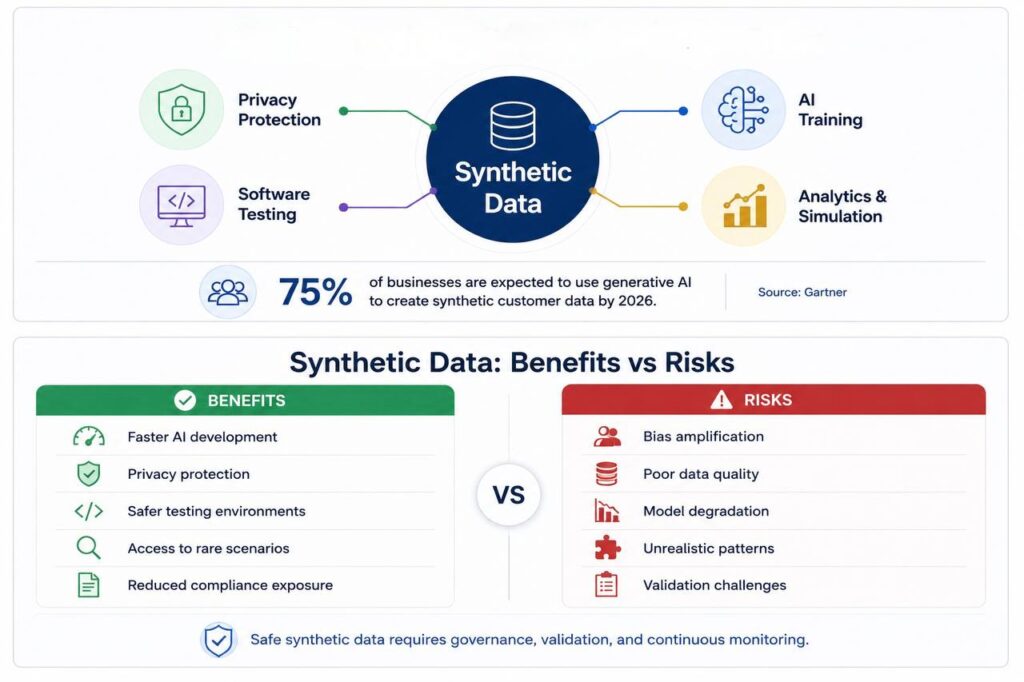
Synthetic data offers a way to create realistic artificial datasets that preserve useful patterns without directly exposing real customer or business records. It can support model training, software testing, fraud simulation, risk analysis, and product development.
The main advantage is not that synthetic data replaces real data entirely. Its value comes from expanding what teams can safely test, model, and improve without increasing exposure to sensitive information.
Synthetic Data Is Not Automatically Safe
One of the biggest misconceptions is that synthetic data removes risk by default. In practice, safety depends on how the data is generated, validated, and used.
Poorly generated synthetic data can reproduce bias from source datasets. It can overfit to real records and create re-identification risks. It can also produce patterns that look realistic but fail under real-world conditions.
This is why mature organizations treat synthetic data as a governed asset rather than a shortcut. They define where it can be used, how it must be tested, and which decisions still require real-world validation.
Synthetic data reduces certain risks, but it does not remove the need for accountability.
Enterprise Adoption Is Moving From Experimentation to Governance
Synthetic data is moving into mainstream enterprise AI discussions because the need for safe, scalable data is increasing. Gartner has identified synthetic data as a key capability for overcoming enterprise data limitations and enabling AI innovation, while also warning that failures in managing synthetic data can create risks for governance, model accuracy, and compliance.
The World Economic Forum defines synthetic data as artificially generated data created through statistical or AI-based methods, often used to address privacy, scarcity, availability, and representativeness challenges. This reflects why the technology is becoming more relevant across regulated and data-intensive industries.
The market signal is clear: companies are not adopting synthetic data only because they want more training material. They are adopting it because traditional data access models are becoming too slow, sensitive, and restrictive for modern AI development.
Where Companies Use Synthetic Data Safely
The safest use cases are usually those where synthetic data supports development, testing, and simulation rather than replacing real-world judgment entirely.
In software engineering, synthetic data allows teams to test systems without exposing customer records. In financial services, it can support fraud detection scenarios and transaction simulation. In healthcare, it can help researchers and developers work with realistic patterns while reducing exposure to identifiable patient data. In retail and customer analytics, it can support segmentation models without relying on raw personal data.
The strongest use cases share one characteristic: synthetic data is used to reduce risk in controlled environments, not to avoid responsibility in production environments.
Validation Matters More Than Generation
Generating synthetic data is only the first step. The more important question is whether the data is useful, representative, and safe enough for the intended purpose.
Companies need to test whether synthetic datasets preserve the statistical relationships that matter. They also need to evaluate whether rare cases, edge conditions, and minority patterns are represented correctly. Without validation, synthetic data can create confidence in models that perform well in artificial environments but fail in real operations.
This is especially important for AI systems that influence decisions. If synthetic data is used to train or test models, teams must understand where artificial patterns differ from real-world behavior.
Safe synthetic data is not just generated. It is measured.
The Risk Is Shifting From Data Access to Data Quality
As synthetic data becomes easier to produce, the main challenge shifts from availability to quality control. IBM has positioned synthetic datasets as a way to support AI model training and testing in enterprise environments, including areas such as payments, banking, anti-money laundering, and insurance.
At the same time, public discussion around synthetic data increasingly highlights the risk of model degradation when AI systems are trained repeatedly on artificial or low-quality generated data. Recent reporting has noted that major AI companies are using synthetic data to supplement scarce real-world data, while researchers continue to warn about risks such as hallucination, bias amplification, and model collapse.
This creates a practical lesson for enterprises. Synthetic data should be used to expand and protect data workflows, but not as an unchecked substitute for real-world feedback. The safest strategies combine artificial data with validation, monitoring, and carefully selected real data benchmarks.
Governance Defines Safe Use
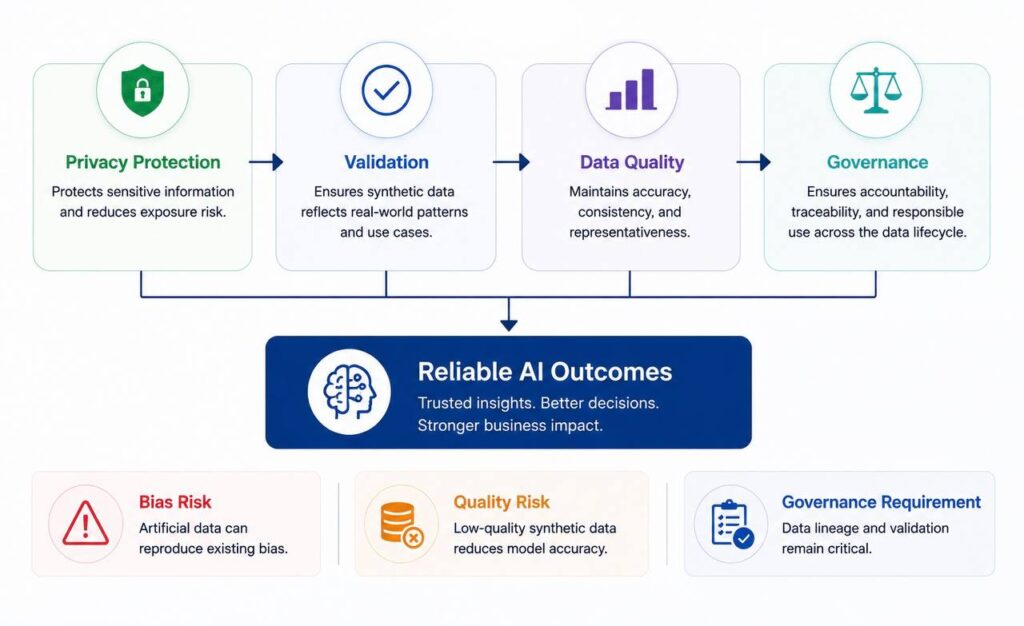
Safe use of synthetic data depends on governance. Companies need clear policies for generation methods, source data, privacy thresholds, validation requirements, and approved use cases.
Ownership also matters. Data teams may generate synthetic datasets, but product, security, legal, and compliance teams all have a role in defining acceptable use. Without shared ownership, synthetic data can move into systems where its limitations are poorly understood.
Governance should answer practical questions. What source data was used? What privacy protections were applied? What assumptions were introduced? Which models or systems depend on this dataset? When must the dataset be refreshed or retired?
Synthetic data becomes safer when its lifecycle is visible.
What Loses Relevance in 2026
Several early assumptions about synthetic data are becoming less useful. The idea that synthetic data is always anonymous is too simplistic. The assumption that more artificial data automatically improves AI systems is also weakening.
Companies are also moving away from one-off synthetic data experiments that are disconnected from real data governance. Standalone generation tools provide limited value if teams cannot validate outputs, trace lineage, or connect datasets to business requirements.
What loses relevance is the idea of synthetic data as a technical trick. What matters is synthetic data as part of a controlled data strategy.
Need a safer data strategy for AI development?
Contact usConclusion
Synthetic data is becoming an important capability for companies building AI-enabled systems, but its value depends on safe implementation.
The strongest organizations use synthetic data to reduce privacy exposure, improve testing, simulate rare scenarios, and accelerate AI development. They do not treat it as risk-free or universally accurate.
In 2026, the question is not whether companies should use artificial data. The question is whether they can govern it, validate it, and connect it to real business outcomes.
Synthetic data is most effective when it expands what companies can safely build without weakening trust, accountability, or model quality.
Why Ficus Technologies?
Ficus Technologies helps companies design scalable data and AI-enabled platforms where innovation, security, and governance work together.
As organizations adopt synthetic data for AI training, analytics, and testing, they need architectures that protect sensitive information while maintaining quality, traceability, and operational control.
Ficus focuses on building cloud-native systems, secure data workflows, and AI-ready platforms that allow companies to use synthetic and real-world data responsibly. The goal is not simply to generate more data, but to create data environments that are safe, reliable, and ready for scale.
Synthetic data is artificially generated data that imitates the structure and statistical patterns of real data without directly copying real-world records.
Not automatically. Privacy depends on how the data is generated, tested, and governed.
Common use cases include AI model training, software testing, fraud simulation, healthcare research, customer analytics, and data sharing in regulated environments.
Usually not entirely. It works best when combined with real-world validation and clear benchmarks.
The biggest risk is using artificial data without understanding its limitations, bias, or difference from real-world behavior.





 Success...!