
Technology trends in 2026 are no longer defined by what is new — they are defined by what businesses actively search for.
Search behavior has become one of the most accurate signals of real demand. It reflects not what companies talk about, but what they are actually trying to implement, fix, or scale.
The shift is clear: organizations are no longer exploring technology. They are trying to make it work.
- Technology searches are now outcome-driven, not exploratory.
- AI, security, cost optimization, and integration dominate demand.
- The biggest gap in 2026 is not adoption — it is execution.
Search Behavior Is Now Business Strategy
Search is no longer about curiosity. It is about intent.
In previous years, companies searched for general concepts — what AI is, how cloud works, or why digital transformation matters. In 2026, those queries have been replaced by highly specific, problem-oriented searches.
Organizations are looking for ways to integrate AI into workflows, reduce infrastructure costs, secure distributed systems, and scale without breaking existing architecture. This reflects a deeper shift.
Technology is no longer a strategic idea — it is an operational tool. And search behavior is where this shift becomes visible.
What Businesses Are Actually Searching For
The most important change is not in what technologies are popular, but in how they are being searched.
AI remains the dominant theme, but the focus is no longer on capabilities. Companies are searching for impact — how AI improves operations, reduces costs, or accelerates decisions.
At the same time, cost has become a central concern. As infrastructure grows more complex, organizations are actively looking for ways to optimize spending without sacrificing performance. Efficiency is no longer optional — it is a requirement.
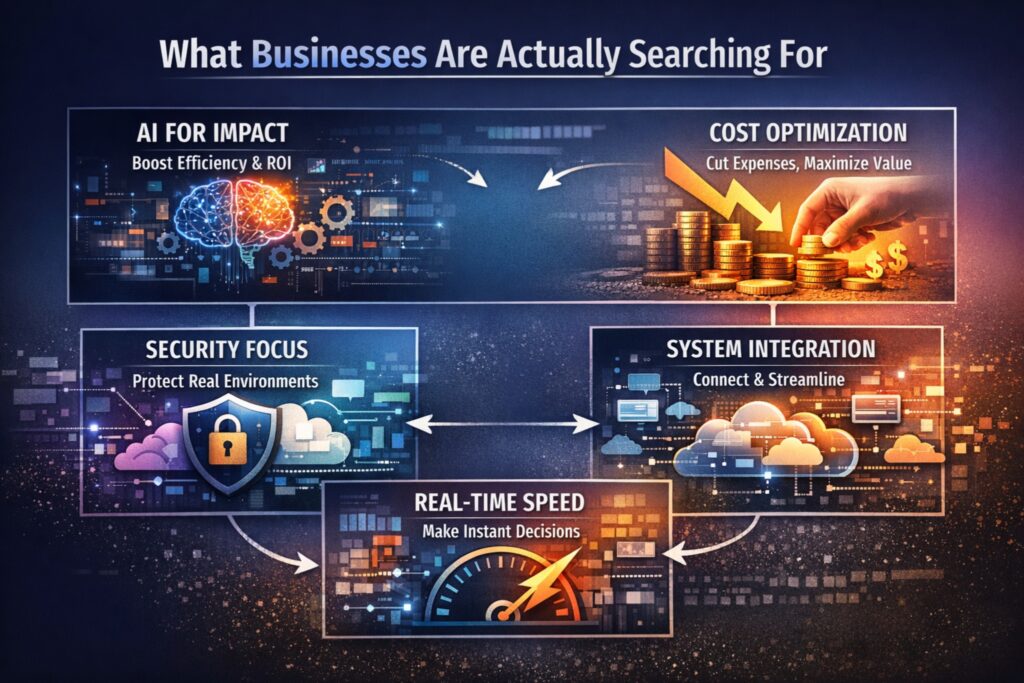
Security searches are also evolving. Businesses are no longer interested in abstract protection models. They are focused on securing real environments — cloud systems, remote teams, APIs, and distributed architectures.
Integration has quietly become one of the most critical topics. As companies adopt more tools, the main challenge is no longer access to technology, but the ability to connect systems into a unified architecture.
And finally, speed is driving demand. Real-time data is no longer a competitive advantage — it is becoming a baseline expectation. Companies are searching for ways to move from delayed insights to continuous, real-time decision-making.
The Numbers Behind the Shift
The way companies search is supported by clear market signals. AI adoption has crossed into the mainstream, becoming part of core business strategy for the majority of organizations. This explains why searches are no longer exploratory — they are focused on implementation and scaling.
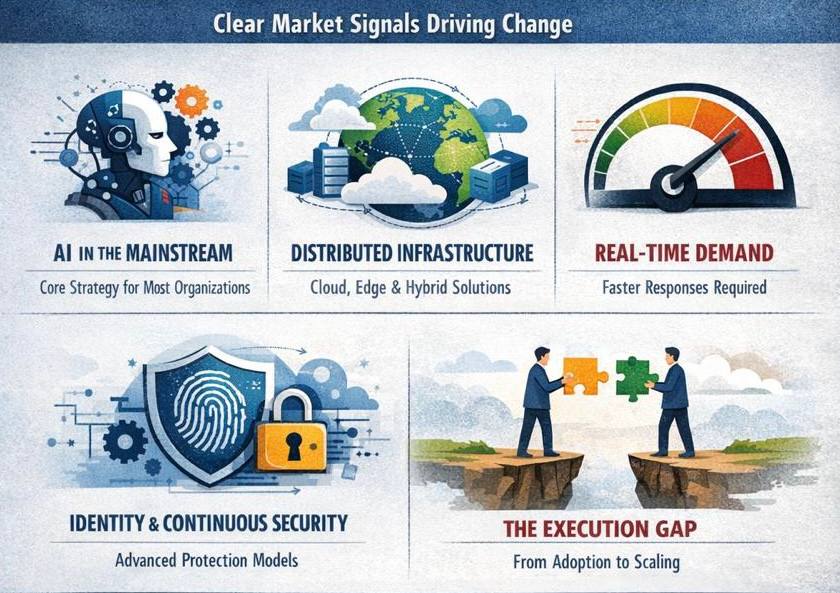
Infrastructure is becoming increasingly distributed, which drives demand for solutions that work across cloud, edge, and hybrid environments.
At the same time, the need for speed is accelerating. Organizations are prioritizing real-time capabilities to respond faster to users, markets, and operations.
Security is evolving alongside this complexity, with companies actively moving toward identity-based and continuous security models.
However, one of the most important insights is the gap between adoption and execution.
Many organizations invest in technology but struggle to scale it. This is why so many searches are now focused on integration, optimization, and operationalization.
The real problem is not access to technology — it is making it work in practice.
What Businesses No Longer Care About
One of the clearest signals of maturity is what companies have stopped searching for. Basic, introductory topics are declining. General explanations of AI, cloud, or digital transformation are no longer in demand. This does not mean these technologies are less important. It means they are already understood.
The focus has shifted toward deeper, more practical questions — how technologies behave in real environments, how they integrate, and how they impact cost, performance, and risk. This is the difference between awareness and execution.

Turn tech trends into real results with Ficus Technologies!
Contact usFrom Search Trends to Competitive Advantage
Search behavior is more than a trend indicator — it is a strategic signal. It shows where budgets are going, what problems companies are facing, and where gaps still exist between expectation and reality.
For technology leaders, this creates a clear opportunity. Understanding what businesses search for allows organizations to build solutions that align with real demand, prioritize the right initiatives, and avoid investing in technologies that do not deliver value.
The companies that win are not those that follow trends — but those that understand why those trends exist.
Conclusion
In 2026, technology trends are no longer defined by innovation alone. They are defined by real business needs, operational challenges, and the ability to execute. Search behavior makes this visible. Companies are no longer asking what is possible. They are asking what works.
Why Ficus Technologies?
At Ficus Technologies, technology decisions are aligned with real business demand — helping organizations implement solutions that scale, integrate, and deliver measurable impact.
They reflect real business needs and priorities.
AI implementation, cost optimization, security, integration, and real-time data.
Execution, not adoption.
Because it shows what companies are actually trying to solve.




 Success...!