

Smart contracts are becoming a core component of modern digital products.
In 2026, businesses are no longer experimenting with blockchain — they are building production systems powered by smart contracts. From finance to supply chains and digital platforms, smart contracts are used to automate transactions, enforce rules, and reduce reliance on intermediaries.
The key question is no longer what smart contracts are. It is how to build them efficiently, securely, and at scale.
Product teams planning smart contract development.
Startups building Web3 or tokenized platforms.
Companies evaluating cost and timelines.
- Smart contract development requires both technical and business alignment.
- Timelines depend on complexity, integration, and testing.
- Costs vary significantly based on architecture and security requirements.
- Security and audit processes are critical for production systems.
What Smart Contract Development Involves
Smart contracts are self-executing programs deployed on blockchain networks. They define rules, automate transactions, and enforce logic without intermediaries. Once deployed, they operate autonomously and cannot be easily changed — which makes design and testing critically important.
Unlike traditional software, smart contracts directly control value. This means that errors are not just technical issues — they can result in financial loss or security vulnerabilities. As a result, development requires a higher level of precision, validation, and security awareness.
Smart contract development is not just coding. It includes architecture design, security validation, integration with external systems, and ongoing monitoring.
Development Timeline: What to Expect
The timeline for smart contract development depends heavily on the complexity of the project. Simple contracts, such as basic token issuance or straightforward logic, can be developed within a few weeks. These typically involve standard templates and minimal integration.
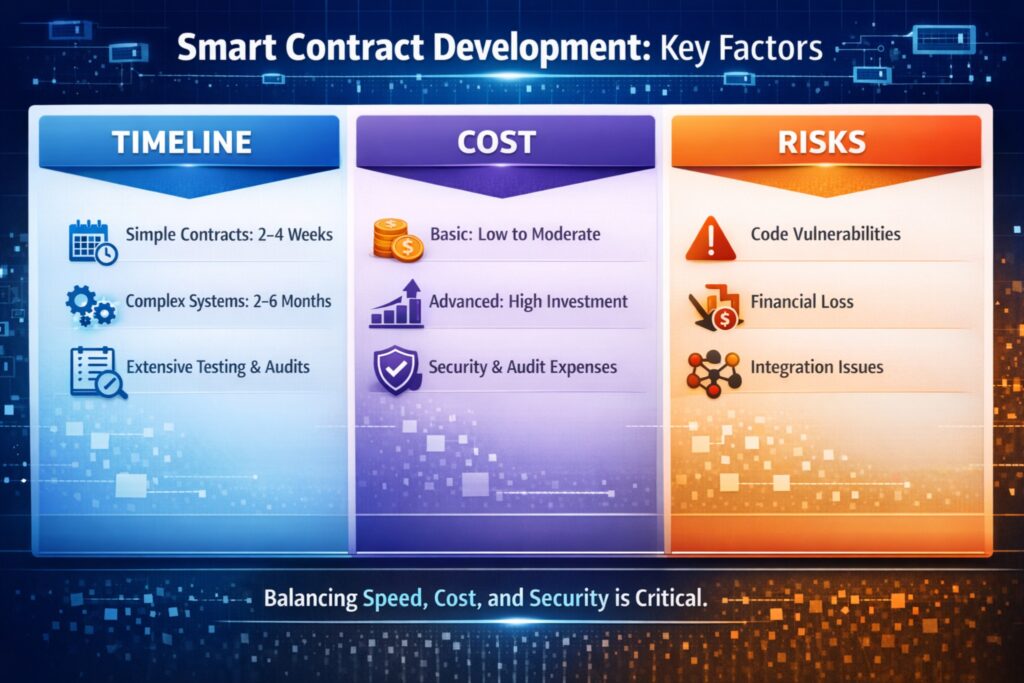
More advanced projects — such as DeFi protocols, marketplaces, or tokenized platforms — require significantly more time.
These systems involve multiple contracts, complex business logic, integrations with front-end applications, and extensive testing. Development timelines can range from several weeks to several months.
One of the most time-consuming stages is testing and auditing. Because smart contracts are immutable after deployment, they must be thoroughly tested before release. Security audits, simulations, and edge-case validation often take as much time as development itself. In practice, successful projects plan for iteration rather than a single release.
Cost of Smart Contract Development
Costs vary widely depending on scope, complexity, and security requirements.
For simple smart contracts, costs are relatively low, especially when using standard templates. These projects typically involve minimal customization and limited risk.
However, as complexity increases, costs grow significantly. Advanced systems require custom logic, integration with external services, and multiple contract interactions. This increases development time and requires more experienced engineers.
Security is a major cost factor. Audits, testing, and risk mitigation are essential for production systems. In many cases, security costs can represent a significant portion of the overall budget.
Another factor is infrastructure. Gas fees, deployment costs, and ongoing maintenance must also be considered, especially on networks with high transaction costs.
The key insight is clear: Smart contracts are not expensive because of development — they are expensive because of risk and security requirements.

Need secure smart contract solutions built for real-world business growth?
Contact usWhat You Need to Start
Successful smart contract development starts with clarity. Organizations must clearly define the use case, the value being transferred, and the logic that governs transactions. Without this, development becomes inefficient and error-prone.
Choosing the right blockchain is another critical decision. Different networks offer different trade-offs in terms of cost, scalability, security, and ecosystem support. The choice directly impacts both development and long-term performance.
Architecture must be carefully designed. This includes contract structure, upgrade mechanisms, and interaction between components. Poor architecture leads to limitations that are difficult to fix later.
Integration is equally important. Smart contracts rarely operate in isolation. They must connect with front-end applications, APIs, and off-chain systems. This requires careful planning and reliable infrastructure.
Finally, security must be embedded from the start. Code reviews, testing, and audits are not optional — they are essential parts of the development process.
Common Challenges
Despite strong potential, many smart contract projects face similar challenges. One of the biggest issues is underestimating complexity. What appears simple at the concept stage often becomes more complex when translated into code, especially when dealing with edge cases and real-world conditions.
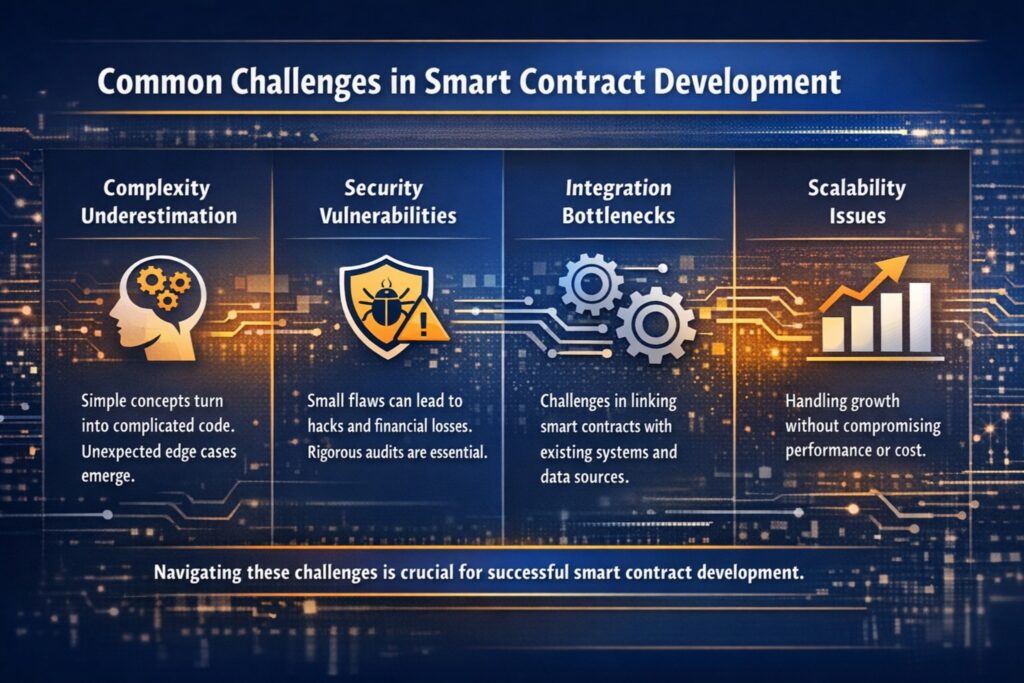
Security vulnerabilities are another major risk. Even small errors can lead to exploits, financial loss, or system failure. This is why auditing and testing are critical.
Integration can also become a bottleneck. Connecting smart contracts with existing systems, user interfaces, and external data sources often requires additional development effort.
Finally, there is the challenge of scalability. Systems must handle growing usage without increasing costs or reducing performance.
The Business Impact of Smart Contracts
Smart contracts fundamentally change how transactions are executed. They reduce reliance on intermediaries, lowering costs and increasing efficiency. They automate processes, reducing manual work and human error. They increase transparency through blockchain-based records.
But the most important impact is strategic. Smart contracts enable new business models, such as decentralized platforms, tokenized assets, and automated financial systems. They allow organizations to build systems that are not only digital — but autonomous.
Any sufficiently advanced technology is indistinguishable from magic.
Arthur C. Clarke
Conclusion
Smart contract development is moving from niche technology to core infrastructure.
In 2026, the challenge is no longer understanding how smart contracts work — it is building them in a way that is secure, scalable, and aligned with business goals.
Organizations that approach development strategically can unlock new opportunities in automation, efficiency, and digital value creation.
Why Ficus Technologies?
Ficus Technologies helps businesses design, develop, and deploy secure smart contract solutions that are scalable, compliant, and aligned with real business use cases.
From a few weeks for simple contracts to several months for complex systems.
Complexity, integration, and security requirements.
Because smart contracts control value and cannot be easily changed after deployment.
Balancing functionality, security, and scalability.





 Success...!