
APIs are no longer just a technical layer.
In 2026, they are becoming a core part of business strategy. Organizations are no longer building systems first and adding APIs later. Instead, they design APIs as the foundation — shaping how systems interact, scale, and evolve. This is the shift to API-first.
Product teams building scalable platforms.
Companies adopting microservices and integrations.
Organizations scaling digital ecosystems.
- API-first enables faster development and integration.
- Systems are designed around interfaces, not implementations.
- It improves scalability, flexibility, and reuse.
- APIs become business assets, not just technical tools.
What API-First Really Means
API-first is an approach where APIs are designed before the system is built. Instead of treating APIs as an afterthought, organizations define how systems will communicate from the beginning. This creates a contract.
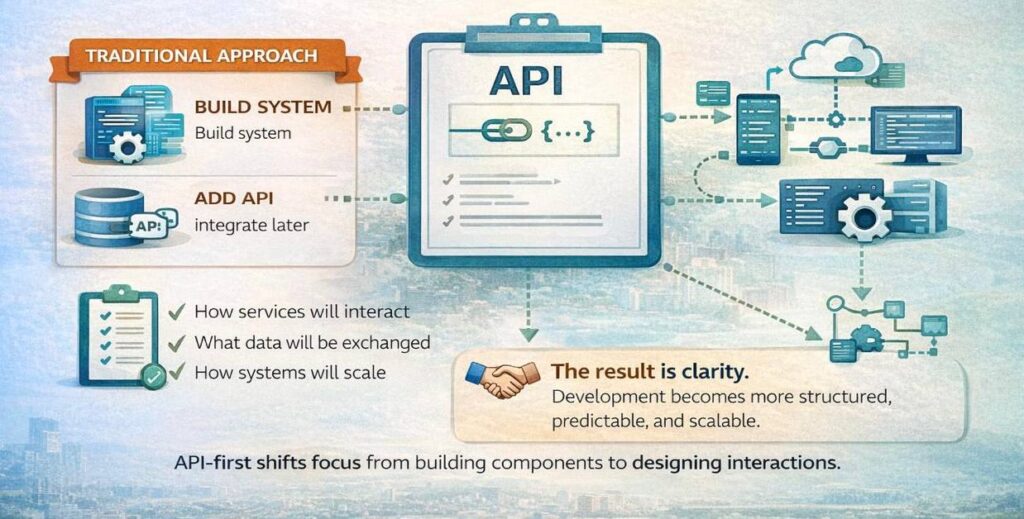
Teams know how services will interact, what data will be exchanged, and how systems will scale.
The result is clarity. Development becomes more structured, predictable, and scalable. API-first shifts focus from building components to designing interactions.
Why Companies Are Adopting API-First
The shift is driven by increasing system complexity. Modern organizations operate across multiple platforms — web, mobile, cloud, third-party services, and internal systems. Without APIs, integration becomes difficult and slow.
API-first simplifies this. It allows systems to connect easily, enabling faster development and more flexible architectures.
Speed is another factor. Teams can work in parallel, building different parts of the system based on defined API contracts. This reduces dependencies and accelerates delivery.
There is also a business driver. APIs enable new revenue streams, partnerships, and ecosystems Companies are not just building systems — they are building platforms.
The Business Value of API-First
API-first directly impacts business performance. It accelerates time-to-market by enabling parallel development. It improves scalability by decoupling system components. It reduces integration complexity across platforms.
But the most important impact is strategic. APIs turn internal capabilities into reusable services. This allows organizations to expand faster, integrate partners, and create digital ecosystems. API-first transforms systems into platforms.
The Numbers Behind API-First Adoption
The shift toward API-first is reflected in market trends.
More than 80% of organizations use APIs as a core part of their digital strategy, highlighting their importance in modern systems.
At the same time, over 70% of companies report that APIs accelerate development and integration, reducing time-to-market.
API-driven businesses also see measurable impact. Companies that leverage APIs effectively can achieve up to 30–40% faster product delivery cycles.
Despite this, challenges remain. Nearly 50% of organizations struggle with API management, governance, and security, especially as systems scale. These numbers highlight a key insight: APIs are no longer optional — they are foundational.
Challenges of API-First Strategy
API-first introduces new complexities. One of the biggest challenges is governance. As the number of APIs grows, managing consistency, versioning, and security becomes more difficult.
Documentation is critical. Poorly documented APIs reduce usability and increase integration effort.
Security is another concern. APIs expose system functionality, making them a potential attack surface.
There is also an organizational challenge. Teams must adopt new workflows, including contract-first development and collaboration across functions. Without discipline, API-first can lead to fragmentation instead of flexibility.
API-First vs Traditional Approach
The difference between API-first and traditional development is not just technical — it is architectural.
In a traditional approach, APIs come later. Teams build the system first, then expose functionality through APIs, and only after that think about integration. This often leads to rework, inconsistencies, and limited scalability. API-first changes the sequence.
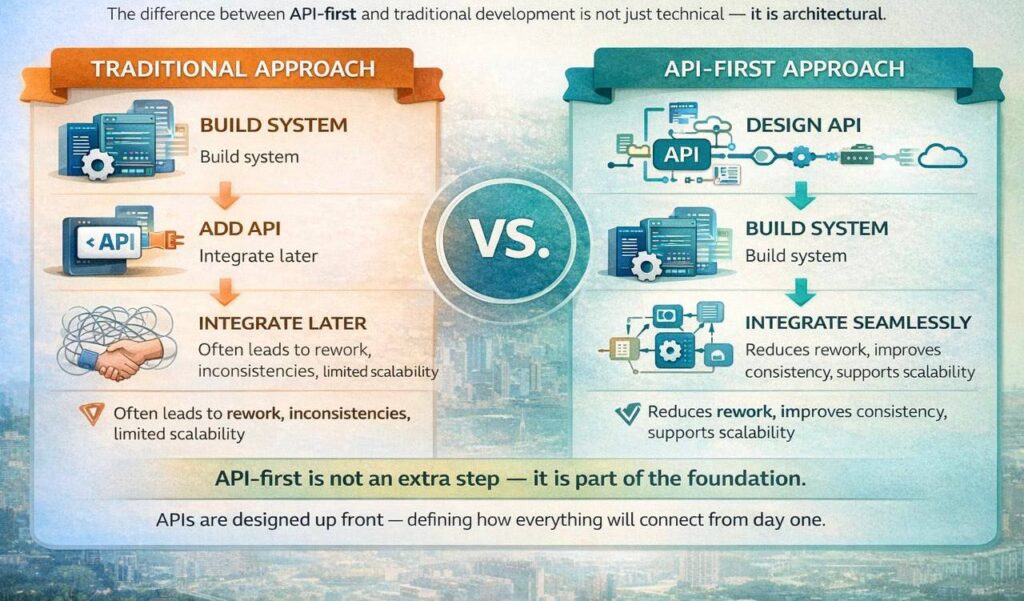
Instead of adapting systems to integrations, organizations design APIs upfront — defining how components will communicate before development begins. As a result, integration is not an additional step — it becomes part of the foundation. This approach reduces friction between teams, improves consistency across systems, and makes scaling significantly easier.
From Integration to Ecosystems
API-first changes how organizations think about systems. Instead of building isolated applications, companies create interconnected ecosystems. APIs allow internal and external systems to interact seamlessly. This enables partnerships, integrations, and new business models. The shift is from building products to enabling platforms.
Conclusion
API-first strategy is becoming a business standard.
In 2026, organizations that adopt API-first approaches can build systems that are more flexible, scalable, and aligned with real business needs. The focus is no longer on building features — it is on building systems that connect.
Why Ficus Technologies
Ficus Technologies helps businesses design and implement API-first architectures that enable scalable integration, faster development, and long-term flexibility.
An approach where APIs are designed before system implementation.
It improves scalability, integration, and development speed.
Governance, security, and documentation.
It is most valuable for scalable, integrated systems.





 Success...!