Modern systems are no longer built for static environments.
In 2026, businesses operate in real time — processing user actions, transactions, and data streams instantly. Traditional architectures struggle to keep up with this speed. This is where event-driven architecture becomes critical. It enables systems to react, adapt, and scale in real time — without bottlenecks.
Product teams building real-time applications.
Companies adopting microservices and cloud-native architectures.
Organizations dealing with high-volume data flows.
- Event-driven architecture enables real-time responsiveness.
- Systems communicate through events instead of direct dependencies.
- It improves scalability, flexibility, and system resilience.
- The main challenge is managing complexity and data flow.
What Event-Driven Architecture Really Means
Event-driven architecture (EDA) is based on a simple concept: systems react to events.
An event is any significant change — a user action, a transaction, a system update, or a data input. Instead of tightly connected components calling each other directly, systems publish and consume events.
This creates a decoupled environment where services operate independently. The result is a system that is more flexible, scalable, and responsive. EDA shifts architecture from request-response to react-and-adapt.
Why Real-Time Systems Depend on It
Real-time systems require immediate processing and response.
Traditional architectures rely on synchronous communication, which creates delays and bottlenecks. Every request must wait for a response before continuing.
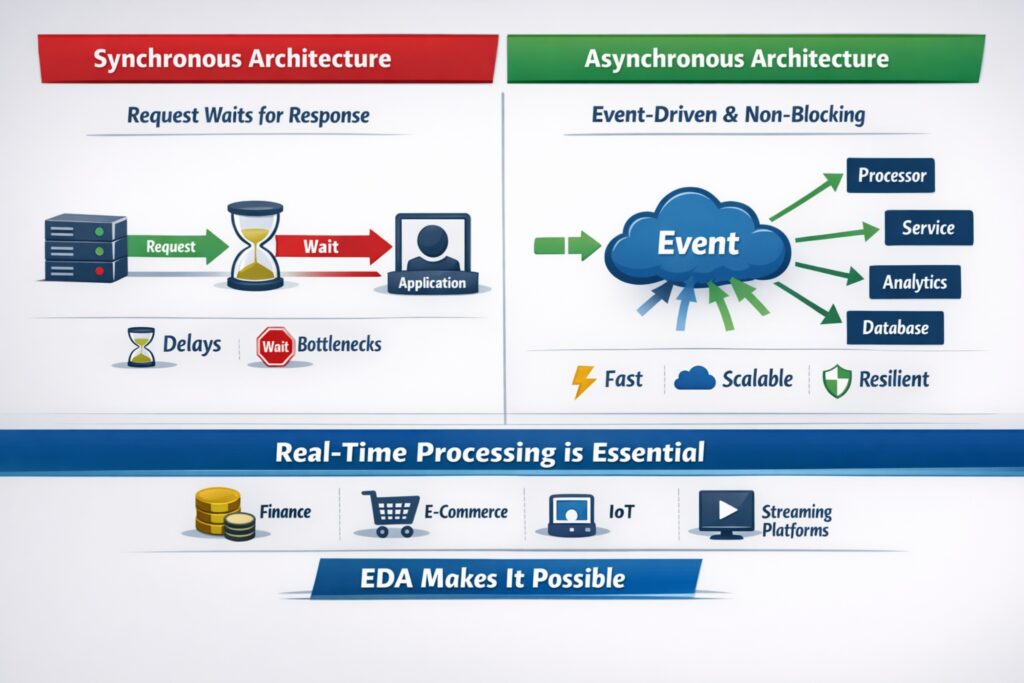
In contrast, event-driven systems process actions asynchronously. This allows multiple components to react to the same event simultaneously, without blocking each other.
The impact is significant: systems become faster, more scalable, and more resilient under load.
In environments such as finance, e-commerce, IoT, and streaming platforms, real-time processing is not optional — it is expected. EDA makes this possible.
How Event-Driven Systems Work
At the core of event-driven architecture are three key components:
- Event producers — systems or services that generate events
- Event brokers — infrastructure that routes and manages events
- Event consumers — services that react to events
When an event occurs, it is published to a broker. Other services subscribe to relevant events and react accordingly. This creates a dynamic system where components communicate indirectly.
The advantage is flexibility. New services can be added without changing existing ones, as long as they subscribe to the right events.
The Business Value of Event-Driven Architecture
EDA directly impacts how businesses operate. It enables real-time decision-making by processing data instantly. It improves scalability by handling high volumes of events efficiently. It increases system resilience by isolating failures.
But the most important impact is agility. Companies can respond to changes immediately — whether it’s user behavior, market conditions, or operational events. EDA turns systems into responsive ecosystems.
Distributed systems are hard because they involve coordination.
Jeff Dean
The Numbers Behind Real-Time Systems
The demand for real-time capabilities is growing rapidly. More than 65% of organizations prioritize real-time data processing to improve decision-making and user experience.
At the same time, over 70% of enterprise systems are becoming event-driven or partially event-driven, especially in cloud-native environments.
Streaming data is also increasing. Organizations process significantly more real-time data than ever before, driven by IoT, digital platforms, and user interactions.
Despite this growth, challenges remain. Nearly 50% of organizations report difficulties in managing event streams, data consistency, and system complexity.
These numbers highlight a key insight: real-time capability is becoming standard — but architecture determines whether it works.
Challenges of Event-Driven Architecture
EDA introduces new complexities. One of the biggest challenges is visibility. Tracking events across multiple services can be difficult, especially in large systems. Data consistency is another issue.
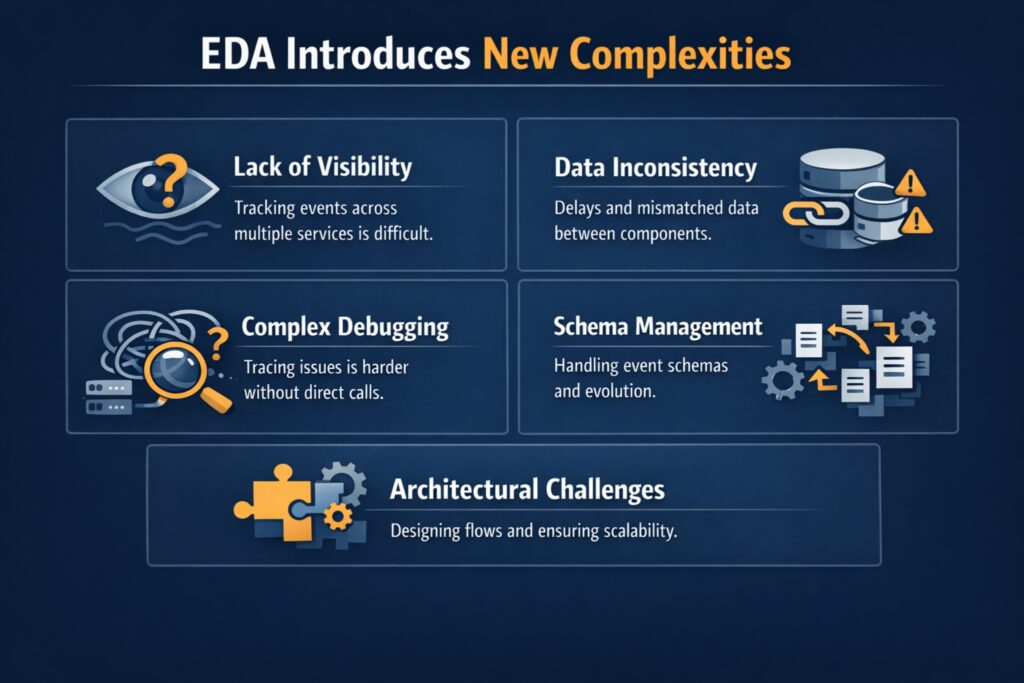
Asynchronous systems may experience delays or inconsistencies between components.
Debugging becomes more complex. Without direct service-to-service calls, tracing issues requires advanced monitoring tools.
There is also an architectural challenge. Designing event flows, managing schemas, and ensuring scalability requires strong expertise.
When to Use Event-Driven Architecture
EDA is not necessary for every system. It is most valuable in environments where:
- real-time processing is required
- systems must scale dynamically
- multiple services need to react to the same data
- high availability and resilience are critical
For simple applications, traditional architectures may be sufficient.
For complex, real-time systems — EDA becomes essential.
From Systems to Ecosystems
Event-driven architecture changes how systems are designed.
Instead of building isolated applications, organizations create interconnected systems that react to events in real time. This enables continuous data flow, faster decision-making, and more adaptive systems. The shift is from control to responsiveness.
Conclusion
Event-driven architecture is becoming a foundation for modern digital systems.
In 2026, the ability to process and respond to events in real time is a competitive advantage.
Organizations that adopt EDA can build systems that are faster, more scalable, and more resilient.
Why Ficus Technologies?
Ficus Technologies helps businesses design and implement event-driven architectures that support real-time processing, scalability, and system resilience.
A model where systems communicate through events instead of direct requests.
It enables real-time processing and scalability.
Complexity, monitoring, and data consistency.
No — it is most useful for complex, real-time environments.




 Success...!