
Deploying AI is not the finish line.
In 2026, the real challenge begins after models go live. As organizations integrate AI into critical workflows, they need to understand how models behave in real-world conditions. Without visibility, even the most advanced AI systems become unreliable. This is where AI observability becomes essential.
ML engineers and data teams.
Product teams deploying AI features.
Companies scaling AI in production.
- AI observability ensures visibility into model performance.
- Monitoring is not optional — it is critical for reliability.
- Data drift, model degradation, and anomalies must be tracked continuously.
- Observability turns AI from experimentation into production capability.
What AI Observability Really Means
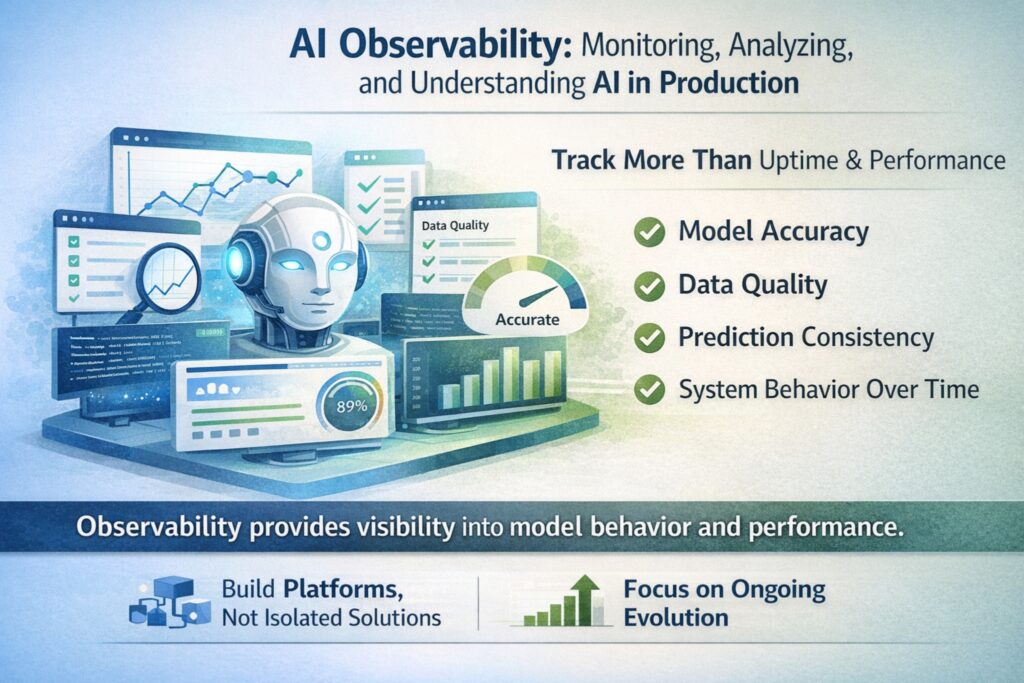
AI observability is the ability to monitor, analyze, and understand how AI models perform in production environments. It goes beyond traditional system monitoring.
Instead of tracking only uptime or performance metrics, organizations must track:
1. model accuracy
2. data quality
3. prediction consistency
4. system behavior over time
AI systems are dynamic.
They interact with changing data, evolving user behavior, and shifting environments. Without observability, these changes go unnoticed — until they cause problems.
Observability provides visibility into what the model is doing, why it behaves a certain way, and when something goes wrong.
Why Monitoring AI Is Different
Traditional software behaves predictably. AI does not.
Models can degrade over time as data changes. This is known as data drift or model drift. Even if the system is technically “working,” its outputs may become less accurate or reliable.
Another challenge is lack of transparency. AI decisions are not always explainable, making it harder to identify issues.
There is also a scale problem. AI systems often process large volumes of data in real time, making manual validation impossible.
This creates a new requirement: continuous, automated monitoring.
What Companies Actually Track
To manage AI systems effectively, organizations focus on several key areas.
Model performance is critical. This includes accuracy, precision, recall, and other metrics that reflect how well the model performs.
Data quality is equally important. Changes in input data can significantly impact outputs. Monitoring data distribution, completeness, and consistency helps detect issues early. Prediction behavior must also be tracked.
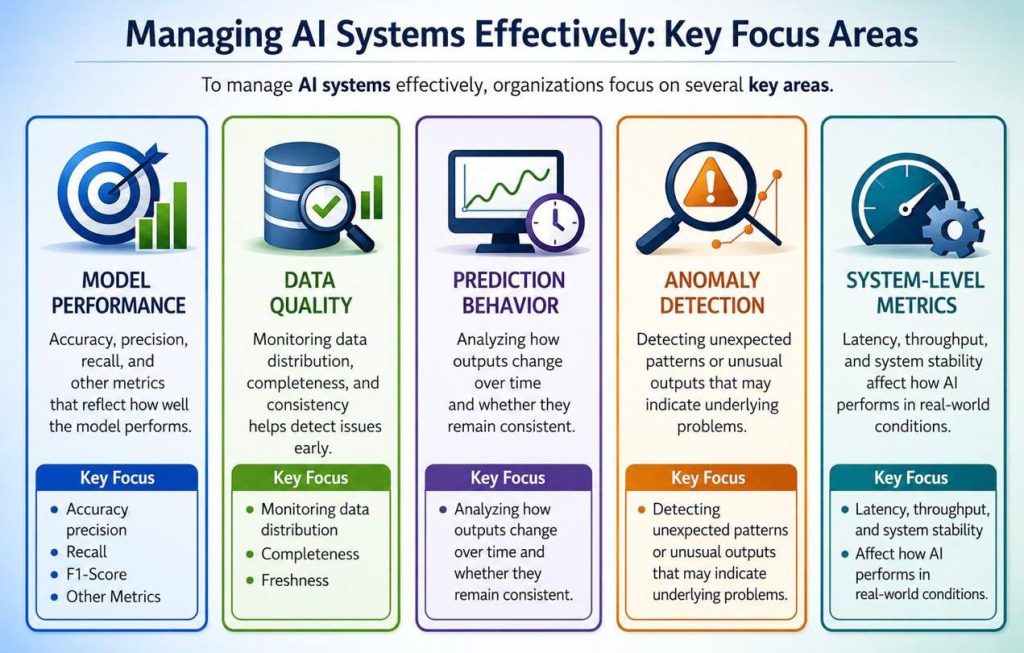
Organizations analyze how outputs change over time and whether they remain consistent.
Anomaly detection plays a key role. Unexpected patterns or unusual outputs can indicate underlying problems.
Finally, system-level metrics matter. Latency, throughput, and system stability affect how AI performs in real-world conditions.
The Numbers Behind AI Observability
The importance of observability is reflected in industry trends.
More than 65% of organizations report issues with model performance after deployment, often due to data drift or changing conditions.
At the same time, over 70% of companies are investing in MLOps and observability tools to improve reliability and scalability. Despite this, nearly 50% of AI systems lack proper monitoring frameworks, increasing the risk of unnoticed failures.
Data-related issues remain a major challenge. Around 60% of AI failures are linked to data quality and distribution changes, rather than model design.
These numbers highlight a key insight: AI does not fail at deployment — it fails over time without visibility.
The Risks of Poor Observability
Without proper observability, organizations face significant risks.
Model degradation can go unnoticed, leading to incorrect decisions. Customer-facing systems may produce inconsistent or unreliable outputs. Operational efficiency decreases as issues are detected too late.
There is also a trust issue. If users cannot rely on AI outputs, adoption declines. In regulated industries, lack of monitoring can also create compliance risks.

Track your AI. Trust your results — with Ficus Technologies!
Contact usHow to Build AI Observability
Effective observability requires a structured approach.
The first step is defining metrics. Organizations must decide what success looks like and how it will be measured.
Automation is essential. Manual monitoring is not scalable. Systems must automatically detect anomalies, drift, and performance issues. Data pipelines must be reliable. Observability depends on accurate and consistent data flow.
Integration with MLOps is critical. Monitoring, deployment, and model management must work together.
Finally, feedback loops are necessary. Models must be continuously updated and improved based on real-world performance.
From Models to Systems
AI observability changes how organizations think about AI.
Instead of treating models as static assets, companies treat them as dynamic systems that require continuous monitoring and improvement. This shift is critical for scaling AI. Observability turns AI from a feature into infrastructure.
Conclusion
AI observability is no longer optional.
In 2026, organizations that deploy AI without monitoring are taking significant risks. The companies that succeed are those that understand not just how to build models —
but how to track, manage, and improve them over time.
Why Ficus Technologies?
Ficus Technologies helps businesses implement AI observability frameworks that ensure models are reliable, scalable, and aligned with real-world performance requirements.
Monitoring and analyzing AI model performance in production.
Because AI behavior changes over time.
Model degradation, incorrect decisions, and loss of trust.
Model performance, data quality, and system behavior.




 Success...!