

Digital transformation has been a priority for years.
Yet in 2026, many large organizations are still struggling to make it work. Despite significant investments, new technologies, and dedicated teams, transformation initiatives often fail to deliver real results. The problem is not technology. It is execution.
Executives responsible for digital strategy.
Large organizations dealing with legacy systems.
Companies struggling to scale transformation efforts.
- Digital transformation fails due to misalignment, not lack of tools.
- Technology alone does not create change — systems and processes do.
- The biggest challenges are cultural, architectural, and operational.
- Successful transformation requires integration, not implementation.
The Illusion of Transformation
One of the most common reasons transformation fails is misunderstanding what it actually means. Many organizations treat digital transformation as a technology upgrade. They invest in cloud platforms, AI tools, and new software — expecting change to follow.
But transformation is not about tools. It is about how systems, processes, and teams work together. Without this alignment, technology becomes an addition — not a transformation.
The Real Reasons Transformation Fails
Digital transformation fails for structural reasons.
One of the biggest issues is fragmentation. Large organizations often operate in silos. Different teams, systems, and processes evolve independently, making integration difficult. Instead of a unified system, companies end up with disconnected solutions.
Legacy systems are another major barrier. Many large enterprises rely on outdated infrastructure that is difficult to replace. New technologies are often layered on top, increasing complexity instead of reducing it.
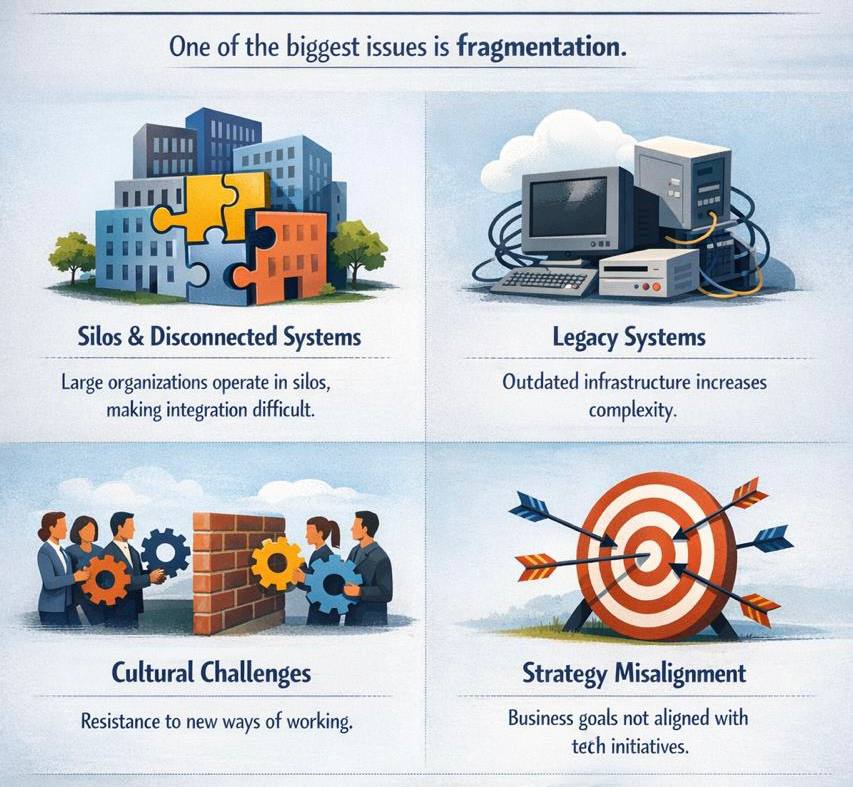
There is also a cultural challenge. Transformation requires changes in how teams work, make decisions, and collaborate. Without this shift, new tools are used within old processes — limiting their impact.
Strategy misalignment is another critical factor. When business goals and technology initiatives are not aligned, projects lack direction and fail to deliver measurable outcomes.
Finally, there is an execution gap. Many organizations start transformation initiatives but fail to scale them across the entire business.
The Numbers Behind Failed Transformation
The scale of the problem is reflected in industry data. Around 70% of digital transformation initiatives fail to meet their objectives, despite significant investment.
At the same time, more than 60% of executives report that transformation efforts are slower than expected. Legacy systems remain a key obstacle, with over 50% of organizations identifying outdated infrastructure as a major barrier.
Cost is also a concern. Many transformation projects exceed budgets or fail to deliver expected ROI, leading to increased scrutiny from leadership. These numbers highlight a critical reality: transformation is widely attempted — but rarely executed effectively.
Why Large Organizations Struggle More
Scale introduces complexity. Large organizations have more systems, more teams, and more dependencies. This makes coordination more difficult and increases the risk of fragmentation.
Decision-making is also slower. Multiple layers of approval and governance can delay progress, making it harder to adapt quickly.
There is also a higher level of risk. Changes impact a larger number of users, systems, and processes, making organizations more cautious. This creates a paradox. The organizations that need transformation the most are often the hardest to transform.
The Role of Architecture
Architecture plays a critical role in transformation success. Without a scalable and flexible architecture, new technologies cannot be effectively integrated. Many organizations attempt to modernize without redesigning their architecture. This leads to complexity, inefficiency, and limited scalability.
Modern transformation requires:
- modular systems
- API-driven integration
- cloud-native infrastructure
Architecture determines whether transformation can scale.
From Projects to Systems
One of the biggest mistakes organizations make is treating transformation as a project. Projects have timelines and endpoints. Transformation does not.
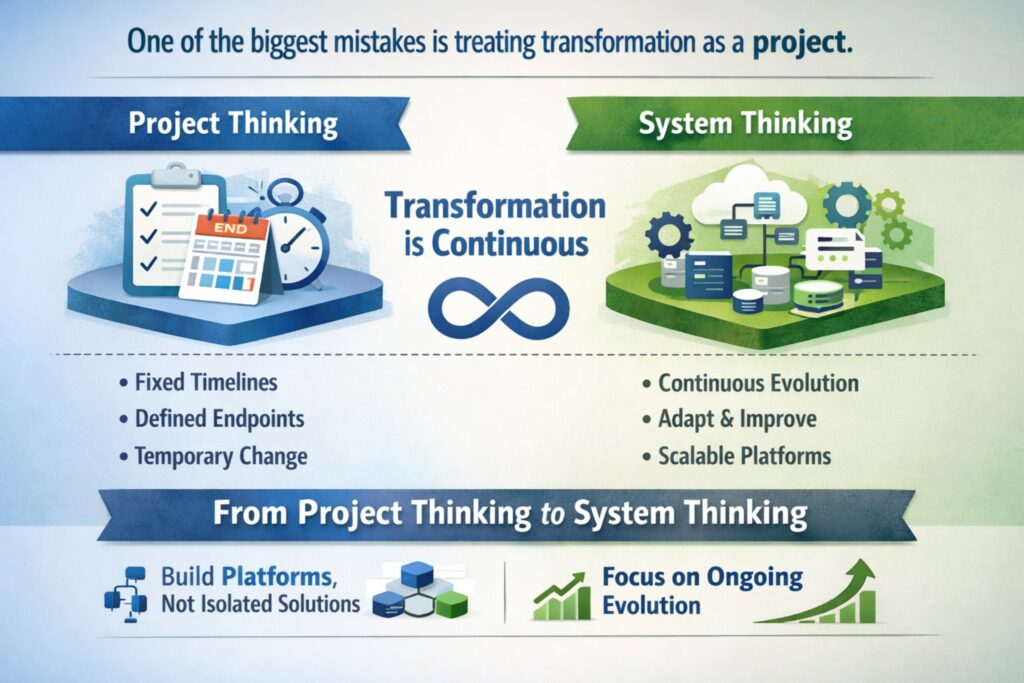
It requires continuous evolution, adaptation, and improvement. Successful organizations move from project thinking to system thinking. They build platforms, not isolated solutions.
What Successful Organizations Do Differently
Companies that succeed in digital transformation approach it differently. They align technology with business outcomes. They focus on integration, not just implementation. They invest in architecture and data foundations. They enable teams to work differently, not just use new tools. Most importantly, they treat transformation as an ongoing capability — not a one-time initiative.
The Risk of Getting It Wrong
Failed transformation has real consequences. It leads to wasted investment, slower growth, and increased operational complexity. It also creates internal resistance.
Teams become skeptical of future initiatives, making change even more difficult. In competitive markets, this can result in lost opportunities.
Conclusion
Digital transformation does not fail because of technology. It fails because of misalignment, complexity, and lack of execution.
In 2026, the organizations that succeed are not those adopting the most technology — but those integrating it effectively into their systems and operations.
Why Ficus Technologies?
Ficus Technologies helps organizations move beyond fragmented transformation initiatives and build integrated, scalable systems that deliver real business impact.
Due to misalignment, legacy systems, and execution challenges.
No — the main issue is integration and strategy.
Because of complexity, scale, and slower decision-making.
Alignment between business, technology, and architecture.






 Success...!