Introduction
Software quality has always been one of the most important parts of product development. A product can have a strong idea, a modern design, clean code, and a well-planned roadmap, but if it is unstable, unpredictable, or full of hidden issues, users will not care how good the concept was. Quality is what turns software from “something that works in a demo” into a product people can actually trust.
For many years, companies tried to solve the quality problem through automation. Manual testing was slow, repetitive, and difficult to scale, so teams started building automated test suites, regression checks, CI/CD pipelines, and quality gates. This changed development in a major way. Automated QA made it possible to release faster, catch defects earlier, reduce repetitive work, and give teams more confidence before every deployment.
But the way software is built has changed again. Products now evolve constantly. Releases happen more frequently. Teams work with complex user flows, third-party integrations, APIs, microservices, cloud environments, mobile platforms, and AI-powered features. Business logic becomes more dynamic. User expectations are higher. The cost of production issues is bigger. And development teams are under pressure to move faster without compromising reliability.
In this environment, traditional test automation is no longer enough on its own. This is where AI in software testing becomes important.
AI can help QA and AQA teams generate test cases, analyze requirements, create test data, detect weak coverage, review failed tests, summarize logs, support regression testing, and even help maintain automation when the product changes. AI agents can go even further: they can work through multi-step testing tasks, execute scenarios, analyze failures, suggest improvements, and help engineers understand what actually went wrong.
But I do not believe the future of QA is fully automated. The real future is smarter testing. AI can make testing faster, broader, and more adaptive, but quality still depends on human judgment, product understanding, engineering discipline, and the ability to understand business risk.
That is why the most successful teams will not be the ones that replace QA with AI. They will be the ones that learn how to combine AI with strong QA and AQA expertise.
The Real Shift: From Test Execution to Quality Intelligence
For a long time, testing was mostly associated with execution. QA teams checked whether features worked, whether bugs were fixed, whether the product behaved according to requirements, and whether a release was safe enough to move forward. When test automation became more common, the focus shifted to writing scripts that could repeat these checks faster and more consistently. Automated tests became a critical part of modern delivery. They helped teams avoid manual regression, detect issues earlier, and make releases less stressful.
This approach is still valuable, but it also has limitations. Traditional automated tests are only as strong as the strategy behind them. They can check what they were designed to check, but they do not automatically understand whether the right risks are covered. They do not know whether the product has changed in a way that requires a different testing approach. They do not know whether a missing test case could become a serious business issue later.
This is the real shift AI is bringing into QA. AI does not only help teams execute tests. It helps them think about quality more intelligently.
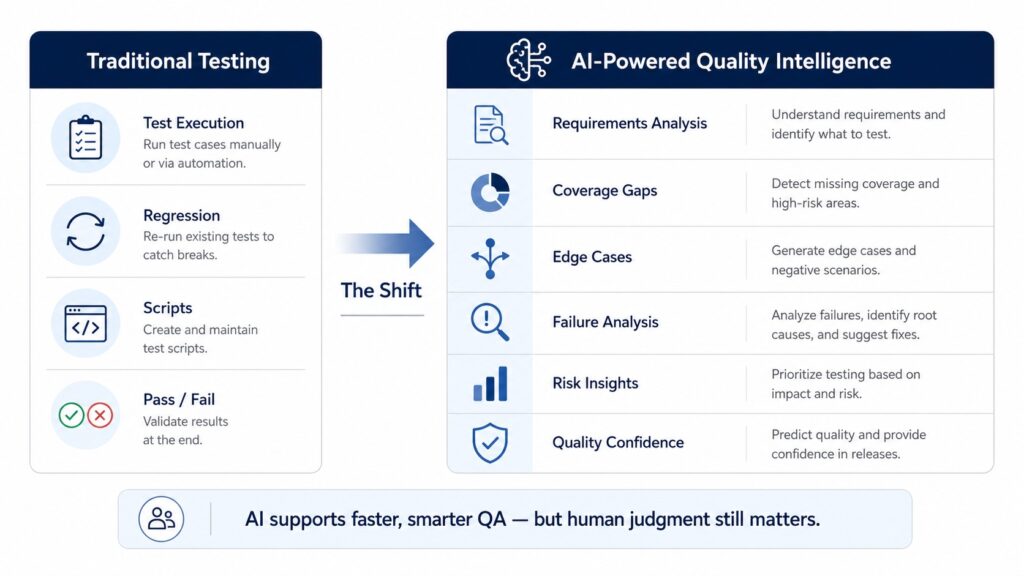
For example, AI can analyze requirements and suggest edge cases that may not be obvious at first. It can compare user stories with existing test coverage and highlight gaps. It can generate negative scenarios for APIs, suggest boundary cases for input fields, or help identify flows where user permissions may behave differently.
It can also support teams after tests have already run. Instead of manually reading long logs and trying to understand why a pipeline failed, QA and AQA engineers can use AI to summarize failures, group similar errors, identify possible root causes, and compare failures with recent code changes.
This changes the role of QA and AQA engineers. They are no longer only writing test cases or maintaining automation scripts. They become quality architects who design the testing process, guide AI tools, validate outputs, and decide which risks matter most for the product.
And this is important because software quality is not just about passing tests. It is about confidence: confidence that the feature works as expected, confidence that critical user flows are protected, confidence that new changes did not break existing behavior, and confidence that the product can scale, integrate, and evolve without becoming unstable. AI can help build that confidence faster, but it cannot replace the responsibility behind it.
Where AI Can Actually Help in QA and AQA
The strongest use cases for AI in testing are practical. They are not about replacing the QA team. They are about removing repetitive work, reducing blind spots, and helping engineers focus on the parts of quality that require experience.
One of the most obvious areas is test case generation. AI can analyze requirements, user stories, acceptance criteria, API documentation, or product flows and suggest possible test scenarios. This is especially useful when a team needs to quickly cover a new feature or prepare regression coverage for an existing module. Instead of starting from an empty page, QA engineers can use AI as a first draft and then refine the result based on product logic.
For example, if a team is building a subscription feature, AI can suggest scenarios around successful subscription, failed payment, expired card, trial period, plan upgrade, plan downgrade, cancellation, renewal, invoice generation, and access restrictions after payment failure. This gives the QA team a strong starting point, but the final decision about what matters most still depends on understanding the product and business priorities.
Another strong use case is test data generation. Many systems require different combinations of user roles, permissions, payment statuses, account types, device types, locations, currencies, languages, or business conditions. Preparing this data manually can take a lot of time. AI can help generate realistic test data and include edge cases that may be easy to miss.
AI can also support automated test creation. For AQA teams, AI tools can help draft Playwright, Cypress, Selenium, API, or unit test examples based on a described scenario. This does not mean the code should be accepted blindly, but it can speed up routine scripting, especially for repetitive checks or standard flows.
Another valuable area is failure analysis. When a test suite contains hundreds or thousands of tests, understanding what failed and why can become a serious bottleneck. AI can group similar failures, summarize logs, detect patterns, compare recent code changes, and suggest likely causes. This helps teams spend less time reading raw output and more time fixing the real issue.
AI can also help with flaky test detection. Flaky tests are one of the biggest problems in automation. They fail inconsistently, reduce trust in the test suite, and create noise in the pipeline. AI can help detect patterns in unstable tests, identify environment-related failures, and suggest where automation should be improved.
There is also growing value in self-healing tests. When UI locators change, AI can sometimes identify alternative selectors or understand that the element still exists but has moved or changed slightly. This can reduce maintenance effort, especially in fast-moving products. But self-healing should be used carefully.
If the test “fixes itself” without proper review, the team may miss an actual product change that should have been validated. A button may not simply have moved. The flow may have changed. The user logic may be different. A permission may have been modified. A required step may have disappeared. That is why AI in AQA should always support the engineer, not bypass the engineer.
AI Agents in Testing: What Changes
AI agents bring a new layer to test automation because they can work through tasks more independently than simple prompt-based tools.
A basic AI assistant can generate a test case when asked. An AI testing agent can potentially analyze a feature, create test scenarios, generate automation code, run tests, inspect failures, adjust the test, and report what happened. This creates a more dynamic testing loop.
For example, imagine a team is testing a new checkout flow. An AI agent could review the acceptance criteria, identify key scenarios such as successful payment, failed payment, discount code usage, empty cart, invalid address, returning customer flow, tax calculation, delivery options, and payment provider errors. Then it could generate initial automated tests, run them in a test environment, analyze which ones fail, and provide a summary for the QA engineer.
This is powerful because it reduces the gap between planning and execution. But it also creates a new responsibility. If AI agents can generate and modify tests, teams need clear rules for how those tests are reviewed, approved, and maintained. Otherwise, the test suite may grow quickly but become weak, duplicated, unstable, or hard to trust.
In our experience, test automation is valuable only when the team trusts it. If tests fail randomly, cover the wrong scenarios, or produce unclear reports, people stop relying on them. Adding AI without structure can make this problem worse. It can generate more tests, but not necessarily better tests.
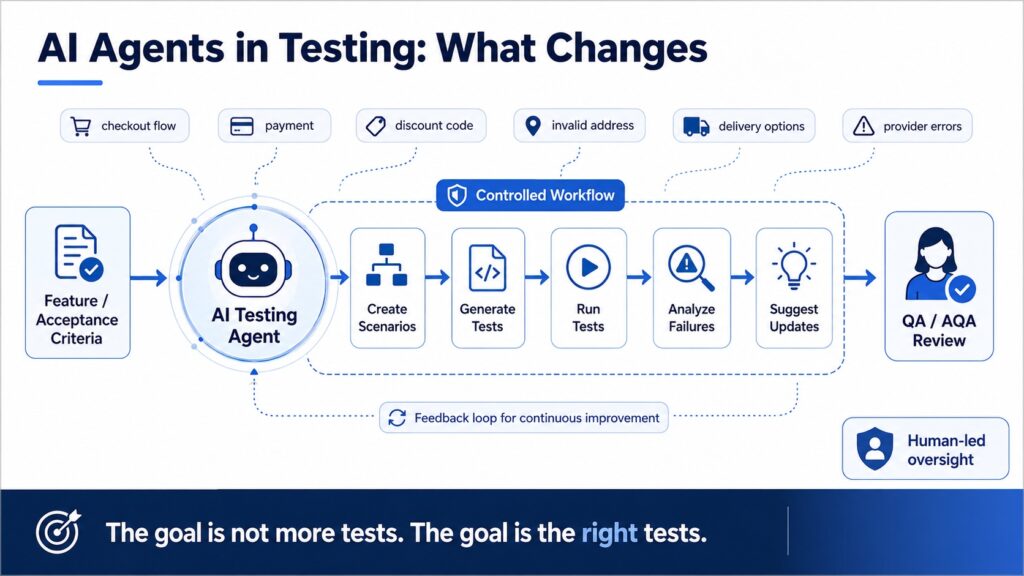
That is why agentic testing should be designed as a controlled workflow. The AI agent can suggest, generate, run, and analyze. But the QA or AQA engineer should define the testing strategy, review critical scenarios, approve meaningful coverage, and make sure the test suite supports the actual product risks. The goal is not to create a huge number of tests. The goal is to create the right tests.
Practical Examples: How AI Can Improve the Testing Process
The best way to understand AI in testing is to look at real situations where it can support the QA process.
In an e-commerce project, AI can help generate test scenarios for the full purchase journey. This includes product search, filtering, cart behavior, discount codes, checkout, payment failures, order confirmation, refunds, and inventory updates. It can also help generate combinations of user types, payment methods, delivery addresses, and currencies.
But a QA engineer still needs to decide which flows are business-critical. For example, a visual issue on a product card may be low priority, while a broken payment flow is release-blocking. AI can help identify scenarios, but the testing strategy must reflect business impact.
In a SaaS platform, AI can help test user roles, subscription logic, onboarding flows, permissions, dashboards, notifications, and integrations. It can suggest edge cases around expired plans, limited access, invited users, deleted accounts, or failed third-party syncs. This is especially useful because SaaS products often have many states and user conditions that are difficult to cover manually.
But again, the team needs to understand the product model. Testing a SaaS platform is not only about checking buttons. It is about making sure the right users have the right access at the right time.
In a fintech product, AI can help generate negative test cases around transactions, limits, validation rules, failed payments, duplicate requests, or incorrect input data. It can also help analyze logs and detect patterns in failed API tests.
But fintech testing requires strict human control. Security, compliance, data accuracy, and auditability cannot be delegated blindly to AI. Every AI-supported test must be reviewed through the lens of risk.
In a healthcare or data-sensitive product, AI can support documentation, regression testing, input validation, and workflow checks. But privacy, correctness, and role-based access become critical. A small mistake in permissions or data visibility can create serious consequences.
These examples show the real value of AI in testing. AI is useful not because it replaces QA thinking, but because it gives QA teams more power to explore, generate, compare, and analyze.
Why AI Will Not Replace QA Engineers
There is a common assumption that if AI can generate tests, QA engineers will become less important. I do not agree with this.
Testing is not only about checking whether something works. It is about understanding how a product can fail. That requires context.
A QA engineer understands the user flow, business logic, release priorities, integrations, risks, edge cases, and the difference between a small visual issue and a critical product failure. AI can assist with many of these areas, but it does not own the product context in the same way a human team does.
For example, AI may generate a test for a login flow. But a QA engineer will know that the real risk is not only whether the user can log in. The real risk may be around blocked accounts, expired sessions, role permissions, two-factor authentication, password reset, security limitations, or how login behaves under high traffic.
AI may generate a test for an API endpoint. But an experienced AQA engineer will think about authorization, data validation, rate limits, backward compatibility, error handling, and how this endpoint interacts with other services.
AI may analyze a failed test. But a human still needs to decide whether the issue is critical for release, whether it affects real users, whether it should block deployment, and what trade-off is acceptable for the business. That is why AI does not remove QA expertise. It makes QA expertise more important. The stronger the QA team, the more value AI can create.
The Risk: More Tests, Less Quality
One of the biggest risks of AI in testing is that it can create the illusion of better quality.
A team may generate more test cases, more scripts, more reports, and more automation. On the surface, this looks like progress. But more tests do not automatically mean better coverage.
If tests are duplicated, shallow, unstable, or disconnected from business-critical flows, they create noise. They slow down pipelines, increase maintenance, and make teams less confident instead of more confident.
This is especially dangerous when AI-generated tests are added without a clear strategy. For example, AI may create five different tests that all validate almost the same behavior. It may generate tests that pass but do not catch meaningful issues. It may miss real edge cases because the requirement was incomplete. It may create automation that depends on fragile selectors or unrealistic data.
This is why AI in testing must be connected to quality goals. Before adding AI-generated automation, teams should ask: What risk are we covering? Is this test stable? Does it protect a critical flow? Is it easy to maintain? Will it give us useful feedback if it fails? Does it belong in regression, smoke, API, UI, or unit-level coverage?
Without these questions, AI can help a team produce more activity but not more reliability. And in QA, activity is not the goal. Confidence is.
What Companies Should Pay Attention To Before Adding AI to QA
Before integrating AI into QA or AQA processes, companies need to understand where AI can create real value and where it may create additional risk.
The first step is to review the current testing process. If a team does not have clear requirements, stable environments, reliable test data, or basic automation structure, AI will not magically fix that. In many cases, it will simply expose the gaps faster.
The second step is to identify repetitive work. AI is especially useful where QA engineers spend too much time on routine tasks: writing similar test cases, preparing test data, reading logs, updating documentation, or analyzing repeated failures.
The third step is to define review rules. AI-generated test cases, scripts, and reports should not be accepted automatically. Teams need a process for reviewing critical scenarios, checking automation quality, and deciding what belongs in the test suite.
The fourth step is to connect AI-supported testing with CI/CD. The real value appears when AI is not used separately, but becomes part of the development workflow. For example, AI can help analyze failed pipeline runs, summarize regression results, suggest affected areas after a code change, or highlight risky modules before release.
The fifth step is to measure the right things. It is not enough to count the number of tests generated by AI. Companies should measure whether AI reduces maintenance time, improves coverage of critical flows, shortens failure analysis, increases release confidence, or helps detect issues earlier.
This is where many companies will need technical guidance. AI in testing is not only about choosing a tool. It is about building a process where AI supports quality instead of creating noise.
Our Perspective
At Ficus Technologies, we see AI in testing as a practical way to improve product quality, but not as a shortcut around proper QA engineering.
For us, AI is most useful when it becomes part of a structured testing strategy. It can help generate first drafts of test cases, support AQA engineers with automation, analyze failed pipelines, improve documentation, and reduce repetitive work. But it should not replace the thinking behind the testing process.
When we work on a project, we look at quality from several angles. We consider the product logic, user flows, technical architecture, integrations, release cycle, business risks, and future scalability. Testing should reflect all of that.
For example, in a product with complex user roles, the main risk may be permission logic. In an e-commerce product, it may be checkout, payments, inventory, and order processing. In a SaaS platform, it may be subscriptions, onboarding, data access, and integrations. In a healthcare or fintech product, the focus may also include compliance, security, auditability, and data accuracy.
AI can help create and maintain tests for these areas, but the priority must come from product understanding. That is where our expertise matters. We do not look at AQA as just writing scripts. We see it as part of engineering quality.
A good automation strategy should help the team release faster, but also safer. It should reduce manual effort without creating fragile pipelines. It should improve coverage without overwhelming the project with unnecessary tests.
This is why we believe the best approach is human-led, AI-supported testing. AI helps with speed, engineers provide context, automation gives consistency, and QA strategy gives direction. Together, this creates a much stronger quality process than any of these parts could create alone.
Final Thoughts
AI is changing software testing, but not in the simple way many people describe it. It is not about replacing QA engineers with agents. It is about giving QA and AQA teams better tools to work faster, think broader, and focus on what actually matters.
AI can generate test cases, support automation, analyze failures, detect gaps, and help maintain test suites. AI agents can make testing workflows more dynamic and reduce the amount of repetitive work. But the responsibility for product quality still stays with people.
The companies that benefit most from AI in testing will not be the ones that generate the most tests. They will be the ones that know which tests matter, how to validate AI output, and how to connect automation with real business risks.
At Ficus Technologies, this is how we approach QA and AQA. We combine automation, AI-supported workflows, engineering expertise, and product understanding to help companies build software that is not only delivered faster, but also more stable, reliable, and ready for real users. Because in modern software development, speed is important. But confidence is what makes speed safe.

Feel free to reach out or book a call with our team to discuss how QA automation and AI-supported testing can improve your development process.
Contact us



 Success...!