Artificial intelligence is moving from systems that answer questions to systems that can perform work.
For the last several years, most enterprise AI has operated as an assistant. It could summarize documents, generate content, analyze information, recommend actions, or help employees complete individual tasks. The human remained responsible for moving the process forward: opening applications, making decisions, approving changes, and executing the next step.
Autonomous systems change that relationship. Instead of waiting for a new instruction after every action, they can interpret a goal, determine the next step, interact with business systems, evaluate results, and continue working within predefined boundaries. A customer service agent can retrieve account information and complete a routine transaction. An IT agent can investigate an alert and trigger an approved remediation. A supply chain system can react to changing inventory conditions without waiting for someone to manually rebuild a plan.
The technology is advancing quickly, but autonomy does not create value everywhere. Many business processes still contain ambiguity, exceptions, sensitive decisions, or consequences that require human judgment. Giving an AI system more independence does not automatically make the underlying workflow better.
The companies getting the most practical value are therefore not trying to make every process autonomous. They are identifying the parts of the business where autonomy has the right combination of clear objectives, reliable information, measurable outcomes, controlled permissions, and predictable boundaries.
- Autonomous systems create the most value in structured, repeatable workflows.
- Clear goals and boundaries matter more than maximum autonomy.
- Customer operations, IT, finance, supply chains, and industrial environments are among the strongest use cases.
From Assistance to Independent Execution
The difference between AI assistance and autonomy is not simply that an autonomous system is more advanced. The important difference is how much of the workflow the system can complete without waiting for a person to direct every step. A traditional AI assistant might analyze a customer request and suggest a response. An autonomous system could analyze the same request, retrieve the customer’s history, determine the appropriate resolution, update the CRM, issue an approved refund, communicate the result, and document the interaction. The human becomes involved only when the request falls outside predefined conditions. This creates a significant change in workflow design. Instead of adding AI to one isolated task, companies can begin connecting multiple tasks into a continuous process.
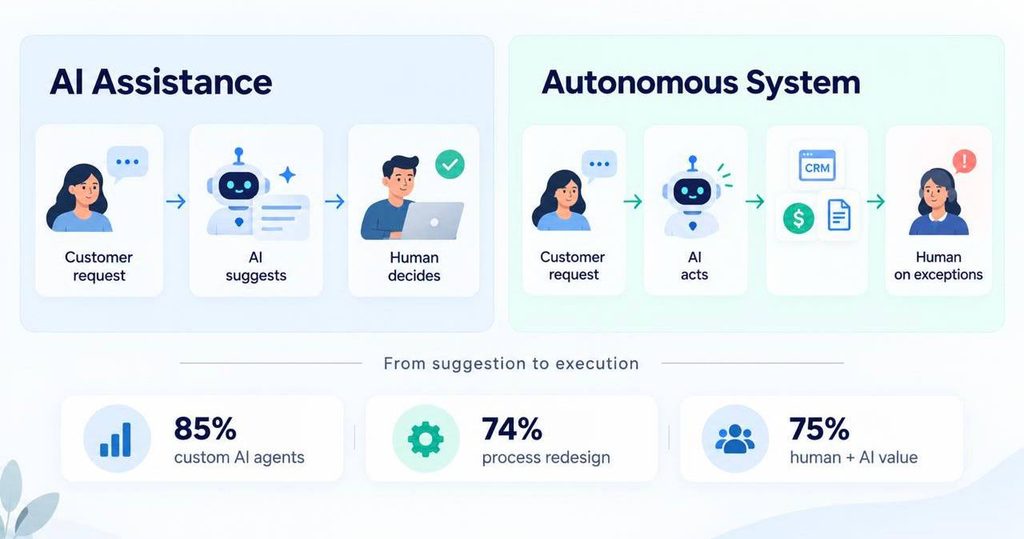
The system does not simply generate information; it uses information to decide what should happen next.
That is one reason business interest in autonomous systems has accelerated. Deloitte’s 2026 research found that 85% of surveyed companies expect to customize AI agents for their business needs, while a later study found that 74% of leaders expect nearly half of their business processes to be redesigned or rebuilt around AI agents within four years. At the same time, 75% said collaboration between people and AI agents creates more value than agent-only automation, suggesting that the emerging model is not unlimited autonomy but a combination of automated execution and human oversight. The distinction matters because successful autonomy is rarely about removing people entirely. It is about deciding which parts of a process no longer require constant human coordination.
Autonomy Works Best Inside Clear Boundaries
The strongest business cases for autonomous systems share several characteristics. The work happens frequently, the desired outcome can be clearly defined, relevant information is available digitally, actions can be performed through connected systems, and the organization can establish boundaries around what the system is allowed to do.
Consider invoice processing. The objective is clear: receive an invoice, match it with a purchase order, check relevant fields, identify exceptions, route the document correctly, and prepare or initiate payment according to company rules. Most cases follow recognizable patterns, which makes the workflow suitable for greater autonomy.
Compare that with negotiating a strategic acquisition. The process involves incomplete information, changing priorities, legal interpretation, interpersonal dynamics, long-term consequences, and decisions that cannot easily be reversed. AI can support the process, but assigning end-to-end autonomy would create a very different risk profile.
This suggests a useful principle for companies evaluating autonomous systems: autonomy works best when the system has freedom to act inside a carefully defined space rather than unlimited freedom to determine both the goal and the rules. The objective is therefore not to maximize autonomy. It is to find the level of autonomy that removes unnecessary human work without removing the judgment that protects the business.
Customer Operations Are Becoming an Early Testing Ground
Customer service is one of the clearest examples because the work combines high transaction volumes with large numbers of repeatable processes.
Earlier generations of AI focused primarily on chatbots that answered common questions. More advanced systems can now interact with customer records, retrieve policies, verify information, modify bookings, create tickets, update CRM systems, initiate approved transactions, and coordinate several steps inside one conversation.
Deloitte reports examples of airlines using agents to handle common transactions such as flight rebooking and baggage rerouting, allowing human employees to concentrate on cases that require negotiation, empathy, or unusual problem solving.
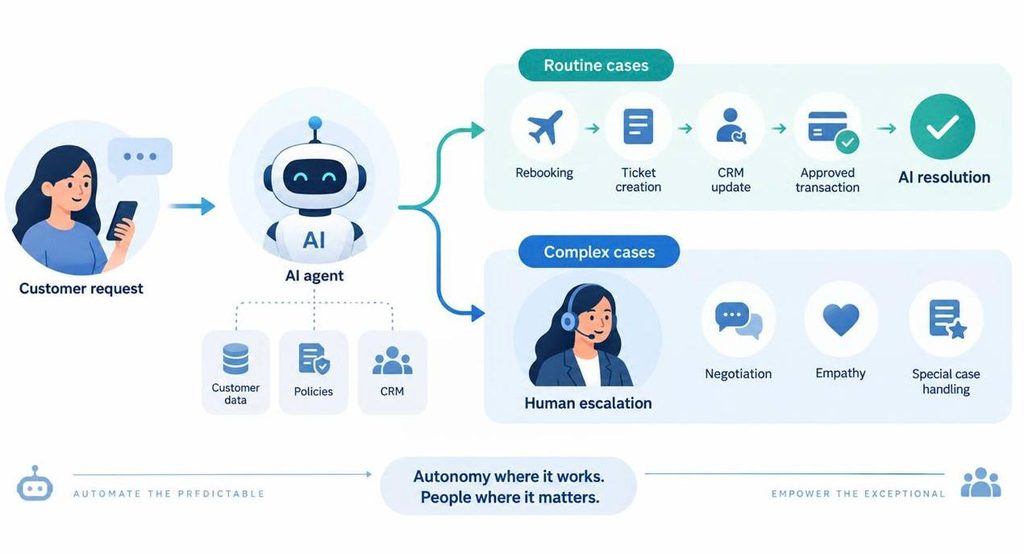
The important boundary is transaction complexity. An autonomous system may be highly effective at changing a reservation when the customer qualifies under a known policy. The same system should not necessarily decide how to compensate a customer during an unusual service failure involving financial, reputational, or legal considerations. This makes customer operations a strong example of bounded autonomy. Routine cases can increasingly move from request to resolution without human intervention, while exceptions are escalated to employees with the relevant context already prepared.
The result is not simply fewer customer service tasks. It is a different division of work in which autonomous systems handle predictable execution and people concentrate on interactions requiring discretion.
Finance and Back-Office Operations Fit the Model
Finance and administrative processes contain many characteristics that autonomous systems handle well: structured documents, explicit rules, repetitive decisions, digital records, and measurable outcomes.
An autonomous workflow might receive an invoice, extract its information, compare it with procurement data, detect inconsistencies, determine the correct accounting category, and route it for payment. Another system could monitor outstanding receivables, identify accounts requiring follow-up, prepare communications, update records, and escalate unusual cases. Procurement provides similar opportunities. Systems can monitor requests, compare approved vendors, check contractual conditions, gather quotes, identify potential savings, and prepare transactions within defined purchasing limits.
The opportunity becomes more significant when autonomous systems connect several applications that employees currently coordinate manually. Many back-office processes do not suffer from a lack of software; they suffer from the amount of human effort required to move information between systems and ensure that each stage happens correctly.
Autonomy can remove part of that coordination layer. However, financial operations also demonstrate the need for strong boundaries. A system that can prepare a payment is different from a system authorized to transfer unlimited amounts of money. Transaction limits, segregation of duties, approval thresholds, audit logs, and anomaly detection remain essential even when AI performs much of the underlying work.
IT Operations Benefit From Machine-Speed Response
IT environments produce enormous amounts of operational information. Monitoring systems generate alerts, applications create logs, cloud platforms change continuously, and infrastructure teams often need to investigate incidents across multiple systems before determining the appropriate response.
Autonomous systems are particularly useful when the time required to detect and respond to an event directly affects the business. An AI agent can receive an alert, collect relevant logs, compare the incident with previous events, inspect recent deployments, identify likely causes, and execute an approved remediation. A service that has stopped responding might be restarted automatically. A misconfigured resource could be corrected. A capacity problem could trigger scaling before users begin experiencing serious degradation.
These capabilities extend beyond incident response. Autonomous systems can help manage cloud resources, software updates, access requests, infrastructure provisioning, routine maintenance, and service desk workflows.
The advantage comes from continuity. People do not need to manually transfer information between monitoring tools, ticketing platforms, documentation systems, and cloud consoles every time something happens.
But IT also illustrates an important limitation. The more powerful the system, the stronger its controls need to be. An autonomous agent that can read production logs represents one level of risk. An agent that can change network configurations, deploy software, delete infrastructure, or modify identity permissions represents another.
Autonomy therefore needs to expand together with authentication, authorization, monitoring, and rollback capabilities.
Cybersecurity Turns Autonomy Into a Speed Advantage
Security operations face a similar problem but with even greater time pressure. Modern organizations can generate thousands of security signals across endpoints, identities, cloud infrastructure, networks, applications, and external services. Human analysts cannot investigate every signal manually at the speed at which attacks can develop.Autonomous systems can help correlate alerts, enrich them with context, investigate suspicious behavior, identify affected assets, and recommend or perform predefined containment actions. A compromised credential might trigger additional authentication requirements. A suspicious endpoint could be isolated. Malicious infrastructure could be blocked automatically while an analyst receives a complete incident summary.
This is valuable because many security workflows contain a combination of machine-scale information processing and recognizable response procedures.
The system does not need to independently invent a cybersecurity strategy. It needs to detect conditions and execute actions that security teams have already defined as appropriate for those conditions.
The strongest implementations therefore combine autonomous detection and response with escalation thresholds. Low-risk, reversible actions can happen automatically, while actions with large operational consequences continue to require human authorization.
Supply Chains Need Continuous Coordination
Supply chains are another strong environment for autonomous systems because decisions are continuous and highly interconnected. Inventory levels change. Orders arrive. Suppliers experience delays. Transportation costs fluctuate. Production schedules move. Demand forecasts change as new information becomes available. A decision made in one part of the network can affect several others. Traditional planning systems already automate many calculations, but autonomous systems can add another layer by continuously evaluating conditions and coordinating actions across applications. A system might detect that a supplier delay will create an inventory shortage, identify alternative suppliers, calculate the cost difference, check contractual conditions, update the production forecast, and propose or initiate the appropriate response. The business value comes from reducing the delay between detecting a problem and adapting to it. McKinsey notes that agentic systems are increasingly being explored for planning, scheduling, procurement, product development, and other operational processes precisely because these workflows combine decisions with repeated actions.
This does not mean autonomous supply chains operate without people. Strategic sourcing, supplier relationships, major production decisions, and unusual disruptions still require human judgment. The opportunity is to automate the enormous amount of continuous coordination happening between those decisions.
Physical Autonomy Is Moving Beyond Traditional Robotics
Autonomous systems are not limited to software agents. Physical AI combines perception, AI models, sensors, robotics, and control systems to allow machines to respond more dynamically to real-world environments. This includes autonomous vehicles, warehouse robots, inspection systems, industrial robots, agricultural equipment, and other machines capable of adapting their behavior based on current conditions. Adoption is already substantial. Deloitte’s 2026 enterprise AI research found that 58% of surveyed companies reported at least limited use of physical AI, with that figure expected to reach 80% within two years.
Manufacturing provides some of the most practical applications. Autonomous systems can inspect products using computer vision, adjust equipment parameters, move materials, detect unusual machine behavior, and coordinate robotic processes. Warehouses provide another natural environment. Work is repetitive, locations are mapped, objectives are measurable, and many actions can be constrained to controlled spaces. Autonomous mobile robots can move products while software continuously optimizes routing and inventory placement.
These systems work because the operating environment can be structured. The more unpredictable the physical environment becomes, the harder autonomy becomes to implement safely.
Software Development Is Moving Toward Controlled Autonomy
Software engineering has become another major area of experimentation. AI coding assistants initially focused on completing individual lines or generating small functions. More advanced systems can now analyze repositories, create implementation plans, modify several files, generate tests, investigate failures, update documentation, and work through development tasks with less direct supervision.
The productivity opportunity is significant because software development includes a large amount of surrounding work that does not require the highest level of engineering judgment. Creating boilerplate, updating repetitive code, writing routine tests, migrating APIs, reviewing logs, and preparing documentation can consume substantial capacity.
Autonomous development systems can handle more of this execution while engineers concentrate on architecture, system design, product decisions, security, and complex debugging.
The limit appears when code changes carry consequences that are difficult to evaluate automatically. A technically correct implementation can still introduce architectural problems, security weaknesses, operational costs, or business behavior that the system does not fully understand.
For this reason, successful autonomous software development is likely to rely heavily on controlled environments, automated testing, code review, permission boundaries, and human responsibility for important releases.
The system may write more of the code, but ownership of the software remains a human and organizational responsibility.
Build autonomy that works in the real world — with Ficus Technologies.
Contact usThe Business Case Depends on Workflow Economics
One of the biggest mistakes companies make is evaluating autonomous systems based primarily on technical capability. A system may be capable of completing a task autonomously without being economically useful.
The relevant question is how much human effort the workflow currently requires and how much of that effort autonomy can reliably remove. Companies need to consider transaction volume, labor cost, error rates, exception rates, infrastructure costs, model usage, integration work, monitoring, and governance. A process performed ten times per year is unlikely to justify the same investment as one performed ten thousand times per day. Exception rates matter particularly. If an autonomous system completes 90% of transactions independently but the remaining 10% require complex human intervention, the business case may still be strong. If the system escalates half of all transactions, employees may spend so much time reviewing its work that the supposed automation produces limited value. This helps explain the difference between widespread experimentation and actual scale. McKinsey reported in April 2026 that nearly two-thirds of enterprises had experimented with AI agents, but fewer than 10% had scaled them to deliver tangible value. The same research found data limitations to be a major scaling obstacle for many organizations. The lesson is straightforward: successful autonomy requires a business process worth redesigning, not simply an agent worth demonstrating.
Human Oversight Changes Rather Than Disappears
Autonomous systems are sometimes described as technology that removes humans from the loop. In practice, business autonomy usually changes the location of human involvement rather than eliminating it completely.
In traditional workflows, people may participate in almost every transaction. They collect information, choose actions, update systems, and verify the result. With autonomy, people increasingly supervise the system instead.
Employees define policies, determine permissions, handle exceptions, investigate unusual behavior, review performance, and decide how the system should evolve. One person may oversee a process that previously required several employees to execute manually. This creates a different kind of work. Operational roles can shift from completing individual tasks toward managing systems that complete those tasks. Deloitte’s August 2026 research reflects this direction: 75% of surveyed leaders said human collaboration with AI agents creates more value than automation powered by agents alone. The strongest model is therefore often not human-in-the-loop for every action or human completely outside the process. It is human-over-the-loop, with people monitoring performance and stepping in when risk, ambiguity, or exceptions exceed predefined thresholds.
Governance Becomes Part of the Architecture
Traditional automation could often be governed through predefined workflow rules. Autonomous systems require a more dynamic model because they can determine their own sequence of actions within a goal.
That makes permissions especially important. An autonomous system should not automatically inherit every capability of the employee whose work it supports. Its authority should be explicitly defined: which data it can access, which systems it can use, what actions it can perform independently, what financial or operational limits apply, and which actions require human confirmation. Monitoring also becomes more important because organizations need visibility into how systems behave after deployment.
The World Economic Forum’s 2026 work on autonomous agents emphasizes this shift toward explicit authorization. As agents move from generating information to performing actions, organizations need mechanisms that make delegated authority enforceable, auditable, and accountable throughout deployment.
This is not simply a compliance requirement. Clear boundaries make autonomy easier to scale because teams know exactly how much independence a system can receive without creating uncontrolled risk.
The Hardest Part Is Redesigning the Work
Businesses often approach autonomous systems by looking at an existing job and asking how much of it AI can perform. That can produce useful improvements, but it may also preserve inefficient workflows.
AI automation creates more value when organizations reconsider the process itself. If several employees spend their day copying information between applications, introducing an AI agent to perform the same sequence faster may be useful. But a better architecture might remove several steps entirely. This is increasingly becoming the central challenge of enterprise autonomy. Deloitte found that nearly two-thirds of surveyed executives are reevaluating their business models as agentic AI develops, while its August 2026 research argues that organizations need workflow and process reinvention rather than simply adding agents to existing work.
The technology can execute more work independently, but companies still need to determine how that work should be organized. Autonomy therefore becomes an operating-model question as much as a technology question.
Conclusion
Autonomous systems are becoming capable of doing significantly more than answering questions or recommending actions. They can coordinate workflows, interact with enterprise software, make bounded decisions, and perform real business tasks with decreasing levels of direct supervision. But autonomy itself is not the business objective.
The strongest use cases appear in processes with clear goals, high transaction volumes, reliable digital information, measurable outcomes, and actions that can be constrained through explicit permissions. Customer operations, finance, IT, cybersecurity, supply chains, industrial environments, and software engineering all contain significant opportunities, but each requires a different level of autonomy.
The biggest mistake is assuming that every process becomes better when humans are removed from it.
In many cases, the most effective model combines autonomous execution with human judgment. Systems handle predictable work at machine speed, while people remain responsible for exceptions, strategy, accountability, and decisions whose consequences require broader context. The future of business autonomy will therefore not be defined by which company deploys the most agents or robots. It will be defined by which companies understand where autonomy improves the system and where human judgment still creates more value.
Why Ficus Technologies?
At Ficus Technologies, we help businesses move from AI experimentation to practical systems that can operate inside real workflows. We design custom software, AI integrations, automation platforms, cloud infrastructure, and data environments that connect intelligent capabilities with the systems businesses already depend on.
Autonomous systems require more than a capable AI model. They need reliable data, secure integrations, controlled access, monitoring, scalable infrastructure, and architecture designed around real operational requirements. We help organizations build these foundations and introduce autonomy where it can create measurable business value without adding unnecessary complexity.
Turn intelligent automation into reliable business operations – with Ficus Technologies.
An autonomous system can evaluate information, determine actions, and execute tasks within defined goals and permissions without requiring human direction at every step.
Traditional automation usually follows predefined rules and sequences. Autonomous systems can adapt their actions based on changing information and conditions.
High-volume, repeatable processes with clear objectives, reliable data, measurable outcomes, and predictable boundaries are generally the strongest candidates.
Not necessarily. Many successful systems automate routine execution while humans handle exceptions, sensitive decisions, strategy, and overall accountability.
Common barriers include poor data quality, fragmented systems, weak integrations, unclear permissions, security concerns.




 Success...!