Infrastructure as Code works beautifully when the environment is small. A few Terraform modules, several cloud accounts, a clear repository structure, and a team that knows how everything fits together can make infrastructure changes faster, safer, and easier to reproduce. Instead of configuring environments manually, teams describe infrastructure in code, review changes through pull requests, and deploy through automated pipelines. The difficulty appears later. As organizations add more teams, cloud accounts, environments, regions, services, policies, and dependencies, Infrastructure as Code can become one of the most important engineering systems in the company — and one of the easiest places for complexity to accumulate. State files grow. Modules become difficult to change. Teams copy configurations instead of reusing them. Provider upgrades break previously stable code. CI/CD queues become slower. Permissions become harder to manage. A small change in a shared module can affect dozens of environments. At that point, the challenge is no longer simply writing infrastructure as code.
It is operating Infrastructure as Code as a platform. The systems that fail first are usually not the cloud resources themselves. They are the coordination mechanisms around them: ownership, state management, module design, testing, policy enforcement, deployment workflows, and visibility.
- IaC problems usually appear through coordination and scale, not syntax.
- Shared modules become dangerous when ownership and versioning are unclear.
- State management becomes a critical architectural concern as environments grow.
Small IaC Environments Hide Structural Problems
Infrastructure as Code often starts inside one engineering team. The team creates several reusable modules, stores configuration in Git, connects the repository to a CI/CD pipeline, and uses remote state to coordinate deployments. The architecture is easy to understand because the number of people making changes is small and the number of environments is limited. Many design decisions that appear harmless at this stage become expensive later.
A single state file may seem convenient. A shared module can be changed directly because everyone knows who depends on it. Engineers may apply infrastructure locally because the team communicates closely. Naming conventions can remain informal because everybody understands them.
Then the organization grows. Five teams become twenty. One cloud account becomes dozens. Development, staging, production, regional environments, customer-specific deployments, and shared services all need infrastructure changes. Security teams introduce additional controls. Compliance requires stronger evidence. New cloud services appear faster than central platform teams can standardize them. The original IaC architecture may still technically work, but the operating model around it begins to break. That is usually the first sign that IaC has reached a different stage of maturity.
State Becomes Infrastructure of Its Own
State is one of the earliest scaling problems because it connects IaC configuration with the infrastructure that actually exists.
At small scale, the relationship is manageable. A team may have a single remote state backend for an application environment and a clear understanding of which resources belong to it. At larger scale, state architecture becomes much more important.
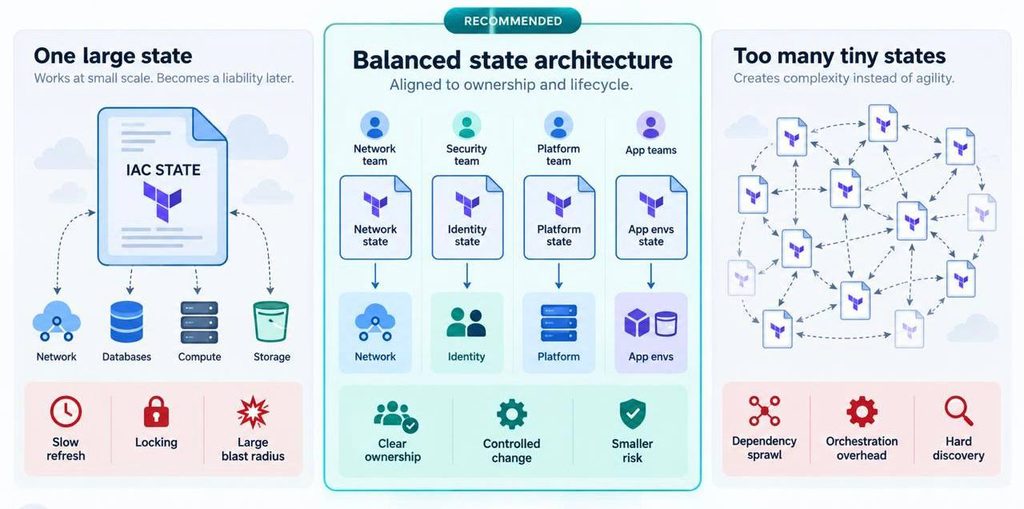
If too many resources are managed through one state file, unrelated changes become connected operationally. A small networking modification may require refreshing information about hundreds of resources. Locking can block several teams from working simultaneously. A failed deployment can affect a much larger area than expected. Large state files also increase the consequences of mistakes. If state becomes corrupted, incorrectly migrated, or accessed by the wrong process, the organization may lose reliable control over a significant portion of its infrastructure.
The opposite extreme creates problems too. Splitting infrastructure into hundreds or thousands of tiny state files can reduce blast radius, but it introduces dependency management, discovery, and orchestration challenges. Teams then need to understand how outputs move between states, which deployment must happen first, and who owns each boundary. At scale, state needs deliberate architecture.
Organizations usually need boundaries aligned with ownership, lifecycle, and failure domains rather than convenience. Shared networking, identity infrastructure, platform services, and application environments may require different state structures because they change at different speeds and have different operational consequences. State is therefore not simply a technical file generated by an IaC tool. It becomes part of the infrastructure architecture itself.
Shared Modules Become a Dependency Network
Reusable modules are one of the biggest advantages of Infrastructure as Code. A platform team can create approved modules for Kubernetes clusters, storage, networking, databases, identity, monitoring, or application environments. Product teams reuse those modules instead of rebuilding infrastructure patterns from the beginning. This works extremely well until the module ecosystem becomes large. A shared module may eventually be used by fifty teams across hundreds of environments. A change that seems minor to the platform team can affect a large number of downstream deployments. Changing a default value, upgrading a provider requirement, renaming an output, or modifying a security rule can create unexpected consequences for consumers that the module owner may not even know exist. This creates a dependency problem similar to software libraries. Modules need versioning. Breaking changes need migration paths. Consumers need visibility into upcoming releases. Deprecated versions need a lifecycle. Owners need to understand how widely each module is used.
Without these practices, organizations often move in one of two directions. Some teams stop upgrading shared modules because change feels too risky. Infrastructure gradually becomes outdated. Other teams copy the modules into their own repositories so they can control them independently. Standardization disappears, and the company ends up maintaining dozens of slightly different versions of the same infrastructure pattern.
Both outcomes reduce the original value of IaC. The goal is not maximum reuse. It is controlled reuse with predictable evolution. At scale, the deployment pipeline itself can become the place where everything slows down. A growing organization may have hundreds of infrastructure pull requests moving through validation, planning, security checks, policy evaluation, approvals, and deployment. Some changes affect only a small development environment. Others modify shared networking or production infrastructure. If every change follows the same process, the pipeline becomes inefficient.
Low-risk updates wait behind large deployments. Engineers spend time watching plan output that contains hundreds of unrelated changes. Shared runners become overloaded. Deployment queues grow. Infrastructure teams begin bypassing the pipeline because applying changes manually feels faster.
That is a dangerous point. The solution is rarely to remove controls. It is to make the deployment system understand risk and scope.
Drift Turns Automation Into Uncertainty
IaC depends on an important assumption: the configuration repository accurately represents the environment. Real organizations frequently violate that assumption. An engineer changes a security group directly during an incident. A cloud administrator updates a permission through the console. A managed service modifies a resource automatically. Another automation tool creates infrastructure that partially overlaps with the IaC system.
Over time, the infrastructure running in production can move away from the configuration stored in Git. This is configuration drift. A small amount of drift may appear harmless until the next deployment tries to reconcile the environment. A change intended to modify one setting can unexpectedly remove or overwrite another manual modification. The larger the environment becomes, the harder drift is to identify manually. Periodic checks are useful, but they are not enough when infrastructure changes constantly. Organizations increasingly need continuous drift detection that compares expected and actual state and identifies differences before they appear inside a production deployment.
Drift also exposes an organizational problem. If teams regularly need to bypass IaC to get work done, the issue may not be engineer discipline. The platform may simply be too slow or restrictive. A healthy IaC environment makes the controlled path easier than the manual workaround.
Provider Upgrades Become Organizational Events
Cloud providers evolve continuously. New resources appear. APIs change. Deprecated properties are removed. IaC providers release new versions that improve support but can also change behavior.A provider upgrade that takes one engineer fifteen minutes in a small project can become a coordinated migration when hundreds of environments depend on it. The difficulty increases when teams are allowed to choose provider versions independently.
Some repositories stay current. Others remain years behind. Shared modules need to support several incompatible versions. Engineers become afraid to upgrade because they do not know which hidden dependency might break. Eventually, infrastructure becomes technically functional but increasingly difficult to evolve.
Mature organizations treat provider versions similarly to platform dependencies. They define supported ranges, test upgrades centrally, communicate migration timelines, and gradually remove support for obsolete versions.
Automation can help identify environments that still depend on older providers and create upgrade pull requests. The objective is to turn upgrades from emergency projects into normal maintenance.
The First Things That Usually Break
Infrastructure as Code failures at scale tend to follow a recognizable pattern. The first problems usually do not appear because Terraform, OpenTofu, Pulumi, or another IaC tool suddenly stops working. They appear because the environment around the code becomes more complex than the original operating model was designed to handle.
As the number of teams grows, ownership becomes less obvious. Infrastructure that was once maintained by a small group may eventually be shared across platform teams, application teams, security engineers, and cloud administrators. A module can have dozens of consumers, but no clear owner responsible for upgrades, documentation, or incident response. At that point, even a simple change can require coordination across several teams before anyone feels confident enough to deploy it.
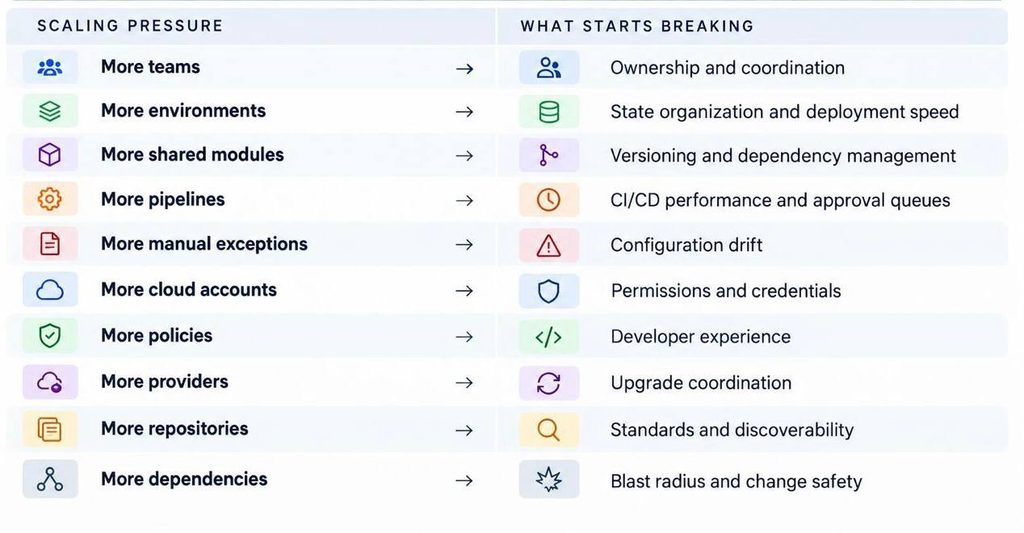
More environments create a different kind of pressure. Development, testing, staging, production, regional deployments, and customer-specific environments all need state, pipelines, permissions, and configuration. If those boundaries were not designed carefully, state files become too large, deployments become slower, and teams begin waiting for locks or approval queues that have nothing to do with their own changes.
Shared modules introduce dependency risk. Reuse initially reduces duplication, but every reused component becomes part of a growing dependency network. A change in one networking or database module may eventually affect dozens of repositories. Without strong versioning and predictable upgrade paths, teams either delay updates for too long or copy modules locally to avoid breaking changes. Both approaches weaken standardization.
Conclusion
Infrastructure as Code remains one of the most important foundations of modern cloud engineering. It makes infrastructure repeatable, reviewable, automatable, and easier to recover. But the characteristics that make IaC powerful at small scale do not automatically make it manageable at enterprise scale.
As environments grow, the first things to break are usually the systems surrounding the code. State becomes too large or fragmented. Shared modules become dependency networks. CI/CD pipelines become bottlenecks. Provider upgrades become migrations. Drift reduces confidence. Permissions become too broad. Policies become difficult to navigate. Ownership becomes unclear. Solving these problems requires more than choosing a different IaC tool.
Organizations need stronger boundaries, clear ownership, versioned modules, automated testing, policy enforcement, observable deployment workflows, reliable state architecture, and platform capabilities that reduce the amount of infrastructure complexity each team has to manage directly. The goal is no longer simply to define infrastructure as code. It is to create an infrastructure system that can continue evolving as the organization grows.
Scale your infrastructure without scaling the chaos — with Ficus Technologies.
Contact usWhy Ficus Technologies?
At Ficus Technologies, we help businesses design and modernize cloud infrastructure that remains manageable as applications, teams, and environments scale. From cloud architecture and Infrastructure as Code to DevOps automation, CI/CD, platform engineering, security, and custom software development, we help organizations replace fragmented infrastructure processes with reliable, repeatable engineering systems.
We focus not only on automating infrastructure creation, but on building the foundations required to operate that automation safely over time — including reusable architecture, deployment workflows, access controls, monitoring, and scalable cloud platforms.
Build infrastructure that scales with your engineering organization – with Ficus Technologies.
Infrastructure as Code is the practice of defining and managing infrastructure through version-controlled configuration rather than manual setup.
Common tools include Terraform, OpenTofu, Pulumi, AWS CloudFormation, Azure Bicep, Ansible, and cloud-native deployment frameworks.
State management, shared modules, ownership, CI/CD performance, permissions, provider upgrades, and configuration drift are common early scaling problems.
Usually not for large environments. State boundaries should reflect ownership, lifecycle, dependencies, and potential blast radius.
Platform engineering provides reusable infrastructure patterns and standardized workflows so product teams do not need to manage every infrastructure detail directly.
IaC helps establish a desired configuration, but organizations still need drift detection and controls that reduce manual infrastructure changes.





 Success...!