
Digital products have spent the last two decades becoming easier to use. Interfaces became cleaner, mobile applications replaced desktop-heavy workflows, personalization improved, and cloud platforms made digital services available almost everywhere. AI is introducing a different kind of change. The next generation of digital products will not simply give users better screens, faster search, or more recommendations. Products are beginning to understand intent, adapt to context, generate interfaces and content dynamically, anticipate needs, and increasingly complete actions on behalf of the user.
A customer may no longer need to navigate five screens to change a subscription. They can describe the outcome they want. A business user may not need to build a report manually. The product can understand the question, assemble the relevant data, generate an analysis, and suggest the next action. An e-commerce experience may evolve from displaying recommended products to helping customers compare options, answer questions, configure a purchase, and complete parts of the transaction. This represents a shift from software that waits for instructions toward software that participates in the experience. The opportunity is significant, but adding a chatbot to an existing application is not enough. AI-driven products require different thinking about interfaces, data, APIs, personalization, trust, product architecture, and the relationship between users and software. The next evolution of digital products is therefore not simply products with AI features. It is products designed around the assumption that intelligence can become part of the experience itself.
- AI is shifting digital products from navigation-based to intent-based experiences.
- Personalization is becoming dynamic and contextual rather than rule-based.
- Conversational interfaces are evolving from support features into product interfaces.
From Navigation to Intent
Traditional digital products are built around navigation.
Designers create menus, dashboards, search boxes, filters, forms, settings, and workflows that help users find the functionality they need. Even highly intuitive applications still require users to understand something about how the product is organized. AI begins to remove part of that requirement. Instead of learning the structure of the software, users can increasingly describe an outcome. The system determines which information, feature, or workflow is required to achieve it. Consider a financial platform. A traditional interface might require a business owner to open analytics, select a period, choose several metrics, apply filters, and compare reports. An AI-driven experience could begin with a request such as, “Show me why operating costs increased this quarter and which categories changed the most.” The product can interpret the goal, retrieve the appropriate information, perform the analysis, and present the relevant explanation.
The functionality already existed. The difference is how the user reaches it.
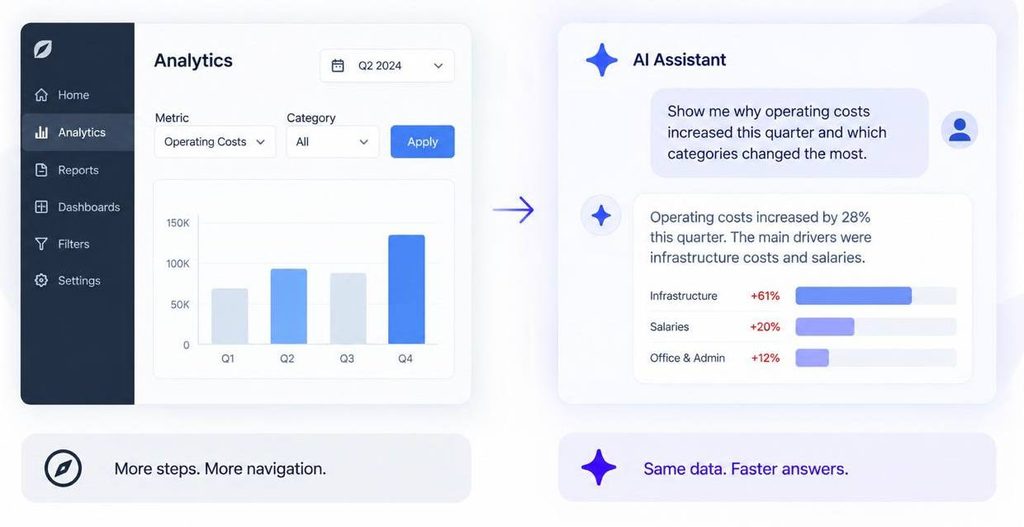
This is an important evolution because complex products often accumulate features faster than users can discover them. Adding another capability traditionally meant adding another menu item, dashboard, or configuration screen. AI creates the possibility of exposing more functionality without continuously increasing interface complexity.
That does not mean graphical interfaces disappear. Visual interfaces remain essential for comparison, exploration, confirmation, and tasks where spatial context matters. The change is that navigation no longer needs to be the only route into the product. The interface can increasingly begin with intent rather than location.
Personalization Becomes an Active Product Capability
Digital personalization has traditionally been based on segmentation and rules. Users are grouped according to location, purchase history, demographics, account type, or previous behavior, and the system changes parts of the experience accordingly. AI makes personalization much more dynamic. A product can potentially interpret what the user is doing now, combine that context with previous behavior, understand the current goal, and adapt the experience in real time. Recommendations can change based on the conversation. Interfaces can surface different tools depending on the task. Explanations can adjust to the user’s level of knowledge. This is already becoming a strategic priority. Adobe’s 2026 AI and Digital Trends research found that 56% of organizations identify more personalized customer experiences as a priority for AI investment, while customers increasingly expect AI to help them find relevant information and products.
The difference between traditional and AI-driven personalization is important. Traditional personalization asks: Which segment does this user belong to? AI-driven personalization can ask: What is this user trying to accomplish right now?
Imagine two customers using the same travel application. Both may have similar profiles, but one is casually exploring destinations while the other needs to change a flight leaving tomorrow. Treating them as the same “frequent traveler” segment misses the most important context. An intelligent product can adapt the experience to the immediate situation.
The first user may see inspiration and comparisons. The second may receive disruption information, available alternatives, rebooking options, and direct access to assistance. That creates a more useful experience without requiring the company to manually design a separate journey for every possible situation.
Conversation Becomes Part of the Product Interface
Conversational AI initially entered digital products through customer service chatbots.
That model is expanding rapidly. Users are becoming comfortable describing what they want in natural language rather than translating their goal into menus, filters, and search queries. Adobe reports that one in four customers already uses AI-powered platforms as a primary source when searching for information, making decisions, or finding recommendations. Nearly half say they would use AI for personalized product recommendations, while 44% would use it for instant customer service. This means conversation can no longer be treated only as a support channel. It can become a layer across the entire product. A user of an analytics platform might ask the product to explain a sudden change in conversion rates. A project-management application could turn a conversation into tasks, priorities, and deadlines. An e-commerce platform could help someone compare products according to requirements that are difficult to represent through traditional filters.
The strongest experiences will probably combine conversation with visual interfaces rather than forcing users to choose between them. A customer might describe a goal conversationally and receive an interactive comparison table. They might ask a follow-up question and see a chart update. They could request a change and then confirm it through a familiar visual control. This combination is important because language is efficient for expressing intent, while visual interfaces are often better for understanding options and confirming consequences.
AI-driven UX therefore becomes less about replacing screens and more about allowing users to move naturally between conversation, visualization, navigation, and action.
From Answers to Actions
The first wave of generative AI inside products focused heavily on information. Summarize this document. Explain this report. Write this message. Answer this question. Users are beginning to expect more.
Gartner’s 2026 customer research found that 58% of customers who use generative AI have already used it to complete a task on their behalf, rising to 74% among B2B users. Customers increasingly expect AI to help with actions such as submitting information, managing an account, booking an appointment, or completing other steps rather than simply providing an answer. This changes product design considerably. An AI assistant inside a travel application becomes more useful when it can move from explaining a cancellation policy to finding alternative flights and initiating a rebooking. An AI interface in business software becomes more valuable when it can move from identifying overdue invoices to creating follow-up tasks or preparing communications. The product moves from knowledge retrieval to execution.
This is also the point where architecture becomes more important. Generating an answer primarily requires access to information. Completing a task requires access to systems. The AI needs authenticated APIs, permission controls, workflow logic, transaction boundaries, and mechanisms for confirming sensitive actions.
The more useful the AI becomes, the more deeply it needs to connect with the underlying product.
Turn AI into a better product experience — with Ficus Technologies.
Contact usAI Agents Turn Products Into Active Participants
AI agents extend this model further by allowing software to perform multi-step work toward a goal.
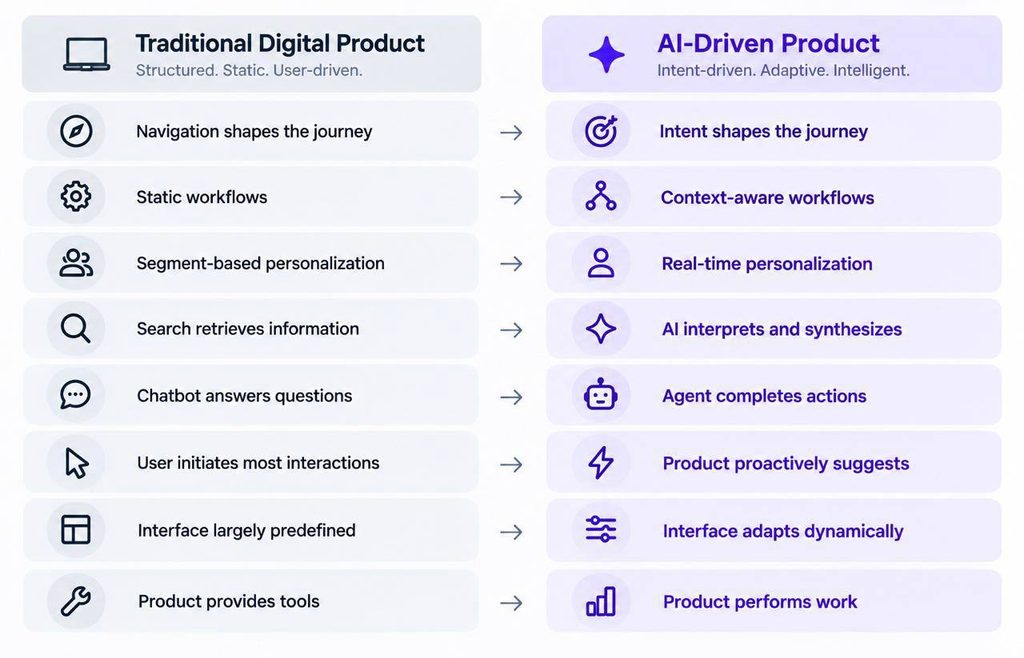
Instead of the user manually directing every action, the product can determine part of the sequence independently. An agent might collect information, compare alternatives, interact with APIs, verify conditions, execute approved actions, and return when the task is complete or human input is required. This creates a new relationship between users and digital products. Traditional software gives users tools. Agentic products can increasingly perform work.
The change is already visible in commerce. Salesforce reported in 2026 that the use of agentic search as the first step in shopping journeys had grown 200% year over year, while 86% of commerce leaders said AI is increasing customer expectations. However, customers are not equally comfortable delegating every decision. Gartner found that only 11% of surveyed U.S. consumers were willing to let AI independently make purchase decisions, even though significantly more were comfortable using AI to narrow choices. That distinction is important for product teams.
Users may happily delegate research, comparison, scheduling, information retrieval, and routine administration while still wanting direct control over purchases, sensitive decisions, financial commitments, or actions that are difficult to reverse.
The best agentic products will therefore make the boundary between assistance, recommendation, and autonomous action clear.
The Product Interface Starts Becoming Adaptive
Digital interfaces have historically been designed in advance. Teams decide which navigation elements, screens, cards, filters, and workflows users will see. Personalization may change the content, but the fundamental structure usually remains stable. AI opens the possibility of interfaces that adapt more dynamically.
A product could prioritize different capabilities depending on the user’s current task. A dashboard could generate a visualization appropriate to the question instead of requiring users to select a chart manually. An enterprise application could simplify the interface for occasional users while exposing deeper controls to specialists. This does not mean applications should generate a completely different interface every time someone opens them. Consistency still matters. Users need to know where important controls are and understand what will happen when they take an action.
The more practical model is controlled adaptation. Stable elements provide familiarity and trust, while AI changes the parts of the experience where context creates meaningful value.
Product Data Becomes Part of the Experience Layer
AI-driven experiences depend heavily on data quality. An intelligent interface can only personalize effectively if customer information is accurate. A product agent can only recommend the correct action if it has access to current account, product, transaction, and policy data. A conversational analytics experience is only useful if business definitions are consistent. This creates a direct connection between backend data architecture and frontend user experience.
Traditionally, poor data quality might appear as an incorrect report or an irrelevant recommendation. In AI-driven products, the same problem can affect an entire conversation or automated workflow. The product might confidently explain incorrect information, personalize the experience using an outdated customer state, or execute an action based on incomplete context. This means data engineering becomes part of product design.
Teams need clear ownership of important data, reliable APIs, lineage, quality monitoring, permissions, and mechanisms for identifying which information an AI system is allowed to use. As interfaces become more intelligent, data quality becomes visible to the customer through the quality of the experience.
APIs Become More Important, Not Less
Generative AI can make the interface feel less structured, but the underlying product needs more structure.
If an AI system is expected to retrieve information, update an account, book a service, create a report, modify a subscription, or trigger a workflow, those business capabilities need reliable machine-accessible interfaces.
That makes APIs increasingly important. A good agentic product should not simulate a human clicking randomly through its own interface. It should interact with clearly defined services that expose approved business actions.
Permissions can be controlled more precisely. Input and output formats become predictable. Actions can be logged. Transaction limits can be enforced. Sensitive workflows can require confirmation. Different interfaces — mobile, web, conversational AI, voice, or external agents – can all use the same underlying capabilities.
AI therefore strengthens the business case for API-first architecture. The user interface may become increasingly flexible, but the services underneath it need clear contracts. The more freedom AI receives at the experience layer, the more discipline is required at the architecture layer.
Conclusion
The next evolution of digital products is not defined by adding more AI features. It is defined by reducing the distance between what the user wants and what the product can accomplish. AI makes it possible for products to understand natural language, adapt experiences to context, personalize interactions dynamically, anticipate needs, combine multiple modes of interaction, and increasingly perform actions on behalf of users.
But the strongest products will not remove structure, interfaces, or people simply because technology makes it possible.
They will combine AI with predictable architecture, trustworthy data, clear permissions, thoughtful UX, and human control when it matters. The result is a different kind of digital experience: less focused on navigating software and more focused on accomplishing outcomes. For product teams, that changes the central design question.
The future is no longer only about which features the product should provide. It is increasingly about how intelligently the product can help users achieve what they came to do.
Why Ficus Technologies?
At Ficus Technologies, we help businesses turn AI capabilities into practical digital products that solve real user and business problems. Instead of adding AI as a separate feature, we integrate it directly into the product experience, architecture, data, and workflows.
Our expertise combines custom software development, AI integration, cloud architecture, data engineering, API development, automation, and scalable infrastructure. This allows us to build AI-driven products that are not only innovative, but also reliable enough for real production environments.
It is a digital experience where AI helps interpret user intent, personalize interactions, generate relevant information, or perform actions as part of the product workflow.
Not entirely. Conversational and agentic interfaces are likely to complement visual interfaces, especially for tasks involving comparison, confirmation, and complex information.
Agents allow products to move beyond recommendations and perform approved multi-step actions on behalf of users.
They typically require reliable APIs, high-quality data, identity and permission controls, monitoring, AI evaluation, and scalable cloud infrastructure.
Personalization is important, but AI can also reduce navigation, automate workflows, improve search, interpret multimodal information, and proactively assist users.





 Success...!