
Artificial intelligence has become one of the defining technologies of modern digital transformation. Organizations across industries are integrating AI into customer service, software development, analytics, healthcare, finance, and manufacturing. To users, these products often appear remarkably simple: a chatbot answers a question, an assistant summarizes a document, or a recommendation engine suggests the next action.
Behind that simplicity, however, lies an increasingly sophisticated technology stack. Large language models receive most of the attention, but they represent only one component of a much larger ecosystem. Every successful AI product depends on infrastructure capable of managing data pipelines, cloud resources, security, monitoring, orchestration, storage, and continuous deployment.
By 2026, organizations are beginning to recognize that building AI is no longer primarily about selecting the right model. Long-term success depends on the platforms that support it. The companies achieving the best results are investing not only in AI capabilities but also in the infrastructure that allows those capabilities to operate reliably, securely, and at scale.
Platform, AI, and engineering teams scaling production-ready AI systems with strong governance and reliability.
Organizations moving from AI experimentation to enterprise deployment while improving performance, operational efficiency, and long-term scalability.
- Successful AI products rely on far more than foundation models. Their long-term performance depends on cloud infrastructure, data pipelines, platform engineering, observability, and governance.
- What works in 2026 is treating AI as part of a complete software platform rather than as an isolated capability.
- What creates the biggest challenges is underestimating the infrastructure required to support reliable, secure, and scalable AI systems.
AI Is Only the Visible Layer
Most AI products present a remarkably simple interface. Users type a prompt, receive a response, and rarely think about what happens behind the scenes. This simplicity creates a common misconception that the intelligence of the model is the primary factor determining product quality.
In reality, the model is only one layer of a much larger architecture.
Before an AI system can generate useful output, data must be collected, cleaned, indexed, stored, and made available through retrieval pipelines. Requests must be routed through APIs, security controls must validate access, cloud infrastructure must allocate computing resources, and monitoring systems must track latency, failures, and costs.
When users evaluate an AI product, they experience the entire platform rather than the model alone. Fast responses, reliable availability, secure interactions, and accurate information all depend on infrastructure that remains largely invisible.
For many organizations, this hidden infrastructure has become the real differentiator.
Infrastructure Shapes the User Experience
The performance of an AI application depends on far more than model quality. Even the most capable model can produce a poor user experience if infrastructure introduces latency, unstable performance, or inconsistent availability.
Every AI request passes through multiple layers before reaching a model. Authentication services verify identity, orchestration platforms determine where requests should be processed, vector databases retrieve relevant information, caching systems reduce response times, and cloud infrastructure manages compute resources based on demand.
These components operate together to determine how quickly and consistently users receive results.
As organizations deploy AI to larger audiences, infrastructure increasingly becomes a competitive advantage. Businesses that invest in scalable platforms often deliver better AI experiences than competitors using similar models but weaker operational foundations.
AI Projects Spend More on Platforms Than Models
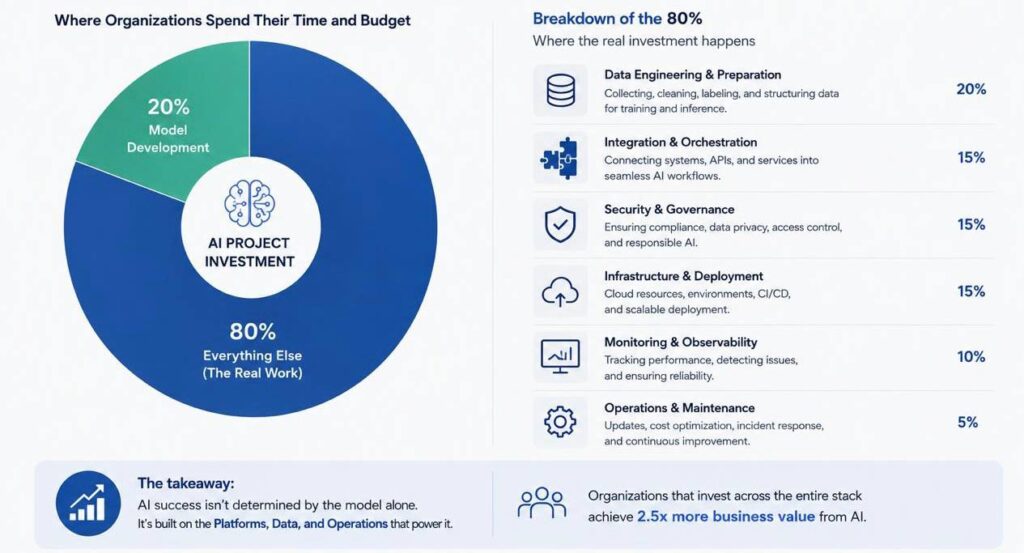
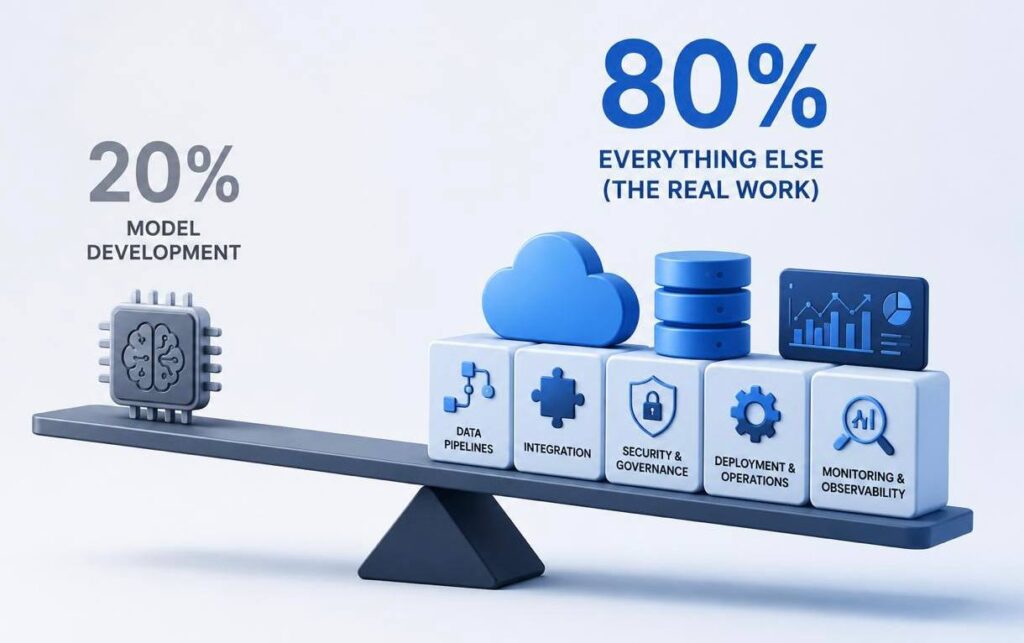
One of the biggest misconceptions surrounding AI is that model development represents the largest investment. In practice, organizations often spend considerably more time and resources building the systems around the model than creating the model itself.
According to industry research from IBM, Gartner, and Deloitte, enterprise AI initiatives devote a significant share of effort to data engineering, integration, governance, deployment, security, monitoring, and operational management rather than model development alone.
McKinsey’s State of AI research also shows that organizations achieving measurable business value from AI typically invest across the entire technology stack instead of focusing exclusively on model performance. Production-ready AI requires mature engineering practices capable of supporting continuous updates, secure data flows, and reliable operations.
The implication is clear. AI products succeed because infrastructure allows intelligence to operate consistently in real business environments—not because the underlying model is inherently more advanced.
Data Pipelines Keep AI Products Alive
Every AI application depends on a continuous flow of reliable information. Whether the system answers customer questions, generates reports, detects fraud, or assists software developers, its performance depends on the quality and availability of the data it receives.
Modern AI platforms therefore invest heavily in data pipelines that ingest, validate, transform, and synchronize information from multiple sources. These pipelines ensure that models operate on current, trusted, and well-structured data instead of outdated or inconsistent records.
As organizations introduce retrieval-augmented generation (RAG), vector databases have become another essential component of AI infrastructure. Rather than relying exclusively on information contained within foundation models, AI applications increasingly retrieve relevant business data in real time before generating responses.
This approach improves accuracy while allowing organizations to maintain greater control over the information their AI systems use.
Platform Engineering Makes AI Scalable
Many organizations successfully build AI prototypes but struggle to operate them reliably once adoption begins to grow. What works in a proof of concept often becomes difficult to manage across multiple teams, business units, and production environments.
Platform engineering addresses this challenge by creating standardized environments where AI applications can be deployed, monitored, secured, and updated consistently. Instead of every team building its own infrastructure, shared platforms provide common services for authentication, deployment, observability, model management, and governance.
This reduces operational complexity while allowing engineering teams to focus on developing business capabilities rather than maintaining infrastructure.
Increasingly, successful AI strategies depend as much on platform maturity as they do on advances in artificial intelligence itself.
Operational Excellence Is Becoming the Competitive Advantage
As AI adoption accelerates, organizations are beginning to compete less on access to models and more on their ability to operate those models effectively.
Most leading foundation models are now widely available through cloud providers or commercial APIs. What differentiates companies is how efficiently they integrate those models into secure, reliable, and scalable business systems.
Google Cloud’s DORA research consistently shows that organizations with mature engineering practices achieve better delivery performance, faster recovery, and greater operational stability. These same capabilities are becoming increasingly important for AI platforms, where availability, governance, monitoring, and continuous deployment directly influence business outcomes.
The trend suggests that AI infrastructure is becoming a strategic capability rather than simply a technical requirement. Organizations investing in operational excellence are likely to realize greater long-term value than those focusing exclusively on model selection.
Why AI Infrastructure Is Becoming a Business Capability?
For many organizations, infrastructure was once viewed as a supporting function—necessary for keeping systems running but largely invisible to business leaders. AI is changing that perspective.
As AI products become integrated into customer service, operations, software development, and decision-making, infrastructure directly influences business performance. Response times affect customer satisfaction, platform reliability impacts revenue, and governance determines whether AI can be deployed safely in regulated environments.
Infrastructure also shapes financial outcomes. Poor resource management can significantly increase cloud costs, while inefficient deployment pipelines slow product delivery and limit the ability to scale new AI capabilities. As a result, decisions about architecture, observability, security, and platform engineering are no longer purely technical. They have become strategic business decisions.
Organizations that treat AI infrastructure as a long-term capability—not simply as a collection of cloud services—are better positioned to adapt as technologies, models, and business requirements continue to evolve.
Building AI for Long-Term Growth
Many companies successfully launch AI pilots, yet only a smaller number manage to scale them across the organization. The difference is rarely the choice of language model. More often, it is the maturity of the surrounding platform.
Scalable AI requires standardized deployment processes, centralized monitoring, secure access controls, reliable data pipelines, and governance that allows multiple teams to build on the same foundation. Without these capabilities, every new AI initiative becomes another isolated project that increases operational complexity.
This is why leading organizations are investing in internal AI platforms rather than individual AI applications. Shared infrastructure allows teams to reuse components, maintain consistent security standards, control operational costs, and accelerate delivery across multiple business functions.
The result is not simply faster AI development. It is a more sustainable operating model where innovation becomes repeatable instead of experimental.
Conclusion
The public conversation around artificial intelligence often focuses on foundation models, prompting techniques, and new applications. While these elements are important, they represent only a small part of what makes AI successful in production.
Behind every reliable AI product is an infrastructure that manages data, orchestrates services, protects information, monitors performance, and enables continuous improvement. As organizations move from experimentation to enterprise-scale deployment, these capabilities become increasingly important.
In 2026, competitive advantage is no longer defined by access to AI models alone. It is determined by how effectively organizations build, operate, and evolve the platforms that support them. The strongest AI products are not only intelligent—they are reliable, scalable, secure, and designed for long-term growth.
Why Ficus Technologies?
Ficus Technologies helps organizations build AI-ready digital platforms where infrastructure, cloud architecture, data engineering, and software development work together as a unified ecosystem.
Successful AI adoption requires much more than integrating a language model. It depends on secure cloud environments, scalable data pipelines, observability, automation, and engineering practices that support continuous improvement.
Whether developing AI-powered products, modernizing enterprise platforms, or building cloud-native infrastructure, Ficus focuses on creating systems that remain reliable, adaptable, and ready for future growth.
Because models depend on supporting infrastructure for data access, security, orchestration, monitoring, scalability, and operational reliability.
Modern AI products typically rely on cloud infrastructure, APIs, vector databases, data pipelines, orchestration platforms, monitoring systems, identity management, and deployment automation.
They ensure AI systems receive accurate, current, and well-structured information. Without reliable data pipelines, even advanced models can produce poor results.
Platform engineering provides standardized environments that simplify deployment, governance, security, and operations, allowing teams to scale AI solutions more efficiently.
For most organizations, the challenge is not model performance but operational complexity—integrating AI into secure, scalable, and maintainable production systems.




 Success...!