Every digital transformation initiative expands an organization’s attack surface. Cloud migration, SaaS adoption, remote work, third-party integrations, APIs, IoT devices, and AI-powered applications all create new entry points that must be managed and secured.
The challenge is no longer the lack of security tools. Most enterprises already operate dozens of security platforms designed to detect vulnerabilities, monitor activity, and respond to threats. Yet security incidents continue to occur because many organizations are protecting only the assets they know about.
By 2026, Attack Surface Management (ASM) has become less about adding another security solution and more about answering a fundamental question: Do you actually know everything that is exposed to the internet? For many organizations, the answer is still no.
Security, infrastructure, and IT teams managing hybrid and multi-cloud environments.
Organizations protecting customer-facing applications, distributed workforces, and complex SaaS ecosystems where visibility and risk management are critical.
- Attack Surface Management is no longer limited to vulnerability scanning. It is about continuously discovering, understanding, and managing every internet-facing asset that could expose an organization to risk.
- What works in 2026 is continuous asset discovery, automated visibility, risk prioritization, and security integrated into cloud operations.
- What fails is relying on periodic inventories, manual asset tracking, and security programs built around infrastructure that no longer reflects reality.
Your Attack Surface Is Larger Than You Think
Ten years ago, an organization’s external infrastructure was relatively predictable. Security teams managed corporate networks, internal servers, and a limited number of public applications.
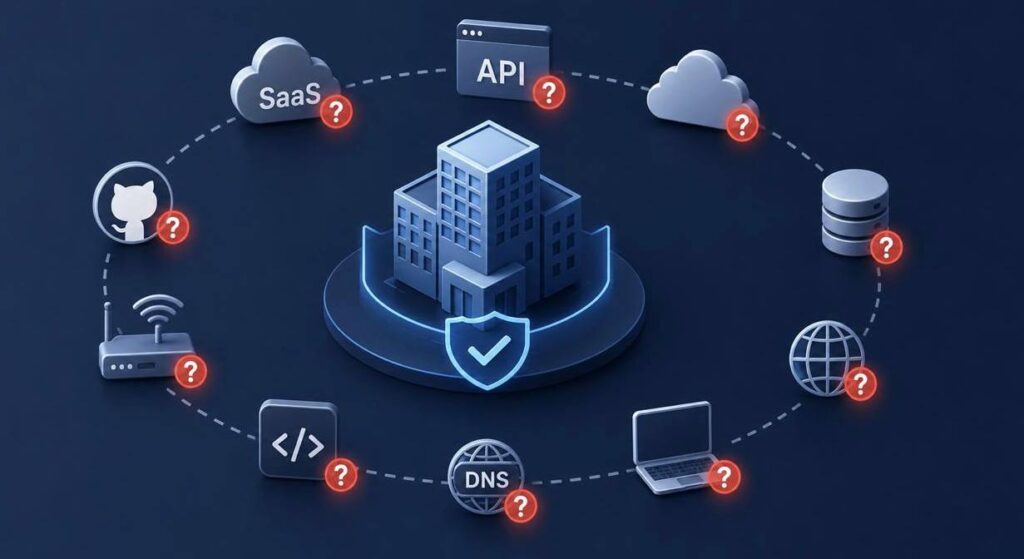
Today’s environments look very different. Businesses deploy workloads across multiple cloud providers, connect dozens of SaaS platforms, expose APIs to partners, operate remote endpoints, and integrate AI services into customer-facing applications. Every new service, domain, storage bucket, or development environment increases the number of assets that could potentially be exploited.
The challenge is that many of these assets appear outside traditional IT processes. Development teams create temporary environments, marketing launches new domains, business units subscribe to cloud services, and acquisitions introduce infrastructure that is never fully integrated into central inventories.
As a result, the organization’s real attack surface often becomes much larger than security teams realize.
Visibility Has Become the First Layer of Security
Security teams cannot protect assets they cannot see.
This simple reality has shifted priorities across the industry. Instead of asking how to strengthen perimeter defenses, organizations increasingly ask whether they have complete visibility into everything connected to their business.
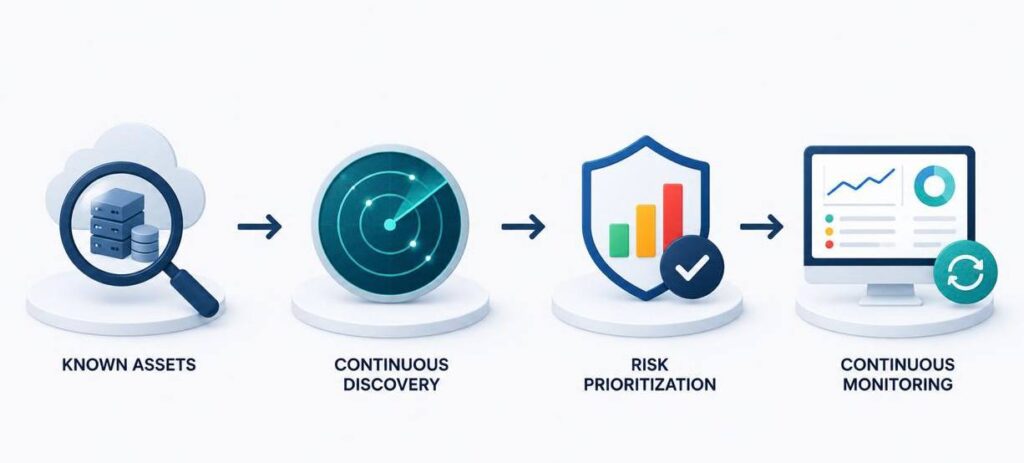
Continuous discovery has become one of the defining characteristics of modern security operations. Rather than relying on manually maintained asset inventories, organizations use automated discovery to identify internet-facing infrastructure, cloud resources, APIs, exposed services, certificates, forgotten domains, and shadow IT.
The objective is not simply to find vulnerabilities. It is to understand what actually exists. Without visibility, every other security investment becomes less effective.
Hidden Assets Create Hidden Risk
Modern attack surfaces change continuously. Cloud resources are created and removed automatically, applications are deployed multiple times a day, and new third-party services appear faster than traditional asset inventories can be updated.
Industry research consistently shows that many organizations struggle to maintain an accurate picture of their external infrastructure. According to IBM’s Cost of a Data Breach Report and Microsoft’s Digital Defense Report, attackers increasingly exploit misconfigurations, exposed credentials, unmanaged internet-facing assets, and cloud environments rather than relying solely on sophisticated malware.
This reflects an important shift. The greatest security risk is often not a sophisticated attack technique but an asset the organization did not know existed.
Continuous asset discovery is therefore becoming just as important as vulnerability management itself.
Cloud Growth Makes Discovery More Difficult
Cloud platforms have dramatically improved speed and scalability, but they have also made infrastructure more dynamic than ever before.
Resources can be provisioned automatically, environments exist only for hours, and applications span multiple cloud providers. Traditional inventory processes cannot keep pace with this level of change.
Organizations also rely on hundreds of external services that operate outside their direct control. APIs connect business partners, SaaS platforms process sensitive information, and AI applications interact with data stored across different environments.
Each connection expands the organization’s digital footprint. Managing this complexity requires continuous visibility rather than periodic reviews.
Attack Surface Management Is Becoming Continuous
One of the biggest changes in security strategy is the move away from periodic assessments.
Annual audits and scheduled vulnerability scans remain useful, but they provide only a snapshot of environments that change every day.
Modern Attack Surface Management operates continuously. It discovers new assets as they appear, identifies changes in exposure, prioritizes risks based on business impact, and helps security teams respond before attackers identify the same weaknesses.
This continuous approach allows organizations to reduce the time between exposure and remediation while improving overall visibility across cloud and hybrid environments.
Security Starts With Knowing What Exists
Research from Gartner, Censys, and Tenable points to the same conclusion: organizations are increasingly investing in External Attack Surface Management because visibility has become one of the biggest gaps in enterprise security.
The most mature security teams are not necessarily those with the largest number of tools. They are the teams capable of maintaining an accurate, continuously updated view of their infrastructure.
This enables faster risk prioritization, better governance, and more effective incident response.
Attack Surface Management therefore becomes less about monitoring threats and more about understanding the environment those threats target.
Unknown Assets Become the Biggest Threat
Security programs have traditionally focused on protecting known systems.
Today’s reality is different. Cloud-native infrastructure changes continuously, development teams deploy resources independently, acquisitions introduce new environments, and business units adopt software without involving central IT. Unknown assets create blind spots where security controls, monitoring, and governance may never be applied. Reducing this uncertainty has become one of the primary goals of modern cybersecurity programs.
Organizations that understand their complete digital footprint are significantly better positioned to reduce risk than those relying solely on traditional perimeter defenses.
Conclusion
Attack Surface Management reflects a broader change in cybersecurity thinking. The challenge is no longer simply protecting infrastructure. It is understanding the infrastructure that already exists.
As cloud adoption, AI, SaaS platforms, and distributed architectures continue expanding organizational boundaries, visibility becomes one of the most valuable security capabilities.
In 2026, organizations that continuously discover, monitor, and manage their attack surface will be better prepared to reduce risk than those relying on static inventories and periodic security reviews. Security begins with visibility. Everything else depends on it.
Why Ficus Technologies?
Ficus Technologies helps organizations build secure cloud-native platforms where visibility, governance, and resilience are integrated from the beginning.
Modern security requires more than vulnerability management. It depends on understanding infrastructure across cloud environments, APIs, third-party services, and continuously evolving digital ecosystems.
By combining cloud engineering, cybersecurity best practices, and scalable platform design, Ficus helps organizations reduce operational risk while supporting secure digital transformation.
Attack Surface Management is the continuous process of discovering, monitoring, and managing internet-facing assets that could expose an organization to cyber risk.
Because organizations cannot protect systems they do not know exist. Continuous visibility helps identify hidden assets before attackers do.
Vulnerability scanning evaluates known systems, while ASM focuses on continuously discovering exposed assets and understanding the organization’s overall digital footprint.
Cloud migration, SaaS adoption, APIs, remote work, third-party integrations, IoT devices, and AI services all expand the number of exposed assets.
Yes. Continuous asset discovery helps organizations identify misconfigurations, forgotten resources, exposed services, and shadow IT across cloud environments.




 Success...!