Cybersecurity used to follow a predictable cycle: assess the environment, identify vulnerabilities, fix the most critical issues, and repeat the process several months later.
For modern businesses, that model is becoming increasingly difficult to rely on. Cloud environments change constantly. Applications are updated every day, new APIs are deployed, permissions change, third-party dependencies evolve, and infrastructure can be created or modified automatically. A system that successfully passes a security assessment today may look very different just a few weeks later.
This is why businesses are moving toward continuous security — an approach that integrates security monitoring, testing, validation, and risk management directly into everyday technology operations.
The goal is no longer simply to demonstrate that an environment was secure at the moment of an audit. Organizations need to understand whether their systems remain secure as they change.
- Periodic audits provide a snapshot of security, while modern infrastructure changes continuously.
- Continuous security integrates detection, validation, and remediation into everyday operations.
- Automation makes it possible to identify vulnerabilities, configuration changes, and suspicious behavior much earlier.
What Continuous Security Really Means
Continuous security is an approach in which applications, infrastructure, identities, configurations, and dependencies are continuously evaluated for potential security risks.
Instead of waiting for the next quarterly or annual assessment, security controls operate alongside the systems they protect. Vulnerabilities can be detected as new code is introduced, cloud configurations can be checked when infrastructure changes, and access permissions can be monitored as users and roles evolve.
This creates a fundamentally different security model. If a cloud resource is accidentally exposed to the public internet, the organization should not discover it three months later during an audit. If a vulnerable dependency enters a production build, teams should know before or immediately after deployment. And if an account suddenly receives excessive privileges, that change should become visible while it can still be investigated quickly.
Continuous security therefore focuses on reducing one of the most dangerous variables in cybersecurity: the time between a risk appearing and the organization becoming aware of it.
Why Periodic Audits Are No Longer Enough
Periodic security audits still serve an important purpose. They provide structured assessments, support regulatory compliance, and help organizations validate whether controls meet defined standards.
The limitation is that an audit represents a specific moment in time. Imagine a company completing a comprehensive security assessment in January. The infrastructure passes the required checks, vulnerabilities are addressed, and access controls are verified. But over the following months, developers release new functionality, teams create cloud resources, third-party libraries are updated, new employees receive access, and APIs are added to the environment.
By March, the infrastructure may already be significantly different from the environment that was originally assessed. This creates a security gap between audits. The faster an organization develops and deploys technology, the larger that gap can become. Modern security therefore needs to operate at approximately the same speed as modern infrastructure.
Why Faster Detection Matters
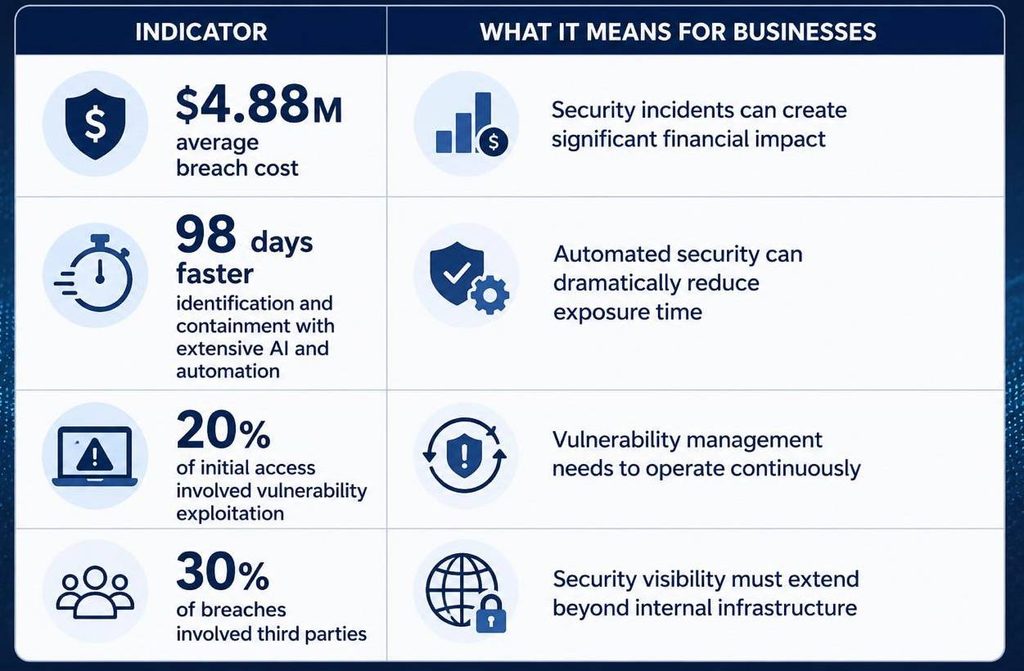
Security incidents become significantly more expensive when threats remain undetected for long periods. The longer attackers stay inside an environment, the more opportunities they have to access sensitive data, move between systems, compromise credentials, and disrupt business operations. The financial impact is substantial. IBM’s Cost of a Data Breach Report 2024 estimated the global average cost of a data breach at $4.88 million, a 10% increase compared with the previous year.
Speed can make a major difference. Organizations extensively using security AI and automation identified and contained breaches 98 days faster than organizations without extensive use of these technologies.
What Continuous Security Looks Like in Practice
Continuous security is not a single platform or monitoring dashboard. It is a combination of practices that protect systems throughout their lifecycle.
During development, automated security testing can identify insecure code, exposed credentials, vulnerable libraries, and other weaknesses before software reaches production. Within CI/CD pipelines, security policies can automatically evaluate builds and prevent high-risk changes from being deployed.
Infrastructure requires the same level of attention. Cloud configurations, infrastructure-as-code templates, containers, identities, and access permissions can be continuously checked against security policies.
Once applications reach production, runtime monitoring becomes critical. Organizations need visibility into network activity, API behavior, authentication patterns, workloads, and unexpected changes that may indicate an emerging threat. Together, these capabilities create a continuous security cycle: risks are detected, evaluated, prioritized, remediated, and then verified.
Instead of accumulating security issues until the next formal review, teams can address them much closer to the moment they appear.
From DevOps to DevSecOps
Continuous security also changes the relationship between development and security teams. Traditional software delivery often treats security as a separate stage near the end of development. Developers build the application, operations deploy it, and security teams review it before or after release.
That model becomes difficult to sustain when companies deploy software continuously. DevSecOps integrates security directly into development and operations. Static application security testing, dependency scanning, secrets detection, container scanning, infrastructure validation, and policy enforcement can all become part of automated development pipelines.
This allows organizations to detect many vulnerabilities before they reach production, when they are generally easier and less expensive to resolve.
However, securing development is only part of the equation. Organizations also need visibility after deployment because production environments introduce variables that cannot always be predicted during development. Effective continuous security therefore combines shift-left security with continuous runtime monitoring.
Continuous Security vs. Periodic Audits
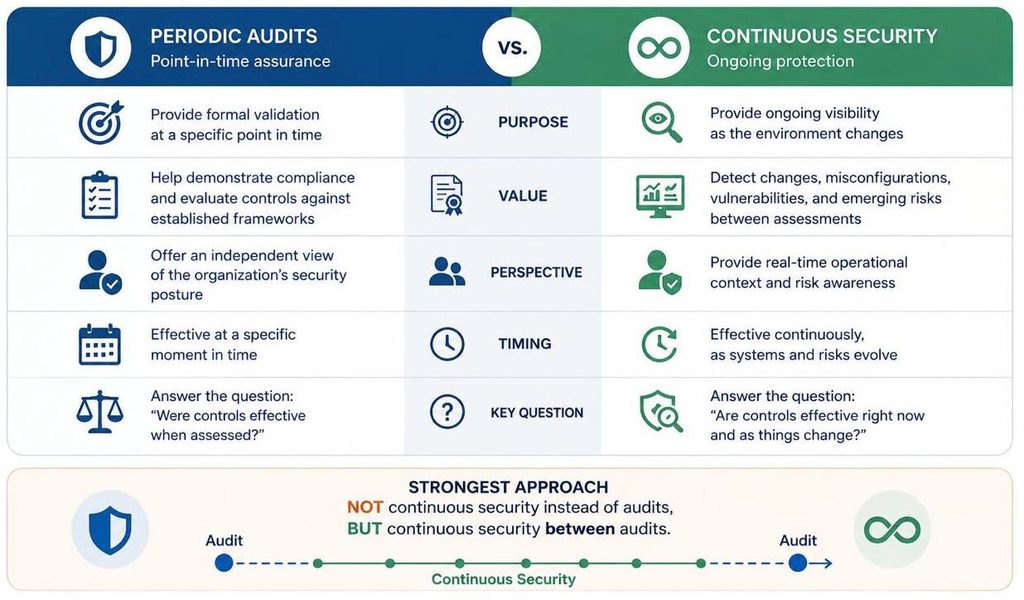
Continuous security does not eliminate the need for traditional security audits. The two approaches serve different purposes, and for modern organizations, the strongest security strategy combines both.
Periodic audits provide a structured, point-in-time assessment of an organization’s security posture. They help businesses demonstrate compliance, evaluate controls against established frameworks, identify weaknesses, and obtain an independent view of how effectively security policies are being implemented.
For industries with strict regulatory requirements, these assessments remain essential. They provide formal evidence that security controls were reviewed and that the organization met specific requirements at a particular moment.
The limitation is that an audit captures a snapshot, while the technology environment continues to change.
A company may successfully complete an audit today, but its infrastructure can look significantly different only weeks later. New applications may be deployed, cloud configurations can change, employees may receive new permissions, third-party services can be connected, APIs can be introduced, and new vulnerabilities may be discovered in existing software.
None of these changes necessarily wait for the next scheduled assessment. This is where continuous security becomes critical. Continuous security provides ongoing operational visibility between formal audits. Instead of evaluating controls only at predefined intervals, organizations continuously monitor systems for vulnerabilities, configuration changes, suspicious activity, excessive permissions, exposed resources, and other emerging risks.
The Business Impact of Continuous Security
The benefits extend beyond preventing security incidents. Earlier detection can significantly reduce remediation effort. When developers discover a vulnerability shortly after introducing it, they still understand the relevant code and context. When the same issue is discovered months later, identifying dependencies, ownership, and potential impact becomes considerably more difficult.
Automation also helps security teams operate at scale. Instead of manually reviewing every infrastructure or application change, organizations can define policies that automatically evaluate whether changes meet security requirements.
This allows development teams to maintain delivery speed without removing security controls. Continuous security can also simplify compliance. Rather than reconstructing months of security activity immediately before an audit, organizations can maintain ongoing evidence of configurations, vulnerabilities, access controls, policy enforcement, and remediation. Security becomes an observable operational process rather than an occasional assessment.
Security is always excessive until it’s not enough.
Robbie Sinclair, Head of Security, Country Energy
The Challenge: More Alerts Do Not Mean Better Security
Continuous monitoring can create a new problem: too much information. Modern security platforms can generate thousands of alerts across applications, endpoints, identities, cloud resources, and networks. Without effective prioritization, security teams may spend significant time investigating low-risk issues while genuinely dangerous vulnerabilities remain buried in the noise.
This is why mature continuous security programs focus on context rather than alert volume. A vulnerability becomes much more meaningful when teams understand whether the affected system is exposed, whether the weakness can realistically be exploited, what data is accessible, and how important that system is to business operations.
The goal is not to detect the largest possible number of issues. It is to identify and prioritize the risks that can actually affect the business. Without this context, continuous security can easily become continuous alerting.
From Security Checkpoints to Continuous Protection
The most important change is not technological. It is structural. Security can no longer exist primarily as a checkpoint before deployment or an assessment performed several times per year. It needs to become part of how digital systems are designed, deployed, operated, and changed.
In this model, policies are automated, infrastructure is continuously evaluated, identities and permissions are monitored dynamically, applications are tested throughout development, and production behavior provides feedback into security decisions.
This does not mean organizations can eliminate every vulnerability. No complex technology environment can remain completely free of risk. The objective is more practical: reduce the amount of time that security risks can exist without being detected, understood, and addressed. That is the real value of continuous security.
Don’t wait for the next audit to discover the next risk. Build continuously secure systems with Ficus Technologies
Contact usConclusion
Periodic audits remain essential for compliance, governance, and independent security validation. But in environments that change every day, periodic verification alone cannot provide continuous protection.
Modern organizations need security practices that evolve at the same speed as their infrastructure. Continuous security brings monitoring, automated testing, policy enforcement, vulnerability management, and remediation into everyday technology operations. It gives organizations greater visibility into changing risks and allows teams to respond before small weaknesses become larger incidents.
The transition is ultimately from periodically checking whether systems are secure to continuously managing whether they remain secure. For businesses operating cloud platforms, distributed applications, APIs, and rapidly evolving digital products, that shift is becoming a fundamental part of modern security strategy.
Why Ficus Technologies?
Ficus Technologies helps businesses integrate security into the architecture, development, and operation of modern digital systems.
Our teams support organizations with secure software development, cloud architecture, DevSecOps practices, infrastructure automation, monitoring, and scalable system design. The focus is not simply on adding another security tool, but on building security into the way technology operates and evolves.
Because modern security should not depend on what an audit discovered months ago. It should provide visibility into what is happening now.
Continuous security means continuously monitoring, testing, and protecting systems instead of relying only on scheduled security checks.
Audits provide a snapshot in time. New vulnerabilities, configuration changes, and access risks can appear immediately after an assessment.
No. Audits provide formal validation, while continuous security helps detect and manage risks between assessments.
It enables earlier risk detection, faster remediation, better visibility, and stronger protection as systems change.




 Success...!