
Serverless computing has fundamentally changed how organizations build and deploy applications. Instead of managing virtual machines, provisioning infrastructure, or scaling servers manually, developers can focus on writing business logic while cloud platforms handle the underlying infrastructure automatically.
This model has accelerated innovation across startups and enterprises alike. Event-driven architectures, APIs, data processing pipelines, and AI-powered services can now be deployed within minutes and scale almost instantly in response to demand.
However, after nearly a decade of widespread adoption, organizations have gained a much clearer understanding of serverless technology. While it delivers significant advantages in many scenarios, it is not a universal replacement for containers, Kubernetes, or traditional cloud infrastructure.
By 2026, the conversation is no longer whether serverless is the future. The real question is where serverless creates measurable business value—and where alternative architectures remain the better choice.
Engineering teams building cloud-native applications, AI platforms, APIs, and event-driven systems.
Organizations choosing between serverless, containers, and Kubernetes to improve scalability, performance, and operational efficiency.
- Serverless has matured into an essential cloud architecture rather than a replacement for every deployment model.
- Organizations achieve the best results by selecting serverless for event-driven workloads, automation, APIs, and burst traffic while relying on containers or Kubernetes for long-running services, complex stateful applications, and infrastructure requiring greater operational control.
Serverless Has Become Mainstream
When serverless platforms first appeared, they were often viewed as experimental technology suitable only for lightweight functions or small automation tasks. That perception has changed significantly.
Today, major cloud providers offer mature serverless ecosystems supporting APIs, event processing, machine learning inference, messaging systems, scheduled jobs, authentication, storage events, and enterprise integrations. Organizations increasingly combine serverless functions with managed databases, object storage, event buses, and API gateways to build highly scalable cloud-native applications.
The appeal is straightforward. Developers spend less time managing infrastructure and more time delivering business functionality.
Infrastructure becomes an operational detail rather than the primary engineering challenge.
Serverless Delivers the Greatest Value for Event-Driven Systems
Serverless excels when workloads are unpredictable or triggered by events rather than continuous user activity.
Processing uploaded files, responding to API requests, transforming data streams, sending notifications, automating workflows, integrating SaaS platforms, and executing AI inference are all examples where serverless architectures provide excellent scalability while minimizing infrastructure management.
Because cloud providers automatically allocate resources only when needed, organizations avoid paying for idle compute capacity. This consumption-based pricing model makes serverless particularly attractive for applications with variable or seasonal traffic.
The architecture also simplifies operational management. Developers rarely think about operating systems, patching, capacity planning, or scaling policies because these responsibilities remain with the cloud provider.
Serverless Adoption Continues to Grow Across Enterprise Cloud
Industry research shows that serverless has moved far beyond experimental projects. According to the CNCF Annual Survey, serverless technologies continue to see widespread adoption alongside Kubernetes, with organizations increasingly using both architectures together rather than treating them as competing approaches.
Cloud providers report similar trends. AWS, Microsoft Azure, and Google Cloud have significantly expanded their serverless portfolios, supporting everything from API backends and event processing to AI inference and enterprise workflow automation. This reflects an important evolution in cloud strategy.
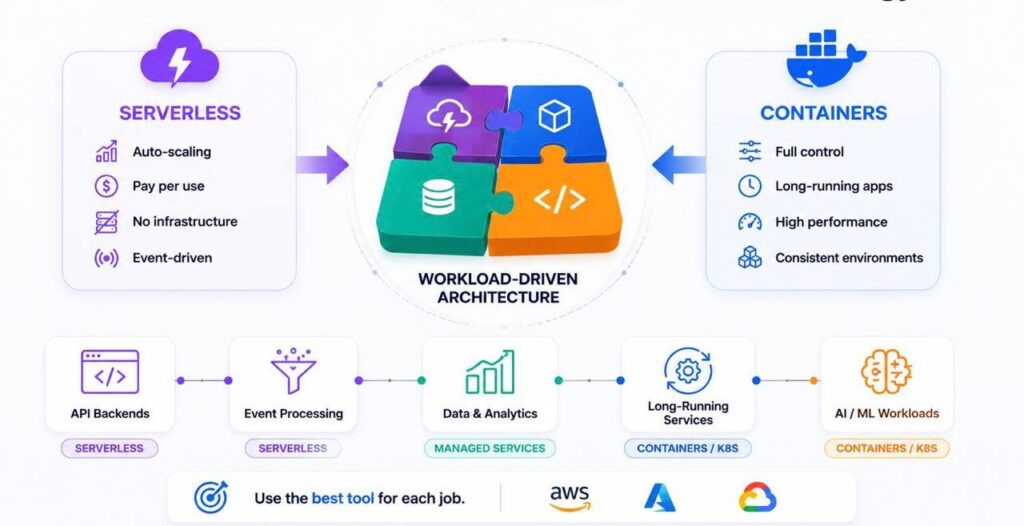
Organizations are no longer choosing between serverless and containers. They are combining multiple deployment models based on workload requirements. Serverless has become another architectural building block rather than a standalone platform strategy.
Long-Running Applications Still Need Different Architectures
Despite its advantages, serverless is not suitable for every workload. Applications requiring continuous processing, persistent network connections, large memory allocations, GPU-intensive computing, or predictable high-volume traffic often perform better on containers or Kubernetes. These environments provide greater control over runtime behavior, resource allocation, networking, and application lifecycle management.
Long-running enterprise platforms also benefit from deployment models that offer consistent performance and more predictable operational characteristics. While serverless minimizes infrastructure management, it also introduces platform-specific limitations, execution time restrictions, and reduced control over underlying environments.
Choosing serverless simply because it is modern can therefore create unnecessary complexity instead of reducing it.
AI Is Expanding Serverless Use Cases
Artificial intelligence is creating entirely new opportunities for serverless computing.
Many AI workloads consist of short-lived inference requests, document processing, image analysis, event-driven automation, and API integrations that align naturally with serverless execution models.
Organizations increasingly use serverless functions to orchestrate AI workflows, preprocess data, trigger retrieval pipelines, connect large language models with enterprise systems, and automate post-processing after model inference.
However, AI training, continuous GPU utilization, and latency-sensitive inference typically remain better suited to dedicated infrastructure or Kubernetes-based environments where compute resources can be optimized more precisely.
AI therefore reinforces an important principle. Serverless complements modern infrastructure. It rarely replaces it entirely.
Operational Simplicity Has Become a Competitive Advantage
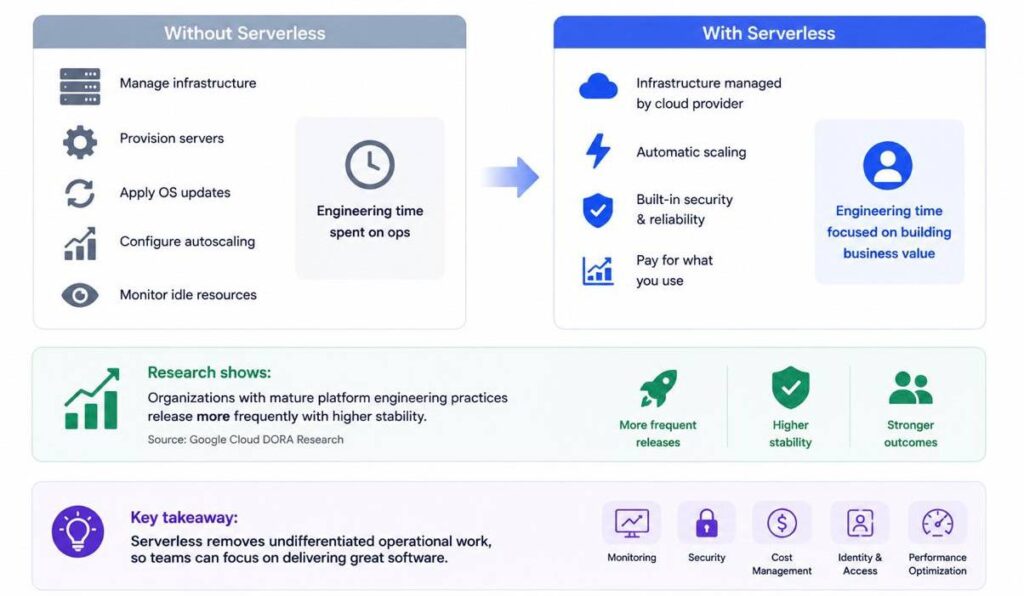
One of serverless computing’s greatest strengths is not scalability—it’s operational simplicity. Engineering teams spend significantly less time managing infrastructure, provisioning servers, applying operating system updates, configuring autoscaling policies, or monitoring idle compute resources. Instead, cloud providers assume responsibility for much of the operational layer, allowing developers to focus on delivering business functionality.
Research from Google Cloud and the DORA program consistently shows that organizations with mature platform engineering practices release software more frequently while maintaining higher levels of stability. Serverless contributes to this maturity by removing routine infrastructure tasks that traditionally consume engineering time.
At the same time, simplicity should not be confused with the absence of operational responsibility. Serverless applications still require monitoring, observability, security controls, cost management, identity governance, and performance optimization. Operational work shifts rather than disappears.
The organizations achieving the greatest value from serverless are those that simplify infrastructure without reducing engineering discipline.
Choosing the Right Architecture Matters More Than Following Trends
The most mature cloud strategies rarely rely on a single deployment model. Instead, organizations increasingly combine serverless, containers, Kubernetes, managed cloud services, and traditional virtual machines according to workload requirements. A customer-facing API may run on serverless functions, while a recommendation engine operates on Kubernetes and a data warehouse relies on managed cloud services.
This architectural flexibility allows engineering teams to optimize each workload independently instead of forcing every application into the same operational model. The lesson is straightforward.
Serverless is neither the future of all software nor a replacement for existing cloud architectures. It is one of several powerful tools that enable organizations to build more efficient, scalable, and resilient digital platforms.
Cloud Architecture Is Becoming Workload-Driven
The conversation around cloud computing has matured significantly. A decade ago, organizations often searched for a single architecture that could support every application. Today, engineering teams recognize that different workloads have different technical, operational, and financial requirements.
Event-driven automation, APIs, scheduled jobs, background processing, notification services, and lightweight AI inference frequently benefit from serverless execution. High-performance applications, long-running services, GPU-intensive workloads, and complex stateful systems generally benefit from Kubernetes or container-based platforms.
This workload-driven approach reduces unnecessary complexity while allowing organizations to balance scalability, operational efficiency, and cloud costs more effectively.
Rather than asking whether serverless is better than containers, modern engineering teams ask which architecture best supports a specific business capability.

Build the right cloud architecture with Ficus Technologies.
Contact usConclusion
Serverless has evolved from an emerging cloud technology into a mature architectural pattern used across enterprise software development.
Its ability to eliminate infrastructure management, scale automatically, and accelerate delivery makes it an excellent choice for event-driven applications, automation, APIs, and many AI-powered services. At the same time, organizations have learned that serverless is not designed for every workload. Long-running applications, resource-intensive computing, and systems requiring deep infrastructure control continue to benefit from containers and Kubernetes.
In 2026, successful cloud strategies are defined not by choosing one deployment model over another, but by selecting the right architecture for each business need.
The strongest engineering organizations do not ask whether serverless replaces traditional infrastructure.
They understand where it delivers the greatest value—and where another approach is the better engineering decision.
Why Ficus Technologies?
Ficus Technologies helps organizations design cloud-native platforms that balance scalability, operational efficiency, and long-term maintainability.
Whether building event-driven applications with serverless technologies, deploying enterprise workloads on Kubernetes, or developing hybrid cloud architectures, Ficus focuses on selecting the right technology for each business objective rather than following infrastructure trends.
By combining cloud engineering, platform architecture, DevOps automation, and software development expertise, Ficus helps businesses build modern digital systems that remain efficient, secure, and adaptable as requirements evolve.
Serverless computing is a cloud execution model where the cloud provider manages infrastructure, scaling, and resource allocation while developers focus on application code.
No. Most organizations use serverless and Kubernetes together, selecting each architecture according to workload requirements.
Serverless performs particularly well for APIs, event-driven systems, automation, scheduled jobs, notifications, data processing, and many AI inference workloads.
Serverless may introduce execution limits, platform-specific dependencies, cold starts, and reduced infrastructure control, making it less suitable for long-running or resource-intensive applications.
No. The most effective cloud architectures combine multiple deployment models instead of relying on a single approach.




 Success...!