
Modern software runs on trust. Every application, cloud platform, deployment pipeline, API, and automated workflow depends on digital credentials that allow systems to authenticate and communicate securely. API keys, database passwords, encryption keys, certificates, OAuth tokens, and service accounts rarely receive the same attention as firewalls or identity platforms, yet they enable nearly every interaction inside modern digital infrastructure.
As organizations embrace cloud-native architectures, Kubernetes, AI applications, and large-scale automation, the number of secrets grows exponentially. What once consisted of a few production passwords has evolved into thousands—or even millions—of machine credentials distributed across cloud providers, development environments, CI/CD pipelines, and third-party services. This rapid growth has quietly created one of the biggest security challenges facing enterprise technology teams.
By 2026, secrets management is no longer viewed as an operational concern reserved for DevOps teams. It has become a strategic cybersecurity capability that influences resilience, compliance, cloud governance, and business continuity. Organizations that fail to manage secrets effectively often discover their weaknesses only after an incident exposes credentials that were forgotten, duplicated, or stored in the wrong place.
Platform, DevOps, and security teams managing Kubernetes, CI/CD pipelines, and multi-cloud infrastructure.
Organizations building API-driven applications, AI platforms, and automated systems where secure machine-to-machine communication is critical.
- Secrets management has become one of the most important pillars of cloud security because machine identities now outnumber human users in many enterprise environments.
- Organizations that succeed centralize secrets, automate credential rotation, implement least-privilege access, and integrate security directly into cloud-native platforms.
- Those that continue relying on manually managed credentials, configuration files, or source code repositories expose themselves to unnecessary operational and security risks.
Every Modern Application Depends on Secrets
Almost every digital service relies on secrets to function. Applications authenticate to databases before retrieving customer records, APIs exchange access tokens to communicate securely, Kubernetes clusters use certificates to establish trusted connections, and CI/CD pipelines require credentials to deploy software automatically. AI applications add another layer of complexity by connecting to vector databases, cloud storage, model providers, enterprise APIs, and retrieval systems, each introducing additional machine identities.
The rapid expansion of automation has fundamentally changed how organizations manage authentication. Unlike human users, machine identities operate continuously, scale automatically, and frequently exist only for short periods of time. A single cloud-native application may generate thousands of temporary credentials every day, making traditional password management practices impossible to sustain.
This shift has transformed secrets from an infrastructure detail into one of the most critical elements of enterprise security. Every new workload, container, serverless function, or API integration expands the number of credentials that must be protected throughout their entire lifecycle.
The Biggest Risk Is Not the Secret—It’s Where It’s Stored
Most security incidents involving credentials are not caused by weak encryption algorithms. They happen because secrets appear in places where they should never exist.
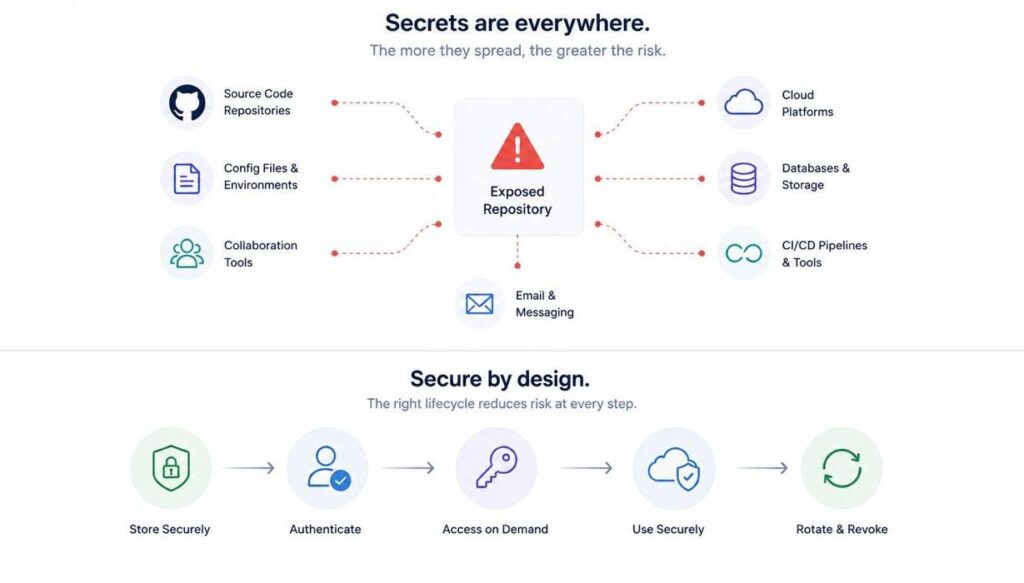
Developers unintentionally commit API keys to Git repositories, production passwords remain inside configuration files copied between environments, cloud credentials appear in internal documentation, and authentication tokens are shared through collaboration tools to simplify troubleshooting. Over time, these small operational shortcuts accumulate into thousands of unmanaged secrets scattered across an organization.
Attackers increasingly target these exposed credentials because they provide legitimate access to systems without requiring sophisticated exploitation techniques. A valid cloud access key or production API token often allows adversaries to bypass traditional perimeter defenses entirely, making stolen credentials significantly more valuable than many software vulnerabilities.
For this reason, modern security programs focus less on hiding secrets and more on ensuring they are never stored, shared, or managed outside controlled security platforms.
Secrets Exposure Continues to Grow Across Modern Infrastructure
The scale of credential exposure continues to increase despite growing awareness of the problem. According to the GitGuardian State of Secrets Sprawl Report 2025, more than 23.7 million new secrets were detected in public GitHub repositories during 2024, representing another year of significant growth. Even more concerning, many exposed credentials remain active long after discovery, giving attackers extended opportunities to gain unauthorized access.
Industry research paints a consistent picture. Verizon’s Data Breach Investigations Report continues to identify stolen credentials as one of the most common initial access vectors in successful cyberattacks, while IBM’s Cost of a Data Breach Report shows that incidents involving compromised credentials remain among the most expensive because attackers often appear as legitimate users and avoid immediate detection.
These findings demonstrate that the challenge is no longer limited to protecting credentials themselves. Organizations increasingly struggle to maintain visibility into where secrets exist, who can access them, and whether they are still needed. As cloud environments become more dynamic, discovering unmanaged credentials is becoming just as important as encrypting them.
Automation Has Changed the Security Model
Cloud-native development has dramatically increased the number of credentials organizations must manage. Infrastructure is provisioned automatically, containers are deployed dynamically, serverless functions appear and disappear within seconds, and applications integrate with dozens of external services. Each of these processes requires authentication, which means every layer of automation introduces new secrets that must be created, distributed, rotated, and revoked safely.
Traditional approaches based on manually sharing passwords or storing credentials in environment files cannot support this level of scale. Static secrets become difficult to track, hard to rotate, and easy to forget. As deployment frequency increases, manual secrets management becomes both a productivity bottleneck and a security weakness.
Modern secrets management platforms address this by centralizing storage, enforcing access controls, generating short-lived credentials, and integrating directly with CI/CD pipelines, cloud providers, and orchestration platforms. Instead of exposing secrets to developers or storing them in application code, systems retrieve credentials securely only when needed.
Machine Identities Now Outnumber Human Users
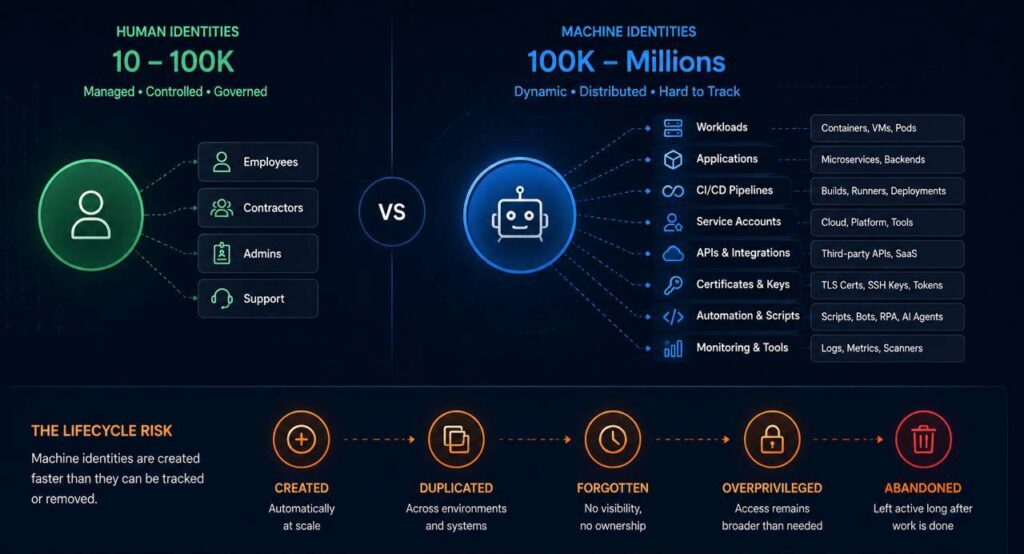
The growth of automation has created a major shift in identity management. In many modern environments, machines now authenticate far more often than people. Applications communicate with databases, containers authenticate with cloud services, CI/CD pipelines access production infrastructure, AI systems call external APIs, and monitoring tools collect data across distributed environments.
Industry research from CyberArk, Venafi, and Gartner continues to highlight the rapid growth of machine identities across enterprise infrastructure. In many organizations, machine identities significantly outnumber human identities, often by large multiples, because every workload, service account, certificate, API token, and automation script requires some form of trusted access. This creates a security problem that traditional identity governance was not designed to solve.
The issue is not only scale, but lifecycle. Human users usually have onboarding, role changes, and offboarding processes. Machine identities are often created automatically, duplicated across environments, or left active long after the workload that required them has disappeared. Without centralized visibility and automated governance, these unused or overprivileged credentials become quiet security liabilities.
Secrets Should Never Be Permanent
Long-lived credentials create unnecessary risk. A password, API key, or cloud access token that remains valid for months gives attackers a large window of opportunity if it is exposed. Even when teams eventually discover a leaked secret, they may not know where it is used, whether rotation will break production systems, or which services depend on it.
This is why organizations increasingly move toward short-lived and dynamic secrets. Instead of storing permanent credentials, systems generate temporary access only for a specific workload, service, or time window. Once the task is complete, the credential expires automatically and becomes useless.
This model reduces the value of exposed secrets and aligns better with zero-trust principles. Access is granted based on context, limited by scope, and continuously controlled through policy rather than assumed indefinitely.
Security Improves When Secrets Become Invisible
The strongest secrets management programs are designed so developers rarely need to handle secrets directly. Developers should not have to copy credentials, paste tokens into deployment scripts, or manually update configuration files. These practices increase both human error and exposure.
Instead, secrets should be delivered through secure automation. Applications retrieve credentials from vaults or cloud-native secret stores at runtime, deployment pipelines request temporary access through controlled workflows, and security teams maintain audit trails showing who or what accessed each secret and when.
This approach improves both security and developer experience. Teams can move faster because they no longer need to manually coordinate credentials, while security leaders gain better visibility into access patterns, rotation status, and policy enforcement across environments.
Modern Security Depends on Credential Lifecycle Control
Secrets management is not only about storage. It is about lifecycle control from creation to retirement. A strong program defines how secrets are generated, where they are stored, who can access them, how often they rotate, how usage is audited, and when they are revoked.
This lifecycle becomes especially important in cloud-native and AI-enabled systems. AI applications may access model providers, vector databases, internal APIs, and customer data pipelines. Kubernetes workloads may generate certificates dynamically. CI/CD systems may require temporary production access. Without lifecycle governance, each integration becomes another potential blind spot.
Organizations that manage this lifecycle well reduce both technical and operational risk. They limit blast radius, simplify compliance, and make incident response faster because they know which credentials exist and where they are used.
Need stronger secrets management for cloud-native systems?
Contact usConclusion
Secrets are among the most valuable assets in modern software systems. They allow applications, services, platforms, and automated workflows to operate, but they also create direct paths into infrastructure when exposed or poorly managed.
The risk is growing because modern environments depend on more machine identities, more APIs, more automation, and more cloud-native services than ever before. Storing secrets in code, configuration files, shared documents, or manually managed environments is no longer a minor operational issue. It is a serious security exposure.
In 2026, effective secrets management depends on centralization, automation, short-lived credentials, strong access controls, and full lifecycle visibility. The strongest security programs protect secrets before attackers have the opportunity to find them.
Why Ficus Technologies?
Ficus Technologies helps organizations build secure cloud-native platforms where identity, automation, and infrastructure security work together from the beginning.
From Kubernetes deployments and CI/CD pipelines to multi-cloud environments, AI platforms, and enterprise applications, Ficus integrates secrets management into modern DevSecOps and platform engineering workflows.
By centralizing credential management, reducing manual handling, and designing systems around secure automation, Ficus helps businesses lower security risk while maintaining the speed and flexibility required for modern software delivery.
Secrets management is the secure storage, distribution, rotation, monitoring, and retirement of sensitive credentials such as API keys, passwords, certificates, access tokens, and encryption keys.
Source code can be copied, shared, forked, or exposed. If secrets are stored in repositories, attackers may gain direct access to cloud resources, databases, APIs, or production systems.
Dynamic secrets are temporary credentials generated automatically for a specific task or time period. They expire after use, reducing the risk created by long-lived credentials.
Modern security practices favor automated rotation and short-lived credentials wherever possible, especially for cloud credentials, service accounts, API tokens, and production access.
No. Any organization using cloud platforms, APIs, CI/CD pipelines, SaaS integrations, or automation needs secure secrets management, regardless of size.





 Success...!