

Speed has become one of the defining competitive advantages in software development. Organizations release new features weekly instead of quarterly, deploy production updates multiple times per day, and use AI-assisted development tools to accelerate everything from coding to testing. Customers expect continuous improvement, while businesses see faster delivery as a direct path to innovation and revenue growth.
Yet speed alone does not guarantee success. Many organizations discover that delivering software faster also means introducing more technical debt, operational complexity, and production incidents. Applications reach customers sooner, but engineering teams spend increasing amounts of time fixing defects, maintaining unstable systems, and responding to avoidable outages.
This has fundamentally changed the conversation around software delivery. The question is no longer whether organizations should move quickly. Instead, leaders are asking how they can increase delivery speed without sacrificing quality, reliability, and long-term maintainability.
By 2026, the highest-performing engineering organizations have stopped treating speed and quality as competing priorities. Instead, they build processes where both improve together.
Engineering and DevOps teams adopting cloud-native development, AI-assisted engineering, and continuous delivery practices.
Organizations building modern software platforms where balancing delivery speed, quality, and long-term maintainability is essential.
- Modern software teams no longer choose between delivering quickly and delivering well. Sustainable engineering depends on combining automation, testing, platform engineering, and continuous improvement to achieve both.
- Organizations that prioritize only speed often accumulate technical debt and operational risk. Those that integrate quality into every stage of development deliver software faster over the long term while maintaining reliability and customer trust.
Speed Has Become a Business Requirement
Software delivery has accelerated dramatically over the past decade. Cloud computing, DevOps, CI/CD pipelines, infrastructure as code, and AI-powered development tools have shortened release cycles that once took months to just days—or even hours.
Business expectations have evolved alongside these technologies. Customers expect new capabilities to appear continuously, security vulnerabilities to be resolved immediately, and digital services to improve without interruption. Investors and executives increasingly measure engineering organizations by how rapidly they can respond to changing market conditions.
As a result, speed has become more than an engineering metric. It has become a business capability directly connected to competitiveness.
The pressure to release faster, however, often creates unintended consequences when organizations optimize for velocity without investing equally in engineering discipline.
Faster Releases Don’t Always Create Better Products
Shipping software quickly is valuable only when every release improves the product.
Organizations sometimes mistake activity for progress. Teams celebrate deployment frequency, sprint velocity, or the number of completed features while paying less attention to customer outcomes, production stability, and long-term maintainability.
This creates a dangerous cycle. Faster delivery introduces more defects, engineers spend increasing amounts of time fixing previous releases, technical debt grows, and future development gradually slows despite the original objective of moving faster.
The most successful engineering organizations recognize that delivery speed has meaning only when software remains stable, secure, and easy to evolve.
In other words, customers experience outcomes—not deployment metrics.
Quality is never an accident. It is always the result of intelligent effort.
John Ruskin
Technical Debt Is the Hidden Cost of Speed
Every engineering shortcut creates a future obligation.
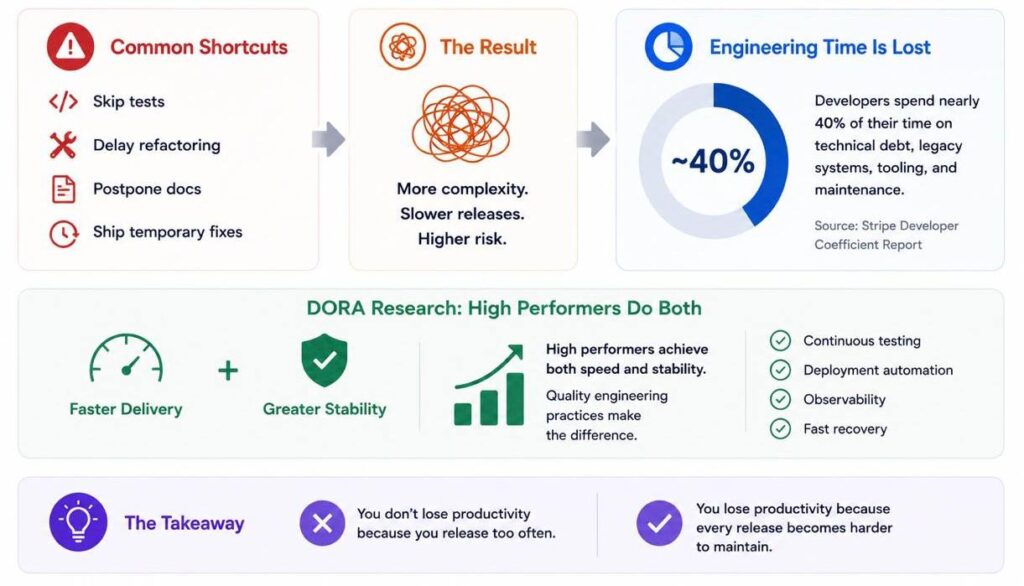
Skipping automated tests, postponing refactoring, delaying documentation, or deploying temporary solutions may accelerate a single release, but these decisions often increase the complexity of every release that follows. Over time, technical debt becomes one of the largest obstacles to sustainable software delivery.Industry research reflects this challenge. Stripe’s Developer Coefficient Report estimates that developers spend nearly 40% of their working time dealing with technical debt, legacy systems, inefficient tooling, and maintenance rather than building new functionality. This represents a significant loss of engineering capacity while also slowing innovation.
Google Cloud’s DORA research reaches a complementary conclusion. High-performing engineering organizations consistently achieve both faster delivery and greater stability because they invest in engineering practices such as continuous testing, deployment automation, observability, and rapid recovery. Speed itself does not create instability. Poor engineering practices do.
The implication is important. Organizations rarely lose productivity because they release software too frequently. They lose productivity because every release becomes progressively harder to maintain.
Quality Is No Longer a Separate Phase
Traditional software development treated quality assurance as the final stage before release. Development happened first, testing came later, and production issues were often discovered only after deployment.
Modern engineering works differently. Quality is integrated throughout the entire delivery process. Automated testing begins during development, security scanning runs continuously inside CI/CD pipelines, infrastructure is validated before deployment, and observability provides immediate feedback after every release.
Instead of asking whether software is ready for testing, high-performing teams build systems where testing, validation, monitoring, and deployment operate as a continuous workflow. This shift allows organizations to move faster while reducing operational risk at the same time.
AI Accelerates Development—But Not Engineering Judgment
Artificial intelligence is transforming software development by generating code, automating documentation, improving testing, and assisting with debugging. Developers can produce working code more quickly than ever before.
However, AI does not eliminate architectural decisions, system design, or engineering responsibility.
Generated code still requires review. Security vulnerabilities still require validation. Business requirements still need interpretation. Performance bottlenecks, scalability challenges, and technical debt continue to depend on human engineering decisions.
Organizations adopting AI successfully treat it as a productivity multiplier rather than a replacement for engineering discipline. AI can accelerate delivery. It cannot replace sound software engineering.
The Best Teams Optimize for Sustainable Delivery
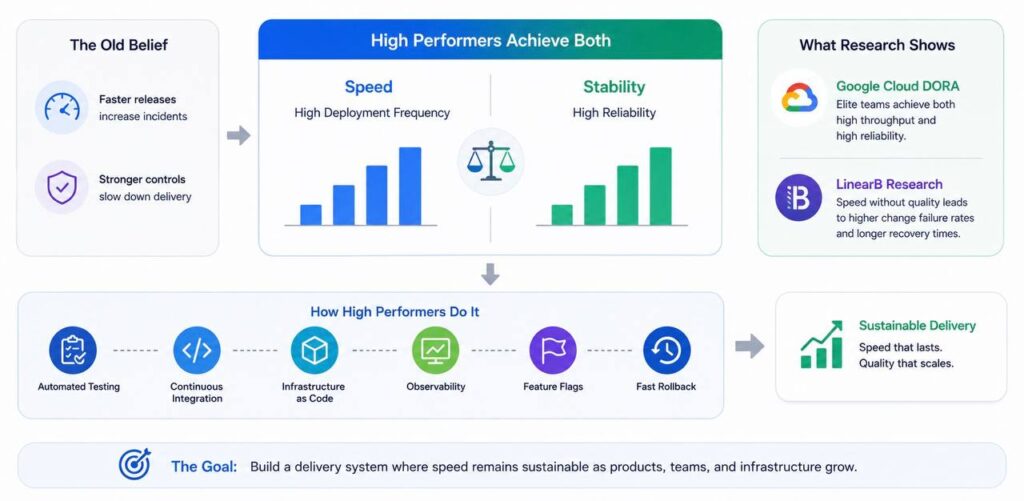
For many years, engineering organizations believed they had to choose between speed and stability. Faster releases were expected to increase production incidents, while stronger quality controls were seen as obstacles to rapid delivery. Modern engineering research challenges this assumption.
Google Cloud’s DORA research program consistently shows that elite engineering teams achieve both high deployment frequency and high reliability. Their advantage does not come from writing more code or working longer hours. It comes from mature engineering practices that make change predictable. Automated testing, continuous integration, infrastructure as code, observability, feature flags, and fast rollback mechanisms allow teams to release frequently without increasing operational risk.
Research from LinearB reaches a similar conclusion. Organizations that focus only on delivery speed often experience higher change failure rates and spend more time recovering from production incidents. Teams that balance velocity with engineering quality deliver more consistently because fewer releases require emergency fixes or lengthy stabilization efforts. These findings point to an important shift in software engineering.The goal is to build a delivery system where speed remains sustainable as products, teams, and infrastructure continue to grow.
Building Fast and Building Right Are No Longer Opposites
The most successful engineering organizations no longer separate delivery speed from software quality. Instead, they design development processes where quality supports faster delivery rather than slowing it down.
Automation plays a central role in this approach. Every automated test, deployment pipeline, monitoring dashboard, and infrastructure validation reduces the amount of manual work required before releasing software. Developers spend less time repeating operational tasks and more time solving business problems.
Equally important is engineering culture. High-performing teams are comfortable making small, incremental changes instead of waiting for large releases. They review code continuously, monitor systems in real time, and treat production feedback as part of the development process rather than as a separate operational responsibility.
This approach reduces technical debt, shortens recovery times, and gives organizations greater confidence to release software whenever new business opportunities appear.
Sustainable Engineering Creates Long-Term Business Value
Business leaders often view engineering speed as a competitive advantage, but long-term competitiveness depends on consistency rather than short-term acceleration. Software that is difficult to maintain eventually slows product development, increases operational costs, and reduces an organization’s ability to respond to market changes. Engineering teams become occupied with fixing yesterday’s decisions instead of building tomorrow’s capabilities.
Organizations that invest in sustainable delivery create a different outcome. Stable architectures, automated quality controls, modern platform engineering, and continuous improvement allow development teams to maintain high delivery speed without accumulating excessive technical debt.
The result is not simply better software. It is a business that can innovate with greater confidence.
Build faster. Scale smarter. Deliver with confidence — with Ficus Technologies.
Contact usConclusion
The debate between building fast and building right is gradually disappearing.
Modern software engineering demonstrates that organizations do not have to sacrifice quality to increase delivery speed. The strongest teams achieve both by integrating automation, testing, observability, platform engineering, and continuous improvement into every stage of software delivery.
Speed without discipline eventually creates technical debt. Quality without efficient delivery slows innovation.
In 2026, competitive advantage belongs to organizations capable of combining both. Sustainable delivery enables engineering teams to release software quickly while maintaining the reliability, security, and scalability that modern businesses depend on.
Why Ficus Technologies?
Ficus Technologies helps organizations build software delivery processes that combine speed with long-term engineering quality.
From cloud-native architectures and DevOps automation to AI integration, platform engineering, and scalable software development, Ficus designs systems that support continuous delivery without sacrificing reliability or maintainability.
By embedding quality into every stage of development, Ficus enables businesses to innovate faster while reducing operational risk and technical debt.
Yes. Modern engineering practices such as CI/CD, automated testing, infrastructure as code, and observability allow organizations to increase delivery speed while maintaining stability.
Technical debt accumulates when short-term development decisions—such as skipping tests, delaying refactoring, or implementing temporary solutions—create additional maintenance work in the future.
AI accelerates coding, documentation, testing, and debugging, but it does not replace architecture design, engineering judgment, security validation, or business decision-making.
DORA measures software delivery performance using four key indicators: deployment frequency, lead time for changes, change failure rate, and mean time to recovery (MTTR). These metrics help organizations evaluate both delivery speed and operational stability.
Sustainable delivery allows engineering teams to release software consistently over time without accumulating excessive technical debt or increasing operational risk.







 Success...!