
Data has become one of the most valuable assets inside modern organizations. It supports analytics, financial reporting, customer experiences, automation, AI systems, and everyday operational decisions. But as companies collect and distribute more data, one basic question becomes increasingly difficult to answer: who is actually responsible for it?
Data now moves between cloud platforms, applications, databases, APIs, analytics tools, AI models, and external services. Multiple teams may create, transform, and consume the same information. When ownership is unclear, problems with quality, security, access, and consistency become much harder to resolve.
A dataset may contain incorrect information, but nobody knows who should fix it. Two departments may use different definitions of the same metric. Sensitive information may remain accessible longer than necessary because responsibility for permissions is unclear. An AI system may depend on outdated information without anyone being accountable for maintaining its source.
This is why data ownership is becoming a fundamental part of modern data strategy. It establishes clear accountability and ensures that important business data is not simply stored and consumed, but actively managed throughout its lifecycle.
- Data ownership creates accountability. It establishes who is responsible for decisions about data quality, access, security, and appropriate use.
- AI increases the importance of ownership. Organizations need to know who is responsible for the datasets used by models and automated systems.
- Ownership becomes more important as data environments scale. The more distributed data becomes, the more important clear responsibility becomes.
What Data Ownership Really Means
Data ownership defines who is accountable for a particular dataset, data domain, or category of information within an organization. An owner does not necessarily create the data, maintain the database, or operate the infrastructure where it is stored. Ownership means having responsibility for how that information should be managed and used.
A data owner may determine who should have access to a dataset, what level of quality is required, how sensitive information should be classified, how long it should be retained, and what should happen when the structure or meaning of the data changes.
This distinction between ownership and technical responsibility is important. An engineering team may maintain the infrastructure containing customer information, but the business unit responsible for customer relationships may be better positioned to determine what that information means, which fields are critical, and how the data should be used.
The same applies to financial information. IT teams may operate the systems where financial data is stored, while finance teams understand the business rules that determine whether those numbers are complete and accurate.
Effective data ownership connects these perspectives. Technical teams provide the systems and controls required to manage data, while business owners provide context, standards, and accountability. Together, they create a clear answer to an important question: when something happens to the data, who has the authority and responsibility to make a decision?
Why Data Ownership Matters
Data ownership becomes increasingly important as organizations grow. In smaller environments, responsibility is often informal. Employees know which colleague created a dataset, which engineer manages a database, or which department should answer a particular question.
At scale, those informal relationships become difficult to maintain. The same customer information might appear in a CRM platform, billing system, data warehouse, analytics dashboard, marketing application, and AI model. Each system may transform or interpret that information differently.
Without clear ownership, inconsistencies begin to accumulate. One department may define an “active customer” differently from another. Analysts may create duplicate datasets because they do not trust existing information. Access permissions may remain active longer than necessary. Data quality problems may move through several downstream systems before anyone notices them.
The issue is not simply that data is distributed. Responsibility becomes distributed with it. Clear ownership creates a point of accountability. Teams know who defines standards, who approves important changes, who can authorize access, and who should be involved when data quality deteriorates.
This improves the speed of decision-making and reduces the amount of time teams spend trying to determine who should solve a particular problem.
Data Growth Requires Clear Ownership
The scale of modern data environments makes accountability increasingly important. Organizations now operate across growing numbers of cloud platforms, SaaS applications, databases, analytics systems, APIs, and AI tools. Every additional system creates another place where data can be copied, transformed, accessed, or interpreted differently.
Poor data quality has a direct impact on analytics and decision-making, while data teams can spend significant amounts of time investigating inconsistencies, repairing pipelines, and validating information before it can be trusted. At the same time, unclear ownership can make even relatively simple issues more difficult to resolve because teams first need to determine who has responsibility for the affected information.
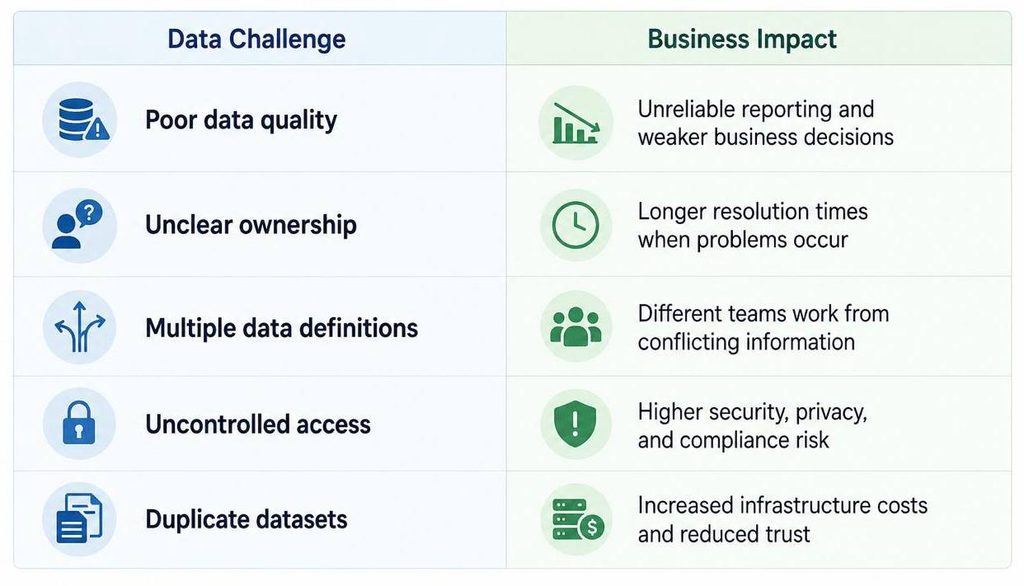
There is also a hidden operational cost. When employees stop trusting organizational data, they begin checking it manually. Analysts create their own datasets, departments maintain separate spreadsheets, and engineers spend time validating information before they can address the actual business problem.
As a result, companies can invest heavily in modern data infrastructure while still struggling to use their information effectively. The problem is not always the amount of data available. Often, it is the absence of clear responsibility for keeping that data trustworthy.
Data Ownership and Data Governance
Data ownership is one of the foundations of effective data governance. Governance establishes the rules for how organizational information should be managed, including requirements for security, privacy, quality, retention, classification, access, and regulatory compliance. But policies alone cannot create accountability.
A governance framework may state that sensitive information should only be available to authorized employees, but someone still needs to decide who should receive that access. A quality standard may define acceptable levels of completeness or accuracy, but someone needs to respond when a dataset falls below those standards.
Data ownership gives governance this operational layer. Instead of treating data governance as the responsibility of an abstract central team, organizations assign accountability to specific people or business domains that understand the information they manage. Central governance teams can establish company-wide standards, while individual owners apply those standards within their domains. Technology teams can support the process through access controls, data catalogs, lineage tools, automated quality monitoring, classification, and policy enforcement. Governance defines how data should be managed. Ownership determines who is accountable for making sure it actually happens.
Data Ownership in the Age of AI
AI has made data ownership significantly more important because AI systems depend on data at almost every stage. Information may be used to train models, provide context, generate recommendations, automate decisions, personalize customer experiences, or evaluate model performance.
When the underlying information is inaccurate, incomplete, outdated, or inappropriate for a particular use, those weaknesses can influence the system’s output. A technically sophisticated AI model cannot compensate for every problem in the information it receives.
This creates a new responsibility question. An AI engineering team may develop and maintain a model, but that does not necessarily mean it owns the business data consumed by that model.
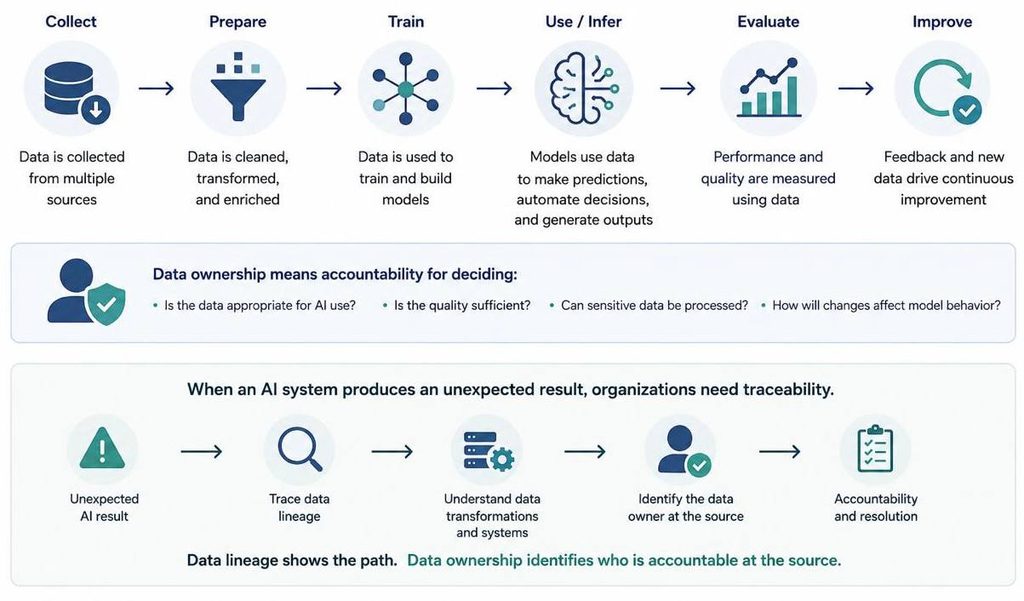
Organizations need to determine who is responsible for deciding whether specific datasets are appropriate for AI use, whether their quality is sufficient, whether sensitive information can be processed, and whether changes to the data could affect model behavior.
Clear ownership also improves traceability. When an AI system produces an unexpected result, organizations need to understand where the relevant information originated, how it was transformed, and which systems interacted with it.
Data lineage can show the path. Data ownership identifies who is accountable at the source. As businesses move from AI experimentation toward production systems, ownership becomes part of responsible AI management rather than simply a traditional data governance concern.
From Shared Data to Clear Accountability
For years, organizations have focused heavily on making data more accessible. Cloud platforms, data warehouses, APIs, and self-service analytics have made it possible for more employees and applications to use information without depending on a centralized IT department for every request.
That accessibility creates enormous value, but accessibility without accountability introduces another type of complexity.
When many teams can consume and transform the same data, definitions can diverge. Copies appear across systems. Old datasets remain active. Changes introduced by one team can unexpectedly affect another. Eventually, the organization may have more access to data while having less confidence in which information should actually be trusted.
Modern data management therefore requires a balance between accessibility and responsibility.
Employees should be able to discover and use trusted information without unnecessary barriers. At the same time, they should understand where that information comes from, what it represents, which standards apply to it, and who owns it. This changes data from something that is simply available into something that is deliberately managed as a business asset.
The Challenges of Implementing Data Ownership
Defining data ownership sounds straightforward. Implementing it across a large organization is considerably more difficult.
One common mistake is assigning ownership without authority. A person may be listed as the owner of a dataset but have no ability to approve access, establish standards, request corrections, or influence the systems that produce the information. In this case, ownership exists on paper but provides little operational value.
Another problem is defining ownership too broadly. Assigning an entire department responsibility for “customer data,” for example, may still leave uncertainty around individual datasets, systems, definitions, or decisions.
Ownership can also become outdated. Employees change roles, teams reorganize, applications are replaced, and new datasets appear. Unless ownership information is maintained alongside these changes, the governance model gradually loses accuracy.
Organizations also need to avoid turning ownership into unnecessary bureaucracy. The objective is not to require manual approval for every data operation. Effective ownership should make important decisions faster by establishing clear authority rather than creating another administrative bottleneck.
Successful models therefore combine clear responsibility, sufficient authority, practical processes, and automation.
From Data Ownership to Data Accountability
Assigning a name to a dataset is only the beginning. Mature organizations connect ownership with measurable expectations.
Owners need to understand what they are accountable for. Depending on the data domain, this may involve maintaining quality standards, reviewing access, approving significant changes, responding to incidents, or ensuring compliance requirements are followed. Technology can make this model easier to operate at scale. Data catalogs can make ownership visible across the organization. Data lineage can show where information originates and which systems depend on it. Automated quality monitoring can alert responsible teams when standards are violated. Data contracts can establish clear expectations between producers and consumers.These practices work together rather than independently.
Data ownership identifies responsibility. Data governance establishes the rules. Data contracts define expectations. Monitoring shows whether those expectations are being met.
Together, they create data accountability — an environment where organizations not only understand what data they have, but also know who is responsible for keeping it reliable.

Create reliable, scalable data systems with Ficus Technologies.
Contact usConclusion
The biggest data challenge inside many organizations is not storage or volume. It is responsibility.
As data moves across more teams, applications, cloud environments, analytics platforms, and AI systems, informal ownership becomes increasingly difficult to maintain. Without clear accountability, quality problems take longer to resolve, governance becomes harder to enforce, and employees gradually lose confidence in the information they use.
Clear data ownership gives organizations accountability for quality, access, security, governance, and appropriate use. It also provides a stronger foundation for analytics, automation, and AI because teams can understand not only where information comes from, but who is responsible for maintaining it.
Every data-driven organization should therefore be able to answer a simple question: if critical data becomes inaccurate, exposed, unavailable, or misused tomorrow, who is responsible for it?
If the answer is unclear, data ownership needs to become part of the organization’s broader data strategy.
Why Ficus Technologies?
At Ficus Technologies, we help businesses build reliable and scalable data systems where governance, security, and accountability are considered as part of the architecture. From cloud and data platforms to analytics, AI solutions, and custom software development, we help organizations create environments where information remains reliable and manageable as systems grow. Turn your data into a trusted business asset — with Ficus Technologies.
Data ownership defines who is accountable for managing a particular dataset or data domain. Responsibilities can include quality, access, security, classification, compliance, and appropriate use.
Data should generally be owned by the business team or domain that understands its meaning and purpose and has sufficient authority to make decisions about how it is managed.
Not entirely. IT and engineering teams often manage infrastructure, storage, security controls, and technical access. Business teams are usually better positioned to define meaning, quality expectations, acceptable use, and business requirements.
Data governance establishes the policies and standards for managing information across an organization. Data ownership establishes who is accountable for applying those standards to particular datasets or domains.
AI systems depend on reliable and appropriately governed information. Clear ownership establishes responsibility for the quality, suitability, access, and management of datasets used by AI systems.





 Success...!